Search This Blog

Wednesday, 24 May 2017

Punch (combat)

When Michelangelo was working as an apprentice, a fellow student Pietro Torrigiano took a dislike to his arrogant ways. Torrigiano punched Michelangelo's nose so hard he virtually flattened it. Torrigiano later boasted that he left his signature on the great man's face.

Sir Isaac Newton's college notebooks contained a coded list of his childhood sins, which included punching his sister.

In 1870, British boxing champ Jim Mace and American boxer Joe Coburn fought for three hours and 48 minutes without landing one punch.


Oscar Wilde was surprisingly physically strong. At Oxford University when a gang of students tried to beat him he up he booted out the first, virtually knocked out the second with a punch, threw out the third through the air then carried the fourth downstairs and buried him beneath his own furniture.

In a 1917 game against the Washington Senators, Boston Red Sox pitcher Ernie Shore retired 26 batters in a row after replacing Babe Ruth, who had been ejected for punching the umpire.

On October 18, 1926, Harry Houdini was talking to a group of students in his dressing room after a lecture in Montreal and he commented on the strength of his stomach muscles and their ability to withstand hard blows. Suddenly, one of the students punched Houdini twice in the stomach.
The magician hadn't had time to prepare, and the blows ruptured his appendix. He fell ill on the train to Detroit, and, after performing one last time, was hospitalized. Doctors operated on him, but to no avail. The burst appendix poisoned his system and he died of peritonitis twelve days later.

Among Ernest Hemingway's many injuries was a finger gashed to the bone in an accident with a punching ball.


The actress Rita Hayworth packed a real punch: she knocked out two of co-star Glenn Ford's teeth during a fight scene in the movie Gilda.

The actor Liam Neeson used to be a teacher, but got fired for punching a 15-year-old pupil when the boy pulled a knife out in class.

David Bowie's right pupil was permanently dilated as a result of his friend George Underwood punching him in the eye while the pair were still at school. The fight was over a girl.

Mike Tyson has cared for pigeons throughout his life. The first punch he ever threw was when he was child and directed at a bully that killed one of his birds.

Claude Monet's 1874 painting Argenteuil Basin With A Single Sail Boat needed two years of repairs after a man punched a hole through it in 2012.

According to the Guinness Book of World Records, Master John Ozuna has the fastest martial arts punch in the world, clocking in at 43.3 miles per hour.

A gorilla’s punch has 1300-2700 pounds of force. That’s enough to shatter a human skull with one hit.

Octopuses sometimes punch fish. One theory is that the octopus is punching out of spite to punish the fish. Research suggests that the octopus brain, though drastically different than ours, is capable of complex behavior and cognition.

If you are attacked by a shark, you are advised to punch at its eyes, snout and gills (on the sides of the head, ahead of the pectoral fins). Play dead and the shark will think you are a free lunch.

Tuesday, 23 May 2017

Pumpkin

 HISTORY

In the 16th and early 17th-centuries a pumpkin was called a 'pompon' or 'pompion'. The word 'pumpkin' was first used in 1647.

The name "pumpkin" originated from "pepon", the Greek word for "large melon."

Native Americans used pumpkin seeds for food and medicine.


When early settlers arrived in America, they discovered that Native Americans were growing and using pumpkins. They roasted strips of pumpkin over an open fire for food.

Pumpkins were once recommended for removing freckles and curing snake bites.

In early colonial times, pumpkins were used as an ingredient for the crust of pies, not the filling.

Halloween pumpkin carving stems from a Celtic tradition of turnip carving to ward off evil spirits. The "head" of turnips were used, with the belief that the head was the most powerful part of the body, containing the spirit and the knowledge. However, it wasn't until 1866 that the pumpkin became associated with Halloween - a tradition originating from North America, where pumpkins were readily available and much larger, making them easier to carve.

On the morning of October 8, 1997, Cornell students, faculty and staff strolling by McGraw Tower noted an unusual sight: a 60 pound pumpkin impaled on the spire 173 feet up. To this day, no one is really sure how this was accomplished without anyone noticing.

CULTIVATION

Illinois, California, Pennsylvania and New York are the four major pumpkin growing states, together producing 1.1 billion pounds of pumpkin in 2008.

A pumpkin patch in Winchester, Oregon

Morton, Illinois calls itself the 'Pumpkin Capital of the World' and holds an annual pumpkin festival in the second week of September.

Nestlé, operating under the brand name Libby's, produces 85% of the world's canned pumpkin at their plant in Morton, Illinois.

USAGE

In the United States and Canada, pumpkin is a popular Halloween and Thanksgiving staple. Pumpkin pie was among the dishes at the first Thanksgiving.

Commercially canned pumpkin puree and pumpkin pie fillings are usually made from different kinds of winter squash than the pumpkins frequently carved as jack-o'-lanterns for decoration around Halloween.


Pumpkin flowers are edible. In the southwestern United States and Mexico they are used to garnish dishes, and they may be dredged in a batter then fried in oil.

Pumpkin leaves are a popular vegetable in the Western and central regions of Kenya; they are called seveve, and are an ingredient of mukimo respectively, whereas the pumpkin itself is usually boiled or steamed.

Raw pumpkin can be fed to poultry, as a supplement to regular feed, during the winter to help maintain egg production, which usually drops off during the cold months.

Canned pumpkin is often recommended by veterinarians as a dietary supplement for cats and dogs and cats that are experiencing certain digestive ailments such as constipation, diarrhea, or hairballs. The high fiber content helps to aid proper digestion.

NUTRITION

Pumpkins are 90% water, which means they are a great low-calorie food.

Pumpkins contain potassium and Vitamin A.

Pumpkin seeds are a popular snack, which are a good source of protein, magnesium, copper and zinc.


RECORDS

According to the Guinness Book of World Records, the largest pumpkin pie ever baked weighed 1,678 kg (3,699 lb). It was made by New Bremen Giant Pumpkin Growers (USA) at New Bremen Pumpkinfest in New Bremen, Ohio (about an hour north of Dayton) on September 25, 2010. The diameter of the pie was 6 m (20 ft). The crust was made of 440 sheets of dough and the filling ingredients were canned pumpkin, evaporated milk, eggs, salt, sugar, cinnamon and pumpkin spice. It was baked in a custom pie pan before before being served up into approximately 5,000 slices for hungry community members.

The farthest distance a pumpkin was fired is 5,545.43 ft using the Big 10 Inch air cannon in Utah, USA in 2010.

The world record for pumpkin pie eating is 20lb 13oz in eight minutes, set by Matt Stonie in 2014 at the Elk Grove Giant Pumpkin Festival.

The Guinness Book of World Records states that the fastest time to carve a face into a pumpkin is  16.47 seconds achieved by Stephen Clarke of the United States. Clarke accomplished the feat on New York City's PIX11 Morning News on October 31, 2013. The jack-o'-lantern is required to have a complete face, including eyes, nose, mouth and ears.

Minnesota horticulture teacher Travis Gienger grew the heaviest ever pumpkin. It was weighed at the 50th Safeway World Championship Pumpkin Weigh-Off held in Half Moon Bay, California on October 9, 2023 at 2,749 pounds (1,246.9 kilograms).


FUN FACTS

In Ukraine if a marriage proposal isn't accepted by the bride or her family, the would-be groom is given a pumpkin, so he doesn't leave empty-handed.


Monday, 22 May 2017

Pulse

A pulse (or heartbeat) is a throbbing of blood vessels as blood goes through them. You can feel someone's pulse in anybody's body where vessels are closer to the skin.

The pulse may be felt in any place that allows an artery to be compressed near the surface of the body, such as at the neck (carotid artery), on the inside of the elbow (brachial artery), at the wrist (radial artery), at the groin (femoral artery), behind the knee (popliteal artery), near the ankle joint (posterior tibial artery), and on the foot (dorsalis pedis artery).

By Pia von Lützau - Wikipedia

A normal pulse is below 100 beats per minute. Our pulse quickens when we exercise because the muscles being used need more oxygen.

Most mammals' hearts beat around one billion times in their lives. Species with shorter lifespans have faster pulse rates.

Humans and chickens are outliers in that homo sapiens get 2.21 billion and chicken gets 2.17 billion beats.

The ancient Chinese were among the first to diagnose illness by taking the pulse of an individual. By around 300 BC, Fifty-one different types of pulse beats had been developed at eleven different locations on the body. Each pulse was linked with a different health problem and the feeling of the pulse was emphasized as the most important aspect of diagnosis.

Herophilus (335–280 BC) was a Greek surgeon and anatomist who described the brain, liver and sexual organs and was the first western physician to measure the pulse, for which he used a water clock.

The Roman physician Galen had a rare understanding of psychosomatic illnesses. The wife of a Roman noble had been suffering from an organic complaint, for which her doctor had been unable to help her with. Galen was called for and while taking her pulse, he mentioned the name of an actor with whom her name was linked in the gossip of the town. Her pulse rate rapidly increased so he made an amusing comment, which made her laugh. That laugh began her cure and was an innovative example of a psychiatric treatment for a psychosomatic illness.

The first person to accurately measure the pulse rate was Santorio Santorii (March 29, 1561 –  February 22, 1636).  The Venetian physiologist, physician, and professor invented the pulsilogium, a form of pendulum, based on the work by Galileo Galilei.

Santorio Santorio.

“Stopped” was the last word of British surgeon and anatomist, Joseph Henry Green (1791 - 1863), while feeling his own pulse.

The pulsilogium was probably the first machine of precision in medical history. Extensive experimentation with his new tool allowed Santorio to derive the circadian rhythm (24 hour cycle) of the cardiac frequency.

The dried leaves of the common foxglove plant, digitalis purpurea, has been used for thoudsands of years in heart medications. Digitalis slows the pulse and increases the force of heart contractions and the amount of blood pumped per heartbeat.

Sunday, 21 May 2017

Pug

The pug probably originated in China before 400 BC and was the mascot of many ancient Buddhist monasteries.

Ancient Chinese emperors kept pugs as lapdogs and treated them to all the luxuries of royal life. Sometimes they were even given their own mini palaces and guards.

The Pug is one of three ancient breeds that originated in China in the pre-Christian era. These breeds were the Lion Dog, the Pekingese, and the Lo-sze or Foo-dog. The Foo-dog was the ancient Pug.

Guardian Foo Dog China, 1622-1722 

Its name comes from the Latin word pugnus, meaning "fist," a reference to the shape of the dog's face.

The Pug breed was introduced into Holland by Dutch traders and then into England by the same route.

In 1572, the Dutch were in the midst of the Eighty Year War, a protracted struggle for independence against the political and religious hegemony of Spain. While The Prince of Orange, William the Silent, was sleeping in his tent one night, Spanish assassins were lurking just outside. Fortunately, William’s pug, Pompey, was there to warn his master by barking wildly and jumping on his face.

As a result of saving the life of the leader of the Dutch forces, the pug was made the official dog of the House of Orange. The pooches became the symbol of Orangists, people who supported the royal family.

When William III came to England to rule with his wife Mary II, he brought his pugs, who wore little orange ribbons to their master’s 1689 coronation.

King William III had a white pug called Kuntze. His pug's barking raised the alarm and saved William during a Spanish raid at Mons.

Painter and his Pug is a 1745 self-portrait created by William Hogarth. 

Napoleon Bonaparte’s wife Josephine had a pet pug named Fortuné that she loved so much that she refused to let the dog sleep anywhere but in her bed.

Before her marriage to Napoleon, Joséphine had Fortuné carry concealed messages to her family while she was confined at Les Carmes prison, as the pooch was the only one given visiting rights.

The breed was much larger then, and the English are credited with the refinement and reduction in size of the Lo-sze to the Pug we know today.

A male Pug 1802

The pug became very popular in the European courts, and reached a peak in popularity in royal circles in Victorian times when it was a popular pet for adults and children alike; indeed, it has only ever been bred as a companion.

Queen Victoria had many Pugs, which she bred herself, including Olga, Pedro, Minka, Fatima and Venus.

Queen Victoria's passion for Pugs was passed on to many other members of the Royal family, including her grandson King George V and his son King Edward VIII.

The Pugs in the UK are so in-bred that the population of 10,000 only has the genetic diversity of 50 distinct individuals.

Because Pugs have short snouts, they are prone to breathing difficulties or unable to efficiently regulate their temperature through evaporation from the tongue by panting.


Their facial structure makes it difficult to take long and deep breaths, which is why you might hear a pug snuffling while running around.

Pugs are often called "shadows" because they follow their owners around and like to stay close to the action, craving attention and affection from their owners.

Sources Europress Family Encyclopedia, Comptons Encyclopedia. Mental Floss

Saturday, 20 May 2017

Puffin

ANATOMY

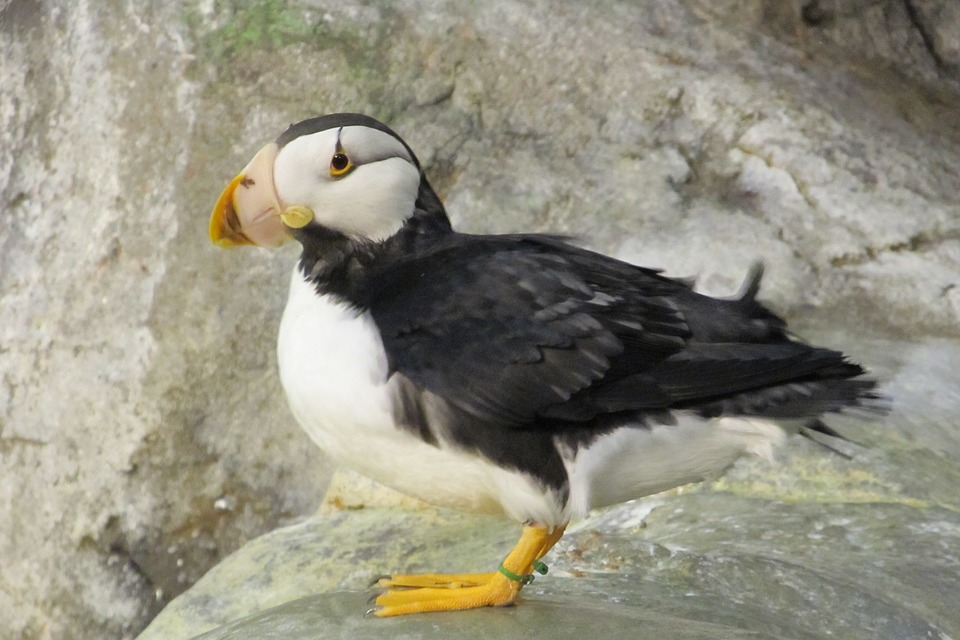
The puffin's scientific name, fratercula, came from the Latin for ‘little brother’ because their plumage resembled monk’s robes.

The puffin stands only 12in tall but can dive 300ft for food and endure eight months a year out at sea.

Their short wings are adapted for swimming with a flying technique under water.

A puffin weighs about the same as a can of Coke.


BEHAVIOR 

Adult pairs appear to kiss, rubbing their beaks together in behaviour known as ‘billing’.

They nest in burrows in the ground. The males dig the burrow using their bill and feet to push the soil out behind them.

Puffins often use existing burrows made by rabbits.

The puffin pairs for life, returning to land in the spring and use the same burrows year after year.

Adults often dig out a separate tunnel in their burrow to use as a lavatory.

Although the puffins are vocal at their breeding colonies, they are silent at sea.


LIFE

A baby Puffin is called a Puffling, and both parents take turns incubating the egg before it hatches.

The young never see their parents. They stay in the burrow for five days before leaving home in the night to avoid predators.

A young puffin spends its first three years at sea before setting foot on land.

The puffin usually lives for 25 to 30 years.

RELATIONSHIP WITH HUMANS

There are at least 10 million puffins in Iceland, compared to a human population of around 350,710, meaning, there are 28 times more puffins than people.

Puffin is regarded as a delicacy in Iceland. It has a rich, gamey taste similar to liver.

Puffins are known as ‘clowns of the sea’ and ‘sea parrots’.


There are at least eight islands worldwide named after the puffin.

Source Daily Mail

Friday, 19 May 2017

Puerto Rico

The Commonwealth of Puerto Rico includes the largest, main island and a number of smaller islands, including Mona, Vieques, and Culebra. Of those three smaller islands, only Culebra and Vieques are populated all year.

HISTORY

The history of Puerto Rico began when the Ortoiroid people started living in the island between 3000 and 2000 BC.

The Igneri tribe migrated to Puerto Rico between 120 and 400 AD from the region of the Orinoco river in northern South America and lived there between the 4th and 10th centuries co-existing with the Saladoid and Arawak Indians and later the Taino people.

By approximately 1000 AD, the Taino people had become dominant. At the time of Columbus' arrival, an estimated 30,000 to 60,000 Taíno Amerindians, led by the cacique (chief) Agüeybaná, inhabited the island. They called it Borikén (Borinquen in Spanish transliteration).

A reconstructed Taíno Village at the Tibes Ceremonial Center

Christopher Columbus first sighted the island now known as Puerto Rico on November 18, 1493 and the following day (November 19) he went ashore named it San Juan Bautista (in honor of St John the Baptist).

Juan Ponce de León, a lieutenant under Columbus, founded the first Spanish settlement, Caparra, on August 8, 1508. Caparra was abandoned in 1521, but it represents the oldest known European settlement on United States territory.

De León later served as the first governor of the island.  Eventually, traders and other maritime visitors came to refer to the entire island as Puerto Rico (meaning "rich port" in Spanish) and San Juan became the name of ITS main trading/shipping port.


Catholicism was brought by Spanish colonists and gradually became the dominant religion in Puerto Rico. The first dioceses in the Americas, including that of Puerto Rico, were authorized by Pope Julius II in 1511.

The first educational establishment in Puerto Rico was the Escuela de Gramática (Grammar School). It was established by Bishop Alonso Manso in 1513, in the area where the Cathedral of San Juan was to be constructed. The school was free of charge and the courses taught were art, history, Latin, literature, philosophy, science and theology.

Puerto Rico formed an important part of the Spanish Empire from the early years of the exploration, conquest, and colonization of the New World.

The island was a major military post during many wars between Spain and other European countries for control of the region between the 16th and 18th centuries.

Puerto Ricon nationalist Ramón Emeterio Betances led the Grito de Lares, a revolt against Spanish rule on the island. The short-lived insurrection began on September 23, 1868, in the town of Lares, for which it is named, and spread rapidly to various revolutionary cells throughout Puerto Rico.

Dr Betances

Although the revolt failed to achieve its main objective, the Spanish government granted more political autonomy to the island.. Since the Grito galvanized a burgeoning nationalist movement among Puerto Ricans, Betances is considered "El Padre de la Patria" (Father of the [Puerto Rican] Nation).

The first Protestant church, Iglesia de la Santísima Trinidad, was established in Ponce by the Anglican Diocese of Antigua in 1872. It was the first non-Roman Catholic Church in the entire Spanish Empire in the Americas.

In 1898, during the Spanish-American war, Puerto Rico was invaded by U.S. forces. The United States took possession of the island and on October 18, 1898 American troops raised their country's flag over the Caribbean nation.

General Nelson Miles and other soldiers on horseback Puerto Rico July 1898

The Spanish–American War ended with the signing of the Treaty of Paris, which was signed on December 10, 1898. Its clauses included Spain ceding Puerto Rico to the United States.

The Treaty of Paris came into effect on April 11, 1899, when the documents of ratification were exchanged. For the next 53 years, it became a felony to display the Puerto Rican Flag.

El Yunque National Forest, is located on the slopes of the Sierra de Luquillo mountains,  in northeastern Puerto Rico. Established on January 17, 1903, it is the only tropical rain forest in the United States National Forest System and is the largest block of public land in Puerto Rico.

Photo of El Yunque from the east, Puerto Rico. By Stan Shebs

President Woodrow Wilson signed the Jones Act on March 2, 1917, granting Puerto Rican people United States citizenship.

Through its passage, the Jones Act imposed mandatory conscription into the U.S. military on Puerto Ricans, precisely at the moment that the United States entered World War I. As a result, more than 18,000 Puerto Ricans served in the U.S. armed forces during World War I.

The country's name was changed from "Porto Rico" to "Puerto Rico" on May 17, 1932, when a bill was signed by President Hoover.

The first elected Governor of Puerto Rico was Luis Muñoz Marín, who was inaugurated on January 2, 1949. Nearly 200,000 people turned out for the six-hour colorful ceremonial celebration. His inauguration marked a significant turning point in the island's history, representing the first time Puerto Ricans directly chose their leader through democratic elections.

On October 30, 1950, the US government bombed Puerto Rico to suppress nationalist feelings to become independent.

Puerto Rico became a self-governing commonwealth of the United States on July 25, 1952. This means it is an organised, self-governing territory with locally elected governors and legislatures. Puerto Rico elects a Resident Commissioner to the U.S. House of Representatives.


On May 3, 2017, the government of Puerto Rico filed for a form of bankruptcy protection under a law known as PROMESA (Puerto Rico Oversight, Management, and Economic Stability Act). The island had accumulated around $72 billion in debt, a figure that was equal to roughly 100% of Puerto Rico's gross domestic product (GDP) at the time.

The financial crisis was a result of a combination of factors, including economic mismanagement, unsustainable borrowing, high levels of public spending, and a shrinking population. The island's economy had been struggling for years, with a high poverty rate and a shrinking tax base.

The bankruptcy filing allowed Puerto Rico to restructure its debt, including negotiating with creditors to reduce the amount owed. However, the process was complicated and lengthy, and it took several years for Puerto Rico to emerge from bankruptcy.

The bankruptcy also highlighted the larger issue of Puerto Rico's political status as a US territory, with many arguing that the island's lack of sovereignty and representation in Congress contributed to its economic woes.

FUN PUERTO RICO FACTS

According to the 2010 US Census, 99% of the population consider themselves of Puerto Rican descent (regardless of race or skin color), making Puerto Rico one of the most culturally unified societies in the world.

The population of Puerto Rico was 3,474,182 on July 1, 2015, a 6.75% decrease since the 2010 United States Census.

Puerto Rico is 75.8% White, higher than the mainland USA.


The most populous Puerto Rico city is its capital, San Juan, with approximately 371,400 people.

Reggaeton is a musical genre which originated in Puerto Rico during the late 1990s. It blends British West reggae and dancehall with Latin American genres, as well as hip hop. Popular Puerto Rican reggaeton stars include Daddy Yankee, Nicky Jam and Wisin and Yandel.

The island's most recognizable endemic species and a symbol of Puerto Rican pride is the coquí, a small frog easily identified by the sound of its call, from which it gets its name.

Common Coquí

The Piña Colada is the national drink of Puerto Rico and National Piña Colada Day is celebrated on the islands on July 10th every year.

Thursday, 18 May 2017

Giacomo Puccini

After Giuseppe Verdi, Giacomo Puccini is considered the greatest Italian opera composer. He is noted for such enduringly popular works as Madama Butterfly and La bohème

Giacomo Puccini

EARLY YEARS

Giacomo Antonio Domenico Michele Secondo Maria Puccini was born on December 22, 1858, in Lucca, Tuscany, one of nine children.

Puccini's birthplace, seen in 1984. By David Wright - Wikipedia

The heads of his family for four generations had been professional musicians and Giacomo was chosen to carry on the Puccini musical tradition.  However, when his father died in 1864, Giacomo was only six years old, and thus not capable of taking on the role.

As a child, Puccini participated in the musical life of the Cattedrale di San Martino, as a member of the boys' choir and later as a substitute organist.

Young Puccini studied at the Pacini Institute of Music in Lucca. At first he was an indifferent student. Then, encouraged by a sympathetic teacher, he began to blossom as a church organist.

Puccini smoked from an early age and when he needed money to buy cigarettes he stole and sold the organ pipes from a village church in which he accompanied the services. The mischievous teenager then changed the harmonies so no one noticed the missing notes.

Puccini liked to improvise on the organ, playing popular tunes from Verdi’s operas. At about 17, inspired by a performance of the great composer's Aida, Puccini determined to specialize in composing for the operatic stage.

Puccini persuaded his family to let him study at the Milan Conservatory. Aided by a bursary and a loan from a great uncle, he attended the establishment from 1880 to 1883.

OPERAS

Puccini's first opera, Le Villi, was produced in 1884; his second, Edgar, in 1889.

When Puccini was composing the music for La bohème (1896), he learned that a rival composer, Leoncavallo, was working on a similar project. Puccini declared: "Let him compose. I will compose. The audience will decide." Puccini them wrote with an urgent speed, completing his opera a year before Leoncavallo's now all but forgotten work. It premiered at the Teatro Regio in Turin on February 1, 1896, eventually becoming one of the most frequently performed operas internationally.


Tosca is an Italian opera in three acts by Giacomo Puccini based on Victorien Sardou's play La Tosca. By 1900, the premiere of a Puccini opera was a national event. Many Roman dignitaries were due to attend the premiere, including The Prime Minister of Italy, Luigi Pelloux and Queen Margherita.

Police received warnings of an anarchist bombing of the theater, and instructed the conductor Leopoldo Mugnone that in an emergency he was to strike up the royal march. The unrest caused the premiere to be postponed by one day, to January 14, 1900 when it was performed without disruption.

Front cover of the original 1899 libretto

Giacomo Puccini's Madama Butterfly premiered at La Scala in Milan on February 17, 1904. It  generated negative reviews that forced the Italian composer to rewrite the opera.

In 1907 Puccini visited New York City to attend the first Metropolitan Opera production of Madama Butterfly. There he conceived the idea of writing an opera with an American setting. The result was The Girl of the Golden West (1910).

PRIVATE LIFE

Puccini was wholly uninterested in religion and politics. Instead, he enjoyed racing sports cars on his property and gambling at cards.

Puccini's wife, Elvira was well aware of her husband's countless infidelities. She planted camphor in his trouser pockets and laced his coffee with bromide to lessen his sexual appetite when attractive women came to dinner.

In 1909 Elvira Puccini accused their maid Doria Manfredi of having an affair with her husband. Doria committed suicide by taking mercury sublimate (then used as a rat poison) and died in terrible agony. It turned out Puccini was having an affair, not with Doria but with her cousin Giulia, which lasted until his death. The maid was merely the go-between. An autopsy found Doria died a virgin and Elvira was sued for slander.

Puccini photographed in 1908

DEATH AND LEGACY

Puccini died following treatment for throat cancer on November 29, 1924, in Brussels, Belgium.

When news of Puccini’s death reached Rome, a performance of La bohème was stopped and Chopin’s funeral march was played.

The whole of Italy went into mourning at Puccini's death and Mussolini spoke at his funeral.


When he died, Puccini was the most commercially successful opera composer of all time, worth the equivalent of of $175 million (£135 million) today.

In all Puccini composed 12 operas. The final one, Turandot, was unfinished and its last two scenes were completed posthumously by Franco Alfano after Puccini's death. Turandot was first performed at La Scala in Milan on April 26, 1926.

Turandot features Puccini's best known work "Nessun Dorma," which was sung by Luciano Pavarotti for the BBC’s television coverage of the Football World Cup that was held in Italy in 1990. It reached #2 in the UK singles chart, the highest position ever for a classical song.

Comptons Encyclopaedia, Classic FM magazine