Search This Blog

Monday, 12 May 2014

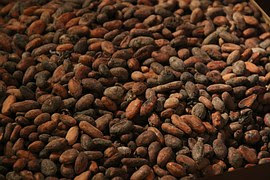
Cocoa

A drink used to be made by the Aztecs for the gods which had the ingredients of ground cocoa mixed in with spices and corn.

About 40 cocoa beans are contained in each cocoa pod.


In 1866 Cadburys became the first company in England to sell cocoa as a drink. The cocoa beans were roasted, ground and then mixed with sugar to make a powder. Customers added hot water or milk to the  powder to make what became a much-liked drink.

The West African island country of São Tomé and Príncipe was popularly known as the Chocolate Islands in the early 1900s, when it was the world's top exporter of cocoa.

Cadbury uses more than sixty thousand tonnes of cocoa each year, in the United Kingdom alone.

A person would have to drink more than 12 cups of hot cocoa to equal the amount of caffeine found in one cup of coffee.

An extract of cocoa has been found to be more effective than fluoride in keeping your teeth healthy.

West Africa collectively supplies two thirds of the world's cocoa crop.  The largest producer of cocoa is Ivory Coast at more than twice as much as second-placed Ghana.

Source Greatfacts.com

Sunday, 11 May 2014

Cocktails and Bitters

The first publication of a bartender’s guide, which includes cocktail recipes, was made in America in 1862. On top of listing recipes for various punches and other types of mixed drinks there were ten recipes for drinks referred to as "cocktails". The "cocktails" were differentiated from other drinks in this guide through the use of bitters as an ingredient.

Bitters, a herbal mixture with a bitter flavor was originally created in 1824 in Venezuela by a German doctor, who intended it as a treatment for stomach ailments. Soon the blend was being exported to England and North America where it began to be used as a flavor enhancer in cocktails. Different types of bitters were developed including Peychaud Bitters whose chief taste comes from a bitter herb called gentian.

The word “cocktail” came about earlier in the century. In the French founded city of New Orleans, Antoine Pechaud, the inventor of Peychaud bitters was serving a mixture of cognac and his own bitters to customers in his apothecary shop. He served them in eggcups, which in French is “coquetier”. His American customers started pronouncing “coquetier” as “cocktail.”

Cocktail

The word "cocktail" originated as a reference to a practice whereby prospective horse sellers in England would give old or droopy specimens a rectal dose of ginger to make them cock their tails for a younger, friskier appearance. From there it was just a short jump to the mixed drinks that made humans perk up, at least at the start of their alcoholic forays.

Sir Francis Drake is credited with inventing the cocktail in 1586. Made with mint and rum, 'The Draque' was a precursor to the modern mojito.

The tomato juice and vodka cocktail known as Bloody Mary was named after Queen Mary I of England. 300 English Protestants were martyred during her reign, which earned her the nickname "Bloody Mary."

The Manhattan cocktail is a mixture of whiskey and sweet vermouth. Popular history suggests that the drink originated at the Manhattan Club in New York City in 1874, where it was invented by Dr. Iain Marshall for a banquet hosted by Jennie Jerome (Lady Randolph Churchill, Winston's mother) in honor of the new governor Samuel J. Tilden.

The Brandy Daisy, a cocktail of citrus juice and brandy, was the forerunner of the Margarita. One of the earliest known recipes was published in 1876 in the second edition of Jerry Thomas's The Bartenders Guide or How To Mix Drinks: The Bon-Vivants Companion. Margarita is the Spainish name for Daisy.

Artist Henri de Toulouse-Lautrec is said to have been the creator of the Earthquake cocktail, so named because of is strength. Its simple recipe is equal parts of absinthe and cognac.

Sir Thomas Gimlette (1857-1943), a British navel surgeon, believed that drinking straight gin was unhealthy and impaired the efficiency of navel officers, so he began to dilute it with lime juice, creating a new cocktail – the Gimlet.

Harry MacElhone and his bar man Fernand Petiot, of Harry's New York Bar in Paris, were the creators of the Bloody Mary cocktail on April 16, 1921. The addition of tomato juice to the vodka-based seasoned mixture gave the Bloody Mary its reddish, blood-like color. The blood-red concoction got it’s name because it reminded one of his staff of the Bucket of Blood Club in Chicago, and a girl there named Mary.

Bloody Mary. By Good1228gmail - Wikipedia Commons

The Hindenburg's signature cocktail was the Kirsch Martini: three parts kirsch (a German brandy), one part dry vermouth, and a dash of grenadine. A creative barman allegedly had to invent the drink on the fly after the passengers finished all of the whiskey on board mid-voyage!

Death in the Afternoon, a cocktail containing absinthe and champagne, was popularized by Ernest Hemingway in a 1935 recipe book.

The cartoon Tom and Jerry is named after a American Christmas cocktail invented in the 1820s.  The Tom and Jerry cocktail is a variant of eggnog with brandy and rum added and served hot, usually in a mug or a bowl.

The Blue Hawaii cocktail was created in 1957 when a representative of the Dutch distiller Bols asked a bartender, Harry Yee to develop a drink using its blue curaçao liqueur.

The Vesper Martini is a classic cocktail made famous by James Bond in Ian Fleming's novel Casino Royale. It's a unique blend of three spirits: 
Gordon's Gin: A classic London Dry Gin   
Vodka: A neutral spirit   
Kina Lillet: A fortified wine   
The drink is shaken, not stirred, and garnished with a large, thin slice of lemon peel.

London celebrity haunt Movida launched the world’s most expensive Christmas cocktail in 2007 at £35,000 a pop. It included a large measure of Louis XII cognac, half a bottle of Cristal Rosé champagne, flakes of 24-carat edible gold leaf — and an 11-carat white diamond ring.

Inspired by his 1993 song "Gin And Juice," rapper Snoop Dogg broke the world record for "the largest paradise cocktail" at California's BottleRock Napa Valley music festival on May 27, 2018. He created the gigantic cup of gin and juice with the help of Top Chef's Michael Voltaggio and fellow rapper Warren G. The drink contained 180 1.75-litre bottles of gin, 156 1-litre bottles of apricot brandy and 28 3.78-litre jugs of orange juice.

An attempt to set the Guinness World Record for the world’s most expensive cocktail was thwarted when a customer dropped and broke the bottle of Cognac that was worth $77,000.

Sources New York Times, Daily Mail

Cockroach

Thomas Edison developed in 1866 a device to electrocute cockroaches.

Tea made of cockroaches was a common Creole medicine for treating tetanus and other ailments in the 19th century.

The world record for cockroaches eaten is 36 in a minute by retired English rat catcher Ken Edwards on March 5, 2001.

In 2007, a Russian cockroach named Nadezhda became the first creature to give birth in space.

On January 31, 2017, doctors at Stanley Medical College and Hospital in Chennai, India, successfully removed a live, full-grown cockroach from a woman's nasal cavity. The woman, identified as Selvi, had been experiencing intense discomfort and irritation in her nose for several hours. After visiting two other hospitals without finding relief, she finally arrived at Stanley Medical College, where doctors performed a nasal endoscopy. The endoscopy revealed the surprising culprit – a live cockroach lodged deep within Selvi's nasal cavity. Using a combination of suction and forceps, the doctors carefully extracted the insect, much to Selvi's relief. Thankfully, the cockroach hadn't caused any serious damage, and Selvi made a full recovery. 

The scientific name for a group of cockroaches is called an intrusion.

Cockroaches can run on two legs, and that they can reach speeds of almost five feet per second.

A cockroach can change directions up to 25 times in a second.

Female cockroaches make eggs more quickly if they cuddle with other roaches.


Baby cockroaches are called nymphs. They are soft and white but turn hard and brown on contact with air.

Cockroaches won't eat cucumbers. This is because of a chemical in cucumbers (trans-2-nonenal) which acts as a natural repellent for ants and roaches.

A cockroach can bite with 50 times more force than its body weight.

Cockroaches can flatten themselves almost to the thinness of a piece of paper in order to slide into tiny cracks.

Much like humans, cockroaches get lonely if they don’t have companionship.

A cockroach can live nine days without its head before it starves to death.

The world’s largest cockroach farm uses AI technology to breed six billion adult cockroaches a year.  The colony is larger than the world’s human population – and they are all for medical use. The farm is run by the Gooddoctor Pharmaceutical Group in the city of Xichang, in southwestern Sichuan province, China.

Scientists who work with cockroaches often develop allergies to cockroaches as well as chocolate and pre-ground coffee at the same time. This could be due to the fact that the FDA allows up to 60 insect fragments on average in a 100-gram sample of chocolate or coffee.

The Cockroach Hall of Fame Museum may be found in Phoenix, Arizona.

Cocker Spaniel

The first mention of the cocker spaniel dates back as far as 1368 in the British Isles. Later strains crossed with toy dog breeds to give it its modern, small stature.


It was bred to its now recognizable breed by the Dukes of Marlborough, by crossing the original Spanish breed with King Charles Spaniels. Thus, the Cocker Spaniel was definitely established by the end of the nineteenth century.

The 'Cocker' part of the Cocker Spaniel's name refers to the reason they were originally bred in the UK - to hunt woodcock.

The cocker spaniel was exported from Britain to America in 1882, American breeders produced a smaller dog with longer legs, while retaining the finely chiselled facial features.

The cocker spaniel was first used in America to flush or "cock" game into nets, and later used for gun hunting of small birds.

By the mid 1930s the English Cocker Spaniel was the most popular breed in Britain and by the 1940s the American Cocker Spaniel breed was the most popular dog in North America.

Steven Spielberg’s cocker spaniel Elmer appeared in four films that he directed: The Sugarland Express, Jaws, Close Encounters Of The Third Kind and 1941.

Corky retired from the U.S. Customs Service in Miami in 1991. The golden cocker spaniel, rescued from an Illinois animal shelter three years earlier, had sniffed out $18-million in drugs. 

Cockfighting

Cockfighting was popular in ancient times in China, India, Persia, and other Eastern countries and was introduced into Greece in the time of Themistocles (c. 524-460 BC).

It was during Magellan's voyage of discovery of the Philippines in 1521 when modern cockfighting was first witnessed and documented by Antonio Pigafetta, Magellan's chronicler.

The earliest known book on the sport of cockfighting was The Commendation of Cocks and Cock Fighting published by George Wilson in 1607.

The phrase well heeled - meaning well-to-do - comes from cock fighting. It refers to where the competitors would provide their birds with good, sharp spurs that would inflict the most damage. It only later transferred its meaning to money.

The Kentucky township of Sharkey was named as such because there was a cock fight going on while they were drafting names. They decided to name it after the winning rooster.

Cockfighting was a popular sport in England until 1849, when it was banned.

The actor Steven Seagal once participated in a raid trying to uncover an illegal cockfighting ring because "Animal cruelty is one of my pet peeves". The raid ended up killing more than 100 hens and roosters and the family dog.

Cocaine

The cottage where Ulysses Grant finished his memoirs is now an historic monument and is kept how it was when he died. On his desk is a large bottle of liquid cocaine. Park rangers check it annually to make sure it is all there.

Sigmund Freud was a chronic migraine and sinusitis sufferer, and he took cocaine to alleviate his sinusitis but found it did little for his headaches.

Sigmund Freud's development of psychoanalysis, including concepts such as the id, ego, superego, and libido, was all done under the influence of a constant supply of cocaine.

Freud was interested in the clinical uses of cocaine, and he suggested using it to wean drug addicts of morphine. His friend, the Viennese eye surgeon, Carl Koller took up and used the idea. Having watched a colleague Dr Von Fieschl battle with morphine addiction, he prescribed injections of cocaine as a cure only to find his patient has got hooked on the drug instead. Koller and Freud thus created Europe's first cocaine addict.

In Arthur Conan Doyle’s novel Last Bow, his hero, the detective Sherlock Holmes suffered from a rare Asiatic disease. This was an euphemism for a cocaine overdose.

Coca-Cola used to contain cocaine when it was initially introduced in 1886. At one point, Coca-Cola contained nearly nine milligrams of cocaine in each glass.

Before Coca-Cola, there was Coca Wine, 10% alcohol and 8.5% cocaine extract by volume, and endorsed by Queen Victoria and Pope Leo XIII.

Only one commercial entity in America can import coco leaves with approval from the DEA, The Stepan Company, after extracting the cocaine, the leaves are then shipped to Coca Cola to be used as an ingredient in the secret recipe thus making an imitation recipe near impossible.

Up until the year 1916, London's famed department store Harrods offered packages of cocaine (and heroin) complete with syringe and spare needles, which was recommended as “A Useful Present for Friends at the Front.”

In the 1970's McDonald's had to redesign its coffee stirrers from spoons to paddles because too many people were using them for snorting and measuring cocaine.

The American comic actor Tim Allen was arrested on October 2, 1978 in the Kalamazoo/Battle Creek International Airport for possession of over 650 grams (1.43 lb) of cocaine. He provided the names of other dealers to reduce his sentence from life imprisonment to 7 years.

JonHs.com

Steven Tyler, Aerosmith's frontman, claims that he spent at least $5 million on cocaine in the 1970s and 1980s.

In 1985 a drug smuggler jettisoned 76 pounds (40 kilograms) of cocaine from his airplane over Georgia's Chattahoochee National Forest. A black bear (later dubbed 'Pablo EskoBear') found and ate all of the cocaine and died of an inconceivably huge overdose.

On January 18, 1990. Marion Barry, the mayor of Washington, D.C., was arrested by the FBI in a sting operation for possession of crack cocaine. The incident was caught on tape and widely reported in the media. Despite the arrest, Barry went on to be re-elected as mayor after serving a prison sentence.

When Jose Luis Betancourt won the $5.5 million Texan state lottery in 2005 he had to forfeit the winnings because he bought the ticket with the proceeds of selling 36 grams of cocaine to a federal informant.

In 2010, three burglars thought that they had found a stash of cocaine while breaking into a woman’s house in Central Florida. They ended up snorting the ashes of a man and his two great danes.

Mexican drug lord Joaquin "El Chapo" Guzmán is estimated to have imported over 450,000 kg of cocaine into the US over the course of his career, 500 imperial tons. This does not count his imports to Europe and other destinations. In 2013, the Chicago Crime Commission named Guzmán "Public Enemy Number One" for the influence of his criminal network in Chicago. The last person to receive such notoriety was Al Capone in 1930.

The movie The Blues Brothers had a cocaine budget.

The fake cocaine actors snort on film is vitamin B powder, a common cutting agent for real cocaine.

Jonah Hill had to be hospitalized while filming Wolf of Wall Street because he snorted so much fake cocaine.

Cocaine is derived from the leaves of the coca plant. Three countries — Colombia, Peru and Bolivia — account for all the coca harvested in the world.

Cocaine that is smoked gets to the brain in as little as eight seconds, while cocaine that is snorted will take about ten minutes.

When you take cocaine, the odds of you having a heart attack in the next hour goes up 24 times or 2400 %.

According to figures from the U.N. Office on Drugs and Crime, coca farmers in Colombia receive $1.30 for each kilogram of fresh coca leaf. In Peru and Bolivia, farmers receive $3.00 per kilogram as the leaf is air-dried before being sold.

Colombian drug smugglers often dump their illicit cocaine cargo when confronted by law enforcement. Lobster fishermen in Nicaragua's Mosquito coast often end up recovering the cocaine, calling it "white lobster".

1 in 40 people in Scotland uses cocaine, a higher rate than anywhere else in the world.

Londoners consume more cocaine per year than Europe's next three cocaine-consuming cities, combined.

Less than 5% of the world lives in the U.S., but Americans consume about 37% of cocaine in the world.

It is legal to consume any drug privately in Spain and that the Spanish rank amongst the highest in Europe for cocaine usage.

Crack cocaine is called "Crack" because of the sound it makes when heated.

Cocaine raises dopamine levels by 250%, compared to 100% from sex and 50% from food.

Taking cocaine increases the chance of having a heart attack within the hour by 2,400%.

Source Stratfor.com