Search This Blog

Sunday, 4 August 2013

Battle of the Bulge

The Battle of the Bulge was a pivotal engagement during World War II, lasting from December 16, 1944, to January 25, 1945. It was the last major German offensive on the Western Front and is widely regarded as one of the most critical battles of the war.

Wikipedia

The battle began as a surprise attack by German forces through the densely forested Ardennes region, spanning eastern Belgium, Luxembourg, and northeastern France. Hitler's objective was to split the British and American Allied forces, cross the Meuse River, and capture the key supply port of Antwerp. The Germans hoped that this victory would force the Allies into negotiations, allowing them to concentrate their efforts on the Eastern Front against the advancing Soviet forces.

The initial German assault involved around 200,000 troops and 1,000 tanks, catching the American forces off guard. The Germans succeeded in creating a bulge in the Allied front lines, which gave the battle its name. Several key events and locations became focal points during the battle. The town of Bastogne was heroically defended by the 101st Airborne Division, despite being surrounded by German forces. Units from the VIII Corps delayed the German advance at St. Vith, while American forces halted the Germans at Elsenborn Ridge.

Despite the initial success of the German offensive, the tide of the battle turned due to several factors. The Allies mounted a strong resistance, with reinforcements arriving, particularly from General Patton's Third Army. Supply shortages and the return of Allied air power hindered the German advance. As weather conditions improved, Allied air support increased, further hampering the German effort. By early January, the Allies launched a counteroffensive from the north and south of the bulge, forcing the Germans to retreat.

During the Battle of the Bulge, German troops who could speak English were air-dropped behind Allied lines while wearing American uniforms to cause confusion for the Allies.

At an Allied checkpoint during the Battle of the Bulge, US General Omar Bradley was detained as a possible spy when he correctly identified Springfield as the capital of Illinois. The American military police officer who questioned him mistakenly believed the capital was Chicago.

During The Battle of the Bulge, clear weather was desperately needed for an Allied advance. General Patton asked a chaplain to compose a suitable prayer. The chaplain complied, and the ensuing prayer was handed out to the troops. The weather cleared, and Patton awarded the chaplain a bronze star on the spot.

The Battle of the Bulge was significant for several reasons. It was the largest battle ever fought by the U.S. Army, involving more than 600,000 American soldiers. Casualties were heavy on both sides, with the Americans losing over 75,000 men, while the Germans suffered between 80,000 to 100,000 casualties. This battle marked the end of Germany's ability to launch a major offensive in the West, severely depleting its armored forces and experienced units. Following their defeat, Nazi forces were forced into retreat, leading to the Allied invasion of Germany and the eventual end of World War II in Europe.

Foxholes dug by American soldiers during the Battle of the Bulge in World War II still exist in the French woods to this day.

Bulgaria

The world’s oldest gold treasure, dating back more than 6,000 years, was discovered in the Varna Necropolis in Bulgaria.

Sofia, the capital of Bulgaria, was founded 7000 years ago. This makes it the second oldest city in Europe.

Sofia's Church of St George was built by Romans in the 4th century.

Bulgaria was founded on August 9, 681 as a Khanate on the south bank of the Danube after defeating the Byzantine armies of Emperor Constantine IV.
 
Bulgaria is the oldest country in Europe that hasn't changed its name since it was first established.


The Bulgarians were the first to use Cyrillic script, which is also the alphabet currently used in Russia. Cyrillic is derived from the Greek uncial script, augmented by letters from the older Glagolitic alphabet, which was devised by St. Cyril and Methodius in the 850s and introduced to the world by the First Bulgarian Empire in 886 AD. Over 300 million people use the Cyrillic script today.

The Battle of Kleidion took place on July 29, 1014, between the Byzantine Empire and the Bulgarian Empire. The result was a decisive Byzantine victory. After winning the Battle of Kleidion, the Byzantine Emperor Basil II took an estimated 14,000-15,000 prisoners; he sorted them into groups of a 100, then blinded 99 men in each one and left a single man in each with one eye so that he could lead the others home.

Basil II 's treatment of the prisoners reportedly caused Tsar Samuil of Bulgaria to die of a heart attack less than three months later, on October 6, 1014.

Vasil Levski, the national hero of Bulgaria, was executed in Sofia on February 18, 1873 by Ottoman authorities for his efforts to establish an independent Bulgarian republic.

Levski

The 1876 April Uprising was  a key point in modern Bulgarian history. It lead to the Russo-Turkish War and the liberation of Bulgaria from domination as an independent part of the Ottoman Empire. The independence of Bulgaria was proclaimed in 1908. 

The first computer in the world was created by a Bulgarian. In the period 1937 – 1942, John Atanasoff, a scientist of Bulgarian descent, together with Clifford Berry, an American inventor working for the University of Iowa, designed and developed the first electronic digital computing device.

Bulgaria did not join the German invasion of the Soviet Union that began in June 1941 nor did it declare war on the Soviet Union. Bulgaria eventually ended up at war with everyone in 1944 by accident. Bulgaria declared war on Germany due to Soviet pressure, not knowing that the Soviets, tired of waiting, declared war on Bulgaria the same day. By the next day Bulgaria was at war with the USSR, US, UK and Germany all at the same time.

The 1944 Bulgarian coup d'état, also known as the 9 September coup d'état, was a coup that overthrew the government of Kingdom of Bulgaria carried out on the eve of September 9, 1944. The coup was led by the Fatherland Front, a coalition of communist, socialist, and agrarian parties, with the support of the Soviet Union.

The coup resulted in the abolition of the monarchy and the establishment of a communist-led government. The new government declared war on Germany and its allies, and the Red Army entered Bulgaria to help the new government consolidate its power.

In 1946, a referendum was held in Bulgaria, and the monarchy was abolished by popular vote. A new constitution was adopted, creating the People's Republic of Bulgaria, a single-party socialist state. Bulgaria remained a member of the Soviet-led Eastern Bloc until 1989.

Communist partisans entering Plovdiv, Bulgaria.

In December 1989 the ruling Communist Party allowed multi-party elections, which subsequently led to Bulgaria's transition into a democracy and a market-based economy.

Simeon Saxe-Coburg-Gotha, also known as Simeon II, was the last Tsar of Bulgaria. He was only six years old when he ascended to the throne in 1943, after the death of his father. He was exiled in 1946 after the Soviet-backed Fatherland Front government abolished the monarchy and established a republic. He remained in exile for many years, living in Spain and Egypt.

Simeon Saxe-Coburg-Gotha, the last Tsar of Bulgaria between 1943 and 1946 when he was a child, was sworn in as Prime Minister of Bulgaria on July 24, 2001. He was one of the first monarchs in history to regain political power through a democratic election to a different office.

By Nadya Reid - Flickr: Simeon II of Bulgaria, Wikipedia Commons

Bulgarians express approval by shaking their heads rather than nodding.
 
The famous Bulgarian rose oil is used for making some of the world’s most popular and expensive perfumes. One gram rose oil is produced out of 1000 rose blossoms.

Sofia is the only big city in Europe that lies just 15 minutes away from an imposing mountain – Vitosha. Cherni Vrah (Black Peak – 2290 m) is its highest peak.
 
Bulgaria is one of the countries in the world suffering from negative population growth. From having 9 million inhabitants in 1988, Bulgaria now has 6,385,500 (2023 estimate).

The Bulgarian army has never lost a single flag in battle.

St George is the patron saint of Bulgaria. Bulgarians celebrate St George’s Day on May 6th when it is traditional to roast a whole lamb.
 
Every year on March 1st, Bulgarians exchange martenitsas. Essentially, these are small pieces of adornment made of red and white thread that symbolizes good health and happiness.


A popular dish is shopska salata - onion, tomatoes, cucumbers, raw or roasted peppers, cheese and parsley.

The nation's favourite drink is a fruit brandy, Rakia.

Bulgarian yogurt has a unique taste because the bacteria used to make it, Lactobacillus bulgaricus, is only found naturally in Bulgarian air.

Sources Daily Mail, Mydestination.com

Building

Göbekli Tepe is generally considered the oldest known building in the world. Located in southeastern Turkey, it's a prehistoric temple complex estimated to date back to around 9500 BC. This makes it significantly older than famous structures like the Great Pyramids of Giza or Stonehenge.  It's a remarkable site due to its size, complexity, and the fact that it was built by hunter-gatherers before agriculture was widely adopted.

Göbekli Tepe, Şanlıurfa By Teomancimit

The Cairn of Barnenez  is a Neolithic monument located near Plouezoc'h, on the Kernéléhen peninsula in northern Finistère, Brittany (France). It dates to the early Neolithic, about 4800 BC and is considered one of the oldest buildings in the world.

The oldest large-scale cut stone construction still existing is the central edifice of the 4,600-year-old mastaba (a tomb for kings) built at Sakkara, Egypt. It was created to honor King Djoser, the first ruler of the Third Dynasty. Djoser's Pyramid stood 62m (203 ft) tall and was covered in polished white limestone.

Many believe the biblical Tower of Babel was likely based on a real building, the Etemenanki, the ziggraut of the Marduck temple in Babylon. A Babylonian text describes it as having a base of 295 feet square with seven platforms over 108 feet high. The top platform had a temple where the god met with humanity. access was achieved by ramps or stairways.

Lincoln Cathedral was the tallest building in the world for two and a half centuries. It took the mantle in the early 14th century from the Great Pyramid of Giza. This lasted until 1549, when the central spire collapsed.

The foundation for what is now known as the Wren Building, the oldest surviving college building in the United States, was laid in a ceremony at Middle Plantation, Virginia on August 8, 1695.

The tallest building in the world in 1885 was The Home Insurance Company in Chicago. It was nine stories tall.

The Washington Monument in Washington, D.C., officially opened to the general public on October 9, 1888. At the time, it was the world's tallest building, standing at 555 feet and 5 1/8 inches tall. It remains the tallest stone structure and the tallest obelisk in the world to this day.

The monument was built to honor George Washington, the first president of the United States. Construction began in 1848, but it was delayed several times due to funding shortages and the Civil War. Work finally resumed in 1876, and the monument was completed in 1884.

Washington Monument By Greyfiveys Wikipedia

The Singer Building was an office building and early skyscraper in Manhattan, New York. It was the headquarters of the Singer Manufacturing Company. After a tower was added to it the skyscraper became the tallest building in the world from 1908 to 1909, with a roof height of 612 feet (187 m). The Singer Building was razed 1967-1969  to make way for One Liberty Plaza, making is the tallest building ever to be demolished at the time of its destruction.

Philadelphia City Hall was the tallest occupied building from 1901 to 1909, when New York City’s MetLife building was completed. It was actually designed to be the tallest building in the world, but both the Eiffel Tower and Washington Monument were completed before it and stood taller.

Mailing an entire building has been illegal in the US since 1916 when a man mailed a 40,000-ton brick house across Utah to avoid high freight rates. When Indiana Bell bought Central Union in 1929, it found the existing headquarters in Indianapolis, Indiana. inadequate. The architect Kurt Vonnegut Sr. suggested moving it to the adjacent lot at 13 West New York Street. Over a month period, he 11,000-short-ton (10,000 t) building was shifted 52 feet (16 m) south, rotated 90 degrees, and then shifted again 100 feet (30 m) west. The work did not disrupt the building's customer telephone service or telephone business operations, nor its gas, water, and electricity supply.
 
The first building to be completely covered in glass, built for the Owens-Illinois Glass Company, was completed in Toledo, Ohio in 1936.

The Pentagon is the world's largest office building. Located in Arlington, Virginia, The Pentagon is about 6,500,000 sq ft (600,000 m2), of which 3,700,000 sq ft (340,000 m2) are used as offices. The headquarters of the United States Department of Defense, approximately 23,000 military and civilian employees and about 3,000 non-defense support personnel work in the building.

The Pentagon photo by David B. Gleason from Chicago, IL. Wikipedia Commons

The North Tower of the World Trade Center in Manhattan, New York was topped out at 1,368 feet (417 m) on December 23, 1970. This made it the tallest building in the world until it was surpassed by the Sears Tower in Chicago in 1973. The entire World Trade Center site was destroyed in the terrorist attacks of September 11, 2001.

The twin towers of the World Trade Center (New York) at night in July 2001. By Filipe Fortes from New York, 

Construction began on the Ryugyong Hotel in Pyongyang, North Korea in 1987, but the exterior wasn't completed until 2011. It is 330 metres (1,080 ft) tall and was intended to be world's tallest hotel but these days it is the tallest unoccupied building in the world.

The pinnacle was fitted on the roof of Taipei 101 on October 17, 2003. A 101-floor skyscraper in Taipei, Taiwan, it surpassed the Petronas Twin Towers in Kuala Lumpur by 56 metres (184 ft) and was officially classified as the world's tallest  building in 2004, and remained such until the completion of Burj Khalifa in Dubai.

Taipei 101 in Taipei, Taiwan. By Alton Thompson - 2007, Wikipedia

The construction of the world's first building to integrate wind turbines was completed in Bahrain in 2008.

The Burj Khalifa skyscraper (see below), the world's tallest building officially opened in Dubai, United Arab Emirates on January 4, 2010. It reaches the height of 829.8 metres (2,722 ft) and has 163 floors. The Burj Khalifa takes it shape from the Hymenocallis or Spider Lily, which is a regional desert flower.


The Shard in Southwark, London was inaugurated as the tallest building in the European Union on July 5, 2012, with a height of 1,016 feet (309.6 metres). It opened to the public on February 1, 2013. The Shard is a 95-storey skyscraper with 72 habitable floors, a viewing gallery and open-air observation deck on the 72nd floor, at a height of 802 ft (244.3 metres). It is also the second-tallest free-standing structure in the United Kingdom, after the concrete tower at the Emley Moor transmitting station.

The tallest building in the European Union is now the Varso Tower in Warsaw, Poland, which stands at 310 meters (1,017 feet) tall. The tower was completed in September 2022.

The Shard By © User:Colin / Wikimedia Commons, CC BY-SA 4.0, $3

The final component of the spire of New York City's One World Trade Center was installed on May 10, 2013, bringing the building, the tallest in the Western Hemisphere, to a height of 1,776 feet (541 m). The building opened in 2014.

The Great Mosque of Mecca, commonly known as al-Masjid al-Ḥarām in Mecca, Saudi Arabia is the  most expensive building in the world having cost around 100 billion $US to build.

The groundscraper, the opposite of a skyscraper, is a building like the Pentagon or Apple's headquarters with relatively few stories but greatly extends horizontally.

NASA's Vehicle Assembly Building in Florida is the biggest one-story building in the world. his massive structure was built to assemble the Saturn V rockets used for the Apollo missions to the Moon. Its immense size allows for the vertical assembly of these colossal spacecraft. It's so big; rain clouds form below the ceiling.

The Palace of the Parliament in Bucharest, Romania is considered the heaviest building in the world. Weighing over 4 million tons, it's a massive structure made of steel, bronze, marble, crystal glass, and wood. Its construction was a controversial project, and it's now the third-largest administrative building in the world. 

London, New York and Paris have fake buildings on residential streets that hide subway vents and other infrastructure. These are essentially facades with no building behind them.

Traditional Japanese buildings do not use nails or glue. Instead, timbers are connected by elaborate dovetail joints.

Some buildings in Malaysia replace the 4th floor with “3A” as the sound of four (sì) is similar to the sound of death in Chinese (sĭ ).

Bug

A bug, strictly speaking, is a type of insect. It refers to insects in the order Hemiptera, which have piercing mouthparts. However, in common usage, the term "bug" is often used to refer to any small, crawling creature, including centipedes, spiders, and other arthropods. So while not all bugs are insects, all insects can technically be called bugs. 

Examples of True Bugs:
Stink Bugs: Known for their ability to release a foul-smelling chemical when threatened.
Cicadas: Known for their loud, buzzing calls, these bugs feed on plant sap.
Bedbugs: Small, parasitic insects that feed on the blood of humans and animals.
Aphids: Small sap-sucking insects that are often found on plants.

Below Species from each of the four suborders of Hemiptera, clockwise from top-left: Acanthosoma labiduroides, Pentatomidae (Stink bugs), Auchenorrhyncha (including Cicadas and Bedbugs) and Aphids.

Wikipedia

The word bug originally (around 1425) meant an object of terror, a hobgoblin or a scarecrow. It was only first applied to insects and similar creatures almost 200 years later

King George III of England appointed an official bug-taker to clear the Palace of lice and fleas. A certain Andrew Cook, the Kings Catcher, advertised in the Public Advertiser his eminent role in response to claims of a rival who is portrayed himself as "Bug-Destroyer to the Majesty."

A bug-loving 8-year-old in Canada who was teased at school for her unusual hobby ended up co-authoring a research paper in September 2017 after the scientific community took her under their wing.

The biggest bug in the world is the Goliath Beetle which can weigh up to 3.5 ounces and be 4.5 inches long.

The katydid bug hears through holes in its hind legs.

The leaf bug of ceylon (phyllum sicci folium) has legs and antennae the color and shape of leaves, has indentations on its body like the vein marks on a leaf, and hangs from branches, swaying in the breeze exactly like a leaf.

A male giant water bug carries his eggs on his back and cleans them until they hatch, one of the only insect fathers to be so attentive.

A ‘tardigrade’ is a practically invincible type of bug that was shot to space to see how it would survive. It came back totally fine.

While all true bugs have sucking mouthparts and most feed on sap, some suck body fluids.

Bugs often end up on their backs when they die because blood flow decreases and their legs deflate, making them top heavy.

According to Scientist, the average person eats about two pounds of bugs a year when they accidentally get ground up in foods like peanut butter and spaghetti sauce. They are actually full of protein.

There are 1.5 million bugs for every human on the planet.

Source Daily Express

Sunday, 21 July 2013

Buffalo (or Bison)

Bison or buffalo are large, even-toed mammals. "Bison" is a Greek word meaning ox-like animal, while "buffalo" originated with the French fur trappers who called these massive beasts bœufs, meaning ox or bullock—so both names, "bison" and "buffalo", have a similar meaning.

By 10,000BC the mammoth was beginning to die out in North America and the buffalo took its place as a principal source of food and hides.

The buffalo formed the mainstay of the economy of the Native Americans, providing them with meat for food, hides and fur for clothing and shelter, and sinew and horn for tools.

Native Americans could easily take down the buffalo. The buffalo’s lungs share the same compartment (unlike humans who have two separate compartments). So when an arrow/spear pierces the Buffalo’s lung cavity (pleura), both lungs collapse, bringing the buffalo down swiftly.

After a successful buffalo hunt a Native American adult might consume as much as four pounds (1.8 kgs) of buffalo meat a day.

The Indians' hunting activities had little impact on the buffalo population, but with the westward movement of white civilization in the 18th and 19th centuries, the bison were wantonly slaughtered in ever-growing numbers.


In the days of pioneer travel great buffalo herds, wading streams, sometimes halted a boat in midstream or, moving over the prairies, blocked and occasionally even derailed a train.

The westward-moving pioneers and railroad workers wantonly killed the huge animals by the thousands for food. Only the choicest pieces of the slaughtered buffalo, the hump and tongues, were cut out of the carcasses.

In just 50 years, between 1830 to 1880, the US slaughtered 40 million bison. The near-extinction bison hunting in the 1800s was not only to gain food. The pioneers also wanted to restrict the American Indians' dominant food supply; herds were shot from trains and left to rot where they died. 

By 1870s, the buffalo had been decimated east of the Mississippi River thus removing a major source of meat. The extension of railroads across the Great Plains had led to the destruction of the huge herds that foraged on the vast grasslands there.

One hunter, William F. Cody who was nicknamed "Buffalo Bill", killed 4,280 animals in 17 months while supplying buffalo meat for railroad construction crews.

The first buffalo ever born in captivity was born at Chicago's Lincoln Park Zoo in 1884.

The Buffalo Protection Act of 1894 was one of the earliest official recognitions of an endangered species problem in the United States. By the late 1880s fewer than a thousand bison were left on the continent, two thirds of them in Canada. The law to protect the few remaining in Yellowstone National Park was the first federal legislation that focused on conserving a once-vast wildlife resource.

President Barack Obama signed into law on May 9, 2016 the National Bison Legacy Act, which designated the bison as the official mammal of the United States.


The United States Senate has passed resolutions each year since 2013 making the first Saturday of November National Bison Day. The purpose of National Bison Day is to encourage celebration of the American Bison, also commonly known as the American buffalo.  

The species is acknowledged as the first American conservation success story, having been brought back from the brink of extinction by a concerted effort of ranchers, conservationists and politicians to save the species in the early 20th century. Bison can also play an important role in improving the types of grasses found in landscapes to the benefit of grasslands and hold significant economic value for private producers and rural communities.

Bison and wisent are the largest terrestrial animals in North America and Europe.

The Yellowstone Park bison herd (approx. 5,500) is descended from a remnant population of 23 individual bison that survived a mass slaughter in the 19th century by hiding out in the Pelican Valley of Yellowstone Park.

There are about 150 bison living on Santa Catalina Island, a small rocky island off the coast of California. They’ve been there since a film crew imported 14 bison for a movie shoot in 1924, then left them behind when the shoot was complete.

Today there are approximately 500,000 -550,000 bison that live across North America.


Male bison live apart and only enter the female herds during mating season, when the males fight over access to females.

European bison herds move by majority rule: each bison “votes” by facing the direction it wants to go, and the herd goes in the direction chosen by the largest number.

Buffalo can jump over 6 feet high from a running start. These massive animals possess surprising athleticism, considering their size. Their powerful legs and strong muscles allow them to clear obstacles with relative ease.  

Buffalo milk contains 25 per cent more protein than cow's milk.

Source Compton's Interactive Encyclopedia © 1998 The Learning Company, Inc, National Bison Association 

Sunday, 7 July 2013

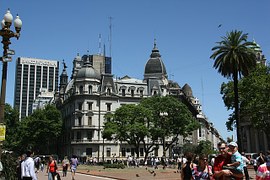
Buenos Aires

Buenos Aires was founded by a Spanish expedition led by Pedro de Mendoza as Puerto de Santa Mariá del Buen Aire on February 2, 1536. It was abandoned after attacks by American Indians (Querandi), and refounded in 1580.

Juan de Garay and the second founding of Buenos Aires, 1580. By José Moreno Carbonero (1858-1942) 

Buenos Aires became the capital of the viceroyalty of Rió de la Plata in 1776, and federal capital of Argentina in 1880.

Tango originated in brothels in the immigrant ghetto of Buenos Aires in the late 19th century, in what is the present-day harbor of La Boca neighbourhood.

The Buenos Aires Metro, also known as the Subte, began operating on December 1, 1913. It is the first underground railway system in Latin America, the Southern Hemisphere, and the Spanish-speaking world. The initial line, Line A, ran between Plaza de Mayo and Plaza Miserere, a distance of about 2.1 miles (3.4 km). The system has since expanded to six lines and 83 stations, serving an annual ridership of over 310 million passengers.


The climate of Buenos Aires is mild all year around. The mean annual temperature is 18º C (64.4º F), making extremely hot and cold days very infrequent. Thus, tourists can enjoy walking around the city in any season.

Argentine Spanish spoken in and around Buenos Aires is distinctly different from that spoken elsewhere not only in Latin America but also other provinces of Argentina.

Aside from a heavy accent, the language is peppered with Lunfardo, a local slang.

The Greater Buenos Aires conurbation, which also includes several Buenos Aires Province districts, constitutes the third-largest conurbation in Latin America, with a population of (2019 est) 15,057.000

                                         
Buenos Aires is home to a large Jewish community, with more than 250,000 members. It is the eighth largest city in the world in terms of Jewish population. 

Avenida 9 de Julio is the widest avenue in the world at an imposing sixteen lanes. It typically takes at least two traffic light rotations to cross. It's so wide that it actually occupies an entire city block!

Ciudad Evita (Evita City) of the greater Buenos Aires area was not only named after Eva Perón, but is shaped like her head in profile.

Buenos Aires has the highest number of bookshops per capita in the world at 25 per 100,000 people, or more than 700 in total,

In Buenos Aires, soccer is like religion, and the best-known clubs are River Plate, Boca Juniors, Independiente, Racing Club and San Lorenzo.

Buenos Aires is home to some of the most iconic stadiums in the world, such as La Bombonera and El Monumental, which hosted the final of the 1978 FIFA World Cup.

Buenos Aires has more psychologists per capita than any other city in the world. It is often referred to as the "psychoanalytic capital of the world" due to its large number of therapists.

Source Studyandliveinba.wordpress.com/

Budweiser

Adolphus Busch was the owner of a brewery supply store in St Louis, Missouri who became a partner in his father-in-law Eberhard Anheuser 's brewery. Busch discovered a means of pasteurising beer so that it could withstand temperature changes. This enabled his firm to distribute its beer on a nationwide basis.

In 1876 Adolphus Busch and Eberhard Anheuser’s brewery introduced a new drier-tasting, light-colored beer called Budweiser in the belief that consumers would prefer it to the more common dark brews.
It was bottled and distributed by Carl Conrad, a local restaurateur

It was called Budweiser from a Czech lager of the same name, which it was brewed in imitation of.

Anheuser-Busch was one of the first US companies to transport beer across America using railroad refrigerator cars.


Until 1986, if you worked for the Anheuser-Busch company in the US, you could drink as much beer as you liked during the work day.

For nearly 150 years, whenever a new heir was born to the Annheiser-Busch brewing family, they would be fed five drops of Budwiser before even having their mothers milk.

In 1953, August Busch Jr., also known as Gussie Busch, purchased the St. Louis Cardinals and initially wanted to rename their stadium "Budweiser Stadium." However, Major League Baseball (MLB) at the time had rules against naming stadiums after alcoholic beverages. This was a common practice back then to maintain a more family-friendly image for the sport. In response, he named it "Busch Stadium" and launched the first Busch branded beer two years later.

Rice plays a crucial role in Budweiser's flavor. It contributes to the beer's crisp taste.

Budweiser beer can also be used as a hair conditioner.

For a time, the actor George Clooney did voice overs for Budweiser TV commercials and allegedly had a beer keg installed in his dressing room during the filming of Ocean's 11.


Hall of Fame Chicago Cubs broadcaster Harry Caray was estimated to have drank 73,000 Budweisers during his lifetime.

Bud Light dropped from an average rating of 5 to -3 among women because of the tagline: "Remove 'No' From Your Vocabulary for the Night."