Search This Blog

Showing posts with label Hygiene. Show all posts

Wednesday, 10 April 2019

Water

Water is a liquid without taste or odor.

Pure water has a slight blue color that becomes a deeper green as the thickness of the observed sample increases. The blue hue of the water is an intrinsic property and is caused by selective absorption and scattering of white light.

Its chemical formula is H2O, meaning that each of its molecules contains one oxygen and two hydrogen atoms, connected by covalent bonds.


HISTORY OF DRINKING WATER

The Ancient Greeks discovered a distillation process whereby pure water was made by the evaporation of seawater.

In 0AD All the world's villages and towns were established close to a suitable water source such as lakes, rivers or wells. However in the large cities, the local natural water supply did not always suffice and local rivers were becoming polluted. To resolve this canals were built and wells became deeper.

In 1270 Louis IX of France sailed from Cagliari in Sicily to take part in the Eighth Crusade and landed on the African coast in July, a very unfavourable season for landing. Much of the army became sick due to poor drinking water, and on August 25th Louis himself died from a "flux in the stomach".

Beginning in 1619, piped water was supplied to houses in London.

Peter the Great built Russia's first spa in Karelia in 1718 based on the water-purifying qualities of shungite.

Henry Cavendish showed that water was composed of oxygen and hydrogen in 1781.

The Secchi disk, created in 1865 by Pietro Angelo Secchi SJ, is a circular disk used to measure water transparency in oceans and lakes. The disc is mounted on a pole or line, and lowered slowly down in the water. The depth at which the pattern on the disk is no longer visible is taken as a measure of the transparency of the water. This measure is known as the Secchi depth and is related to water turbidity.

Secchi disk YouTube.com

In 1900, the average American used just five gallons (19 litres) of water a day. Only 15 percent of households had flushing toilets, and even fewer had bath tubs. People often had no conception of what it was like to be wet all over. People on farms have to dig wells by hand and carry water to the house. They required 50 gallons (189 litres) of it for one load of laundry.

In 1908 chlorine was used in the United States for the first time to sterilize city water.

The "drink 8 glasses of water a day" is based on a 1945 recommendation that had no medical basis. The current recommendation is "drink when you are thirsty, unless you are outside on a hot day or are elderly- then drink a bit more."

Pixiebay

Fluoridation is the act of adjusting fluoride levels in water, with the goal of reducing tooth decay. In 1945, Grand Rapids, Michigan was the first city in the world to do it. In 1999, the CDC declared that water fluoridation was one of the ten great public health achievements of the 20th century.

By 1990 as a result of the hard work of the United Nations and various aid agencies it was estimated over one billion people have been provided with portable water over the previous decade. Unfortunately, many hundreds of millions especially in Africa still did not have access to safe drinking water.

Between 1900 and 2000, water consumption increased by 600% and, with natural sources of water becoming an increasingly valuable commodity the United Nations was anxious that rivers crossing national boundaries, would soon become a source of conflict.

Some studies suggest that by 2025 more than half the people around the world will not have enough fresh water.

WATER CONSUMPTION

70 percent of the Earth is covered by water. Only about .003 percent of it can be drunk by humans.

There are roughly 326 million cubic miles of water on Earth, according to a study by the U.S. Geological Survey.

Pixiebay

The average American uses 100 gallons (379 litres) of water per day. But according to the United Nations, the bare minimum we need is 13 gallons (49 litres).

Three-fourths of household water is used to flush the toilet and take baths and showers.

New York City is one of four major cities in the United States whose drinking water is pure enough not to require purification by water treatment plants. The city is supplied with drinking water by the protected Catskill Mountains watershed.

Iceland's natural water is so pure it is piped into homes without treatment.

FUN WATER FACTS

Studies show that children who drink a glass of water prior to an exam can improve their results by up to a third.

A buyer on eBay paid $455 for some water left in a plastic cup that Elvis Presley had drunk from at a concert in North Carolina in 1977. Fan Wade Jones, who was 13, saw Presley drink from it and a guard gave it to him as a souvenir. He kept the water in a freezer until 1985, then a sealed vial. Wade sold the water but still has the cup.

The rapper 50 Cent made most of his money not from his music, but from an investment in Vitamin Water - He made ten  times more than he ever made rapping.

The world's purest fresh water can be found on the southern tip of Chile, in a town called Puerto Williams. The water has been found to have only two chemical parts per million, hence making it the world's cleanest.

Water makes different pouring sounds depending on its temperature and 96% of people can tell the difference between hot and cold water by the sound it makes being poured. One reason is that hot water generally has more bubbles, so produces a higher frequency sound.


Water splashes when it hits something because a tiny layer of air trapped between liquid and surface prevents the drop from spreading.

You can make your own water by mixing hydrogen and oxygen in a container and adding a spark.

Water itself does not conduct electricity, but the impurities found in water do.

The "triple point" at which water becomes a solid, liquid, and vapor simultaneously occurs at exactly 273.16 K (0.01 °C; 32.02 °F)

At sea level, water boils at a temperature of 212 degrees Fahrenheit or 100 degrees celsius. However, in a plane at 10,000ft, it boils at around 194f or 90c, due to a change in atmospheric pressure.

65 percent of your body is water.

Sheep prefer to drink running water.

A seagull can drink salt water because it has special glands that filter out the salt.

Pixiebay

A 2021 study showed that Oceans are the largest reservoir of water on Earth (at 1.3 billion km^3) followed by groundwater (at 43.9 million km^3). Glaciers are a distant third at 158,000 km^3.

There is a water reservoir floating in space that is equivalent to 140 trillion times all the water in the Earth's oceans.

Source Compton's Encyclopedia

Saturday, 6 April 2019

Washing machine

A washing machine is a device used for washing dirty laundry. It contains a barrel into which the clothes and other textiles are placed. This barrel is filled with water, and then rotated very quickly to make the water remove dirt from the laundry.


HISTORY

Ancient peoples cleaned their clothes by pounding them on rocks or rubbing them with abrasive sands; and washing the dirt away in local streams.

Rain washed a mixture of melted animal fat, or tallow, and wood ashes down into the clay soil along the River Tiber. Roman women found that this clay mixture made their wash cleaner with much less effort.

The earliest washing "machine" was the scrub board invented on March 28, 1797. The patent for "washing cloaths" was issued to Nathaniel Briggs of New Hampshire.

Early washing machines from the 19th century were made of wood and were hand cranked; the washing was carried out in a tub by a reciprocating plunger or paddle.

19th-century Metropolitan washing machine. By User:Itub 

American inventor James King patented the first washing machine to use a drum in 1851, the drum made King's machine resemble a modern machine, however it was still hand powered.

Hamilton E. Smith of Philadelphia is credited by many with inventing the rotary washing machine. In 1858, he received a patent for cycling reheated water in a washing machine. Five years later Smith received a patent dated July 28, 1863 for the reciprocating mechanism to reverse the movement of the revolving drum in the washing machine.

The inventor William Blackstone of Indiana built a washing machine as a birthday present for his wife in 1874. It was a wooden barrel that contained laundry immersed in soapy water, which when turned by hand machine removed and washed away dirt from clothes. This piece of equipment went on sale and Blackstone became the world’s first washing machine manufacturer, with each unit selling for $2.50 ($59.99 in today’s money).

A vintage German model. Wikipedia

Chicago engineer Alva John Fisher is credited by some for inventing the domestic electric washing machine in 1908. However, electric washing machines had been advertised and discussed in newspapers four years earlier. Fisher's machine was a drum type with a galvanised tub and was powered by a small electric motor. It was fitted with a self-reversing gearbox to ensure the clothes were not compacted into a solid mass. Fisher's invention was marketed as the 'Thor' by the Hurley Machine Company of Chicago, and was the forerunner of the modern washing machine.

The 'twin-tub' washing machine introduced in the 1950s had a separate compartment containing a spin-drier. This is a perforated metal cylinder that spins on its axis at high speed, centrifugal force flinging the water out of the washing.

Maytag made the last hand-operated wringer washing machine in 1983. Most other companies had stopped making them years earlier.


The first microchip-controlled automatic washing machines were introduced in 1978. By the early 1990s, most upmarket machines incorporated microcontrollers for the timing process. These proved reliable and cost-effective, so now most machines incorporate microcontrollers rather than electromechanical timers.

The first computer-controlled consumer washers appeared in 1998 when New Zealand-based company Fisher & Paykel introduced its SmartDrive washing machine line in the US. This washing machine uses a computer-controlled system to determine load size and to adjust the wash cycle to match.

FUN WASHING MACHINE FACTS

Vatican newspaper L'Osservatore Romano declared that the washing machine has done more to liberate women than the Pill, abortion or the right to work.

A portion of the fourth movement of Franz Schubert's Trout Quintet is used in some Samsung washing machines, to signal the end of a cycle.

A new washing machine in India has a button for curry stains.


A man in Fuqing, China, was repairing a washing machine when he got his head stuck inside the drum. The fire department spend 40 minutes sawing him out.

Sources Thoughtco, Europress Family Encyclopedia 1999

Wednesday, 2 January 2019

Unilever

Unilever is one of the world's largest conglomerates. It is controlled by two parent Unilever holding companies, one based in London, the other in Rotterdam.

Unilever R&D Centre in Port Sunlight, United Kingdom. By Rept0n1x

In 1885 William Hesketh Lever (September 19, 1851 – May 7, 1925) with his brother James bought a small soap works in Warrington in North West England and founded Lever Brothers as a factory to make soap.

Lever Brothers began manufacturing Sunlight Soap, the world's first packaged, branded laundry soap. They were one of the first companies to use glycerin and vegetable oils such as palm oil, rather than tallow to manufacture soap.


Lever Brothers built a substantial business empire with many well-known brands such as Lux and Lifebuoy. They created Lifebuoy soap in 1895 and sold it as an antiseptic soap. Lever Brothers first coined the term "B.O." for bad odor as part of their marketing company for the soap.

In 1887, William Lever bought some land on the Wirral in Cheshire between the River Mersey and the railway line at Bebington. This site became Port Sunlight where he not only built his works but also a model village to house his employees adjoining the soap factory. Between 1899 and 1914, 800 houses were built to house a population of 3,500 with high architectural standards and many community facilities.

An example of Port Sunlight architecture.By Rich Daley,

Lever Brothers began margarine production 1914. The spread had originally been created in 1869 by the French Province chemist Hippolyte Mège-Mouriès. Two years later he sold the patent to Antoon Jurgens a company based in Oss, Netherlands. Through a series of mergers Jurgens' company became Margarine Unie in 1927. Unilever was founded on September 2, 1929, by the merger of Margarine Unie and Lever Brothers.

During the second half of the 20th century Unilever increasingly diversified from being a maker of products made of oils and fats, and expanded its operations worldwide.


Unilever's American business Lever Brothers of U.S. began manufacturing detergents after World War II. Surf detergent was introduced in 1952 by Crosfields of Warrington, a subsidiary company of Lever Brothers in the United Kingdom, and introduced to the US seven years later.  It became so popular in some parts of the world that 'surf' is the word for detergent in Urdu.

In 1978, National Starch was acquired by Unilever for $487 million, marking the largest ever foreign-acquisition of a US company at that point.

Unilever acquired about 80 companies during 1980s including Brooke Bond (makers of PG Tips tea) in 1984 and Chesebrough-Ponds (maker of Ragú, Pond's, Aqua-Net, Cutex, and Vaseline) in 1987.

Unilever promotes realistic body images in its Dove "Campaign for Real Beauty" commercials but uses skinny female models to promote its Axe line of products to men.


Today, Unilever owns over 400 brands, and reported a turnover of €60.8 billion in 2024.

Unilever is the world's biggest ice cream maker. It sells $4 billion under its Heartbrand name –known as Wall's in the UK. It also owns ice cream brands Ben & Jerry's, Klondike, Popsicle and Breyers.

Sunday, 30 December 2018

Underwear (or undergarment)

Underwear are clothes worn under others, often next to the skin. They keep outer clothes from being made dirty by sweat.

Pixiebay

HISTORY

In ancient Rome, both men and women were known to wear simply wrapped loin-cloths, made from wool, linen or a blend of both, under their outer garments. Only the upper classes would have been able to afford imported silk.

In addition, some women wore a breast band called a strophium or mamillare, made from linen or leather.

In the Middle Ages, the loincloth was replaced in the case of men by loose, trouser-like clothing called braies. Varying in length from upper-thigh to below the knee, the wearer stepped into and then laced or tied around the waist and legs. Braies were usually made of linen, most likely in its natural off-white color, but they could also be sewn from finely woven wool, especially in colder climes.

Braies were not only used as underwear, they were frequently worn by laborers with little else when doing hot work.

Medieval braies

Women wore a  a loose-fitting, sleeveless undergarment called a chemise underneath their gowns or robes, sometimes with petticoats over the chemise. Elaborately quilted petticoats were sometimes displayed by a cut-away dress, in which case they served a skirt rather than an undergarment.

Early Spanish missionaries in Texas hoped to encourage the spread of European values by offering flannel underwear to Native Americans.

Until the mid-19th century many men didn't wear drawers. They simply wrapped their long shirt-tails under them like a nappy and tucked them in.

The 19th century Hungarian pianist Franz Liszt's performances were renowned for being theatrical. They were so showy, they induced hysterical women into throwing their underwear at him.

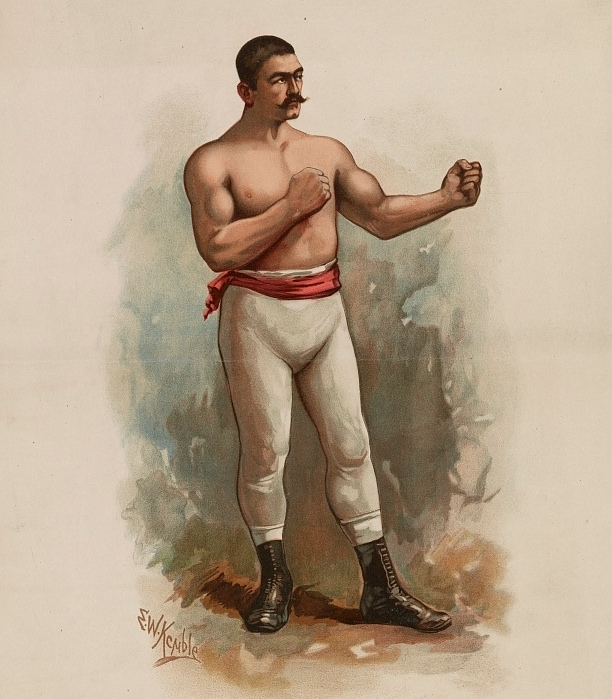
Long johns was a two-piece garment consisting of a long-sleeved top and long pants. They were named after American boxer John L. Sullivan who wore a similar garment in the ring during his prime in the 1880s.

John L. Sullivan

In the 1880s German Dr Gustav Jaeger popularized a combined long johns and vest all in one with buttons up the front and a back opening flap.

In Victorian England, "Pants" was considered a dirty word.

Working class women only begun to wear panties in the 1880s. Before then they had relied on layers of petticoats to keep warm.

The T-shirt was invented in 1904 Wisconsin-based Cooper Underwear Company in 1904 as a 'bachelor undershirt'.

Long johns with button crotches were the usual undergarment for men until the American Cooper Underwear Company, a family business based in Kenosha, near Chicago, caused a revolution in 1911. Their undergarment design called the Kenosha Klosed-Krotch featured overlapping fabric flaps designed to keep the crotch closed.

The first underwear print advertisement in the US appeared in The Saturday Evening Post in 1911.
The Cooper Underwear Co hired Joseph C. Leyendecker, illustrator for The Saturday Evening Post, to create the "Man on the Bag" image to market their "Kenosha Klosed Krotch".

A 19-year-old New York socialite named Mary Phelps Jacob created the first modern bra by tying two silk handkerchiefs together with some pink ribbon. She was granted a patent for the "Backless Brassiere" in November 1914.

Jacob's brassiere, from the original patent application.

When Clark Gable removed his shirt in the 1934 movie It Happened One Night revealing bare skin beneath rather than an undergarment - sales of vests reportedly showed a significant drop.

On January 19, 1935, during a blizzard, Coopers Inc. sold the world's first jockey briefs at the Marshall Field's State Street store in downtown Chicago. Designed by an apparel engineer named Arthur Kneibler, the briefs dispensed with leg sections. The day of its debut, Chicago's popular Marshall Field & Company sold out its stock of 600 packages by noon and sold 12,000 more in the following weeks.

Briefs with a Y-shaped overlapping fly were introduced later in 1935. The Jockey Y-Front  brief became Cooper's most sought after item.

Boxer shorts are a type of undergarment typically worn by men. The term has been used in English since the mid-1940s for all-around-elastic shorts, so named after the shorts worn by boxers, for whom unhindered leg movement ("footwork") is very important.

Since the 1940s, the battle of boxer shorts vs briefs has swayed back and forth in western countries.

Calvin Klein was the first designer to make women’s underwear resembling men’s jockey shorts.

Underwear bomber Umar Farouk Abdulmutallab tried to bring down Northwest Airlines Flight 253 from Amsterdam to Detroit on Christmas Day in 2009. The bomber's al-Qaeda-backed plot failed because he wore the same underwear for two weeks straight and as a result the bomb's fuse became "damp".

FUN UNDERWEAR FACTS

Mormons wear special underwear called temple garments under their clothes as a source of protection from the evils of the world.

Sikh men believe that they should wear the panj kakaar (five articles of faith) at all times. One of the articles is a type of underpants called the kaccha, which are similar to boxer shorts.

Architect Gary Craig of Whitburn in South Tyneside, in North East England put on a record-breaking 211 pairs of underpants, one over the other, in 2010. Beginning with a 40 in pair (Large) and finishing with a 60 in pair (4XL), it took him 25 minutes to get them on. Two years later, his record was beaten when American Janine Keblish overtook him after pulling on 252 pairs of underwear. Later in 2012, the self- styled Geordie Pantsman managed a new record when he wore 302 pairs of underpants.


The average American woman owns approximately 21 pairs of underwear.

Sources ThoughtcoThe Book of Firsts by Ian Harrison

Friday, 26 October 2018

Towel

A towel is a cloth or absorbent paper used for drying a body or wiping clean a surface.

Pixiebay

The word towel occurs twice in the King James Bible. Both times it appears in chapter 13 of the Gospel of John, which describes how Jesus washed his disciples' feet then used using a towel to wipe their feet dry.

Bath towels were traditionally invented in the city of Bursa, now in Turkey, which was the capital of the Ottoman State in the 14th-century.

Charles Dickens was the first to use towel as a verb rather than a noun in 1865. He wrote in Our Mutual Friend, II. iii. iv. 25, "I mean to apron it and towel it.."

Hand towels (the paper variety) were invented in 1907 by Arthur Scott of Philadelphia. They were invented to stop the spread of the common cold in school classrooms. Paper towels for kitchen use followed in 1931.

Early paper towels. Wikipedia

The phrase "throw in the towel" meaning to concede defeat was first recorded in 1915. The allusion is to boxing, in which a trainer would throw a towel into the ring to admit that his man had lost. Before that it was "throw up the sponge",

Douglas Adams wrote in The Hitchhiker's Guide To The Galaxy that a towel "is about the most massively useful thing an interstellar hitchhiker can have."

Towel Day was first observed on May 25, 2001, two weeks after Douglas' Adams' death at the age of 49. On this day, fans carry towels with them as a way to remember Adams and his work.

Boxing promoter Don King charged Mike Tyson $8,000 a week for towels.

Towels are a central part of the culture in Belarus, even appearing on the country's flag. At a traditional Belarusian wedding, the bride walks to the church dragging a towel.

Source Daily Express

Tuesday, 16 October 2018

Toothpaste

Toothpaste is a paste, powder or gel applied to the bristles of a toothbrush in order to help clean and maintain the aesthetics and health of teeth.

Pixiebay

People who lived around the Mediterranean in the 5th millennium BC chewed a gummy substance called mastiche, derived from the resin of the mastic tree, which grew primarily in Greece and Turkey. They found it to be an effective tooth cleanser and breath freshener. 

The ancient Egyptians developed the first toothpaste, which was a crude mixture of powdered ashes of hooves of oxen, myrrh, powdered and burnt egg shells and pumice. They rubbed it on their teeth with their fingers.

A later toothpaste developed in Egypt was a mixture of iris flowers, mint leaves, pepper and powdered salt

The Roman toothpaste was mainly a more primitive, less tasty version using urine as a prime ingredient (the ammonia in it was an excellent cleaner). 

The ancient Chinese used baking soda or chalk as toothpastes.

Tooth powders for use with toothbrushes came into general use in the 19th century in Britain. Most were homemade, with chalk, pulverized brick, or salt as ingredients.

Taft's Myrrahline, to preserve and beautify the teeth, give healthy tone to the gums 

In New York City Colgate & Company became in 1873 the first company to market aromatic toothpaste in America. 

Originally toothpaste was sold in jars, then later metal tubes. In 1880, Doctor Washington Sheffield of New London, Connecticut introduced the first collapsible toothpaste tube, Dr. Sheffield's Creme Dentifrice. They were similar to the tubes that had just been introduced for artist's oil colors and Sheffield had the idea after his son traveled to Paris and saw painters using paint from tubes. 

Sixteen years later  Colgate & Company introduced its Dental Cream was packaged in collapsible tubes imitating Sheffield. 


FUN TOOTHPASTE FACTS

Colgate introduced a toothpaste in France called Cue, which was the name of a notorious pornographic magazine.

Toothpaste contains formaldehyde which is the same chemical used to preserve dead bodies.

Almost all major toothpaste brands contain sodium lauryl sulfate (also sodium dodecyl sulfate), an inexpensive lathering agent that is a known cause of canker sores. The sodium lauryl sulfate in toothpaste suppresses sweetness receptors, which is why orange juice and other juices taste so bad after brushing your teeth. In contrast, apples are known to taste more pleasant after using toothpaste. 

Toothpaste is sold in many brands.

The blob of toothpaste that sits on your toothbrush is called a "nurdle". 

In 2005, Zhonghua toothpaste unveiled the largest ever tube of toothpaste in Shanghai City, China. It was 9.7 ft long and weighed 1,719 lb.

Toothbrush

The toothbrush is a tool used to clean the teeth, gums, and tongue.


HISTORY

Before the toothbrush, people used an assortment of implements to keep their teeth clean. Ancient civilizations cleaned their teeth by rubbing twigs or pieces of wood against them. Chewing sticks, birds' feathers and porcupine quills have also been discovered in the excavated remains of the earliest bathrooms

In medieval Europe few brushed their teeth, and those who did generally used horse hairs. It was customary after meals to use a silver or copper toothpick, or else a goose feather

The first bristle toothbrushes, resembling the modern toothbrush, were made in China during the Tang Dynasty (619–907). Spines were plucked from the neck of a Siberian wild boar and set into a bone handle.


Toothbrushes were introduced to Europe through merchants and travelers in East Asia during the 17th century. French dentists were the first Europeans to promote their use.

The earliest identified use of the word toothbrush in English was in the autobiography of Anthony Wood who wrote in 1690 that he had bought a toothbrush from J. Barret.

Europeans found the hog bristle toothbrushes imported from China too firm and preferred softer bristle toothbrushes made from horsehair.

A horsehair toothbrush said to have been used by Napoleon By Science Museum London

Mid-18th century colonial Americans used to brush their teeth by rubbing soot and salt over them with a rag. 

An English rag trader, William Addis, produced the first mass produced toothbrush in 1780. After being sent to prison in 1770 for inciting riots, Addis decided that the way people were brushing their teeth could be improved. He saved a small animal bone from a meal that he had eaten the previous night, made a hole and tied through it some bristles that he'd obtained from a guard.

After his release, Addis set up a business to mass-produce toothbrushes and became very wealthy. His company, Wisdom Toothbrushes, still exists.

Source of picture http://madeupinbritain.uk/Toothbrush


Du Pont begins commercial production of nylon toothbrush bristles on February 24, 1938. They proved sturdier and more efficient than bristles of natural origin – generally wild boar bristles. They were introduced on the US market under the name “Doctor West’s Miracle Tuft Toothbrush."

Squibb Pharmaceutical introduced America's first electric toothbrush, the Broxodent, at the centennial of the American Dental Association in 1959. The original electric toothbrush had been developed 20 years earlier in Switzerland

FUN TOOTHBRUSH FACTS

Dentists recommend that toothbrushes be kept at least six feet away from a toilet to avoid airborne particles resulting from the flush.

The little rubber thingy at the end of a toothbrush is called a "stimulator tip."

The most popular toothbrush color is blue.

Valentina Tereshkova, the first woman in space, forgot her toothbrush and had to brush her teeth with her finger.

Of the 6.8 billion people on the earth, only 3.5 billion of them use a toothbrush.

Pixiebay

Over 1 billion toothbrushes are discarded in the US each year, which is enough to circle the globe four times.

Saturday, 6 October 2018

Toilet paper

Toilet paper is a tissue paper, used to wipe urine or feces after using the toilet. It is usually sold in white rolls, made up of square sheets.
 
Pixiebay

HISTORY

For a long time people had no toilet paper and instead they used other things to clean themselves after bodily fluid releases. The Greeks, for example, used stones or human hair.  

In ancient Rome instead of toilet paper, all public toilets had a sponge attached to the end of a stick that was soaked in a bucket of brine. The rich used wool and rosewater.

In the Middle Ages people used moss instead of toilet paper and the rich ones preferred sheep wool. 

The first documented use of toilet paper in human history dates back 589 AD, in early medieval China, when the scholar-official Yan Zhitui (531–591) wrote "Paper on which there are quotations or commentaries from the Five Classics or the names of sages, I dare not use for toilet purposes."

The picture below shows anal cleansing instruments known as chūgi from the Nara period (710 to 784) in Japan. The modern rolls in the background are for size comparison.

By Chris 73 / Wikimedia Commons, 

It was recorded in 1393 that the Bureau of Imperial Supplies produced an annual supply of 720,000 sheets of toilet paper (two by three feet in size) for the general use of the Chinese emperor and his imperial court at the capital of Nanjing. 

For the English working classes, newspapers were sometimes a source of toilet paper. In the 18th century Old Farmer's Almanac was sold with a hole in the corner to be hung in the privy.

Joseph C. Gayetty of New York City invented the first factory-produced toilet paper in 1857 and he proudly had his name watermarked on each sheet. Advertising it - very personalized - as "Gayetty's Medicated Paper," he recommended it as "a pure article for the toilet and a prevention for piles!" It is said that the early specimens were made of pearl-colored manila hemp paper. 

Gayetty's Medicated Paper was sold in packs of 500 pieces at 50 cents a pack. It was not successful as people thought it wasteful to use perfectly good paper on such things. 

An advertisement for Gayetty's Medicated Paper

The Victorians referred to toilet paper as "curl papers". The product's present-day description as toilet paper goes back only to the 1880s.

An English businessman Walter Alcock had the bright idea of putting toilet paper on rolls. In 1879, he came up with the perforated toilet roll instead of the common flat sheets.

The British Perforated Paper Company began selling toilet paper in 1880. This paper did not come in roll form, it came in boxes of small pre-cut squares.

Before bath tissue was introduced in the United States in perforated form in 1884, a number of outhouses in America were stocked with dried leaves.

A 1891 patent for toilet paper features an illustration that would imply the correct way the roll should be placed would be so the paper hangs over, and not under.

Toilet-paper in roll form became common in America by 1907. 

By the 1930s, production techniques of toilet paper had improved. In 1935 Northern Tissue advertised its toilet paper as "splinter-free".


The word 'bumph' in relation to piles of paperwork originates from World War II slang for toilet paper.

The first toilet paper factory in the USSR was built in 1969, 8 years after they went to space.

In 1973, Johnny Carson created a fake joke on national TV about a nationwide toilet paper shortage, unintentionally causing a real shortage of toilet paper across the USA. 

Colored toilet paper used to be popular in the U.S. until the 80s. It was colored to better match different bathroom decors. Colored toilet paper is still widely used in France today. 

FUN TOILET PAPER FACTS

There is an average of 333 squares of toilet paper in each roll.

Toilet Paper demand results in 27,000 trees being cut down every day.

In 2012, British supermarket Sainsbury's discovered that reducing the size of a toilet paper tube from 123mm to 112mm would allow more rolls in each truck, taking 500 trucks off the road and reducing carbon emissions by 140 tonnes.


The 2016 Oscars goody bag, given to nominees, contained a £194 luxury toilet paper set. Made by Joseph's Toiletries of Switzerland, it had ‘cloud-like' tissue paper wipes, which apparently took 60 experts five years to create.

Source Europress Family Encyclopedia 1999.

Toilet

A toilet is a bowl, usually with a wooden or plastic seat and flushed by water, used for urination and defection. 

Pixiebay

HISTORY

Skara Brae is an exceptionally preserved Neolithic village of c.3100-2500 BC on the Bay of Skaill, Orkney, north-east Scotland, exposed below sand dunes by storms in 1850. At Skara there is an estate of ten one-roomed houses. In the corner of each little house is a tiny alcove, with a hole in the ground that drops straight into a system of drains that flow into the sea. These are the first known lavatories to be built.

China boasts one of the earliest known toilets: a hut above a pig pen in Xian around 3000 BC.

Excavations in Mesopotamia, Crete, Egypt, and India have brought to light examples of elaborately constructed and carefully designed water closets and sewerage systems.

Brick-built seat-closets of 2000 BC were discovered in the Indus Valley. They were situated on the ground and first floors of private homes. Sloping channels joined them either with a receptacle outside, or a sewer

Evidence for hydraulic sewage systems in the ancient Indus Valley Civilization. By Rama's Arrow 

Ancient Cretans in their island's capital, Knossos, had closets built over a conduit of running water. The palace of their famous king Minos, which was unearthed by Sir Arthur Evans, boasted superb marble lavatories with wooden seats. The pans were constructed so as to hold water and were flushed either by rainwater or, if that was not available, by water drawn from a cistern. 

The Romans used communal toilets, with both genders sitting side by side chatting and sharing a sponge on a stick to clean themselves. 

Public toilet remnants from Ancient Roman times in Ostia Antica

Not only did 43% of Pompeii's buildings have indoor toilets, some also had plumbing for toilets on the second floor.

In 1184 a party of nobles gathered in a room within the Church of St. Peter in Erfurt, Germany, right above the latrine pit of the monks. Due to the weight of the party the floor of the room collapsed and up to 100 nobles died plummeting in the fecal pool. 

The mayor of London Dick Whittington gave the city a public toilet with 128 seats in 1421, known as Whittington's Longhouse. 

Sir John Harington, author, courtier and godson to Queen Elizabeth I, invented the world's first flushing lavatory, called the Ajax, in 1589. Harrington had been banished from the court for telling risqué stories in front of the ladies. In the mansion he built at Kelston, in Somerset he installed the world's first toilet, which he called "a privy in perfection". 

The Ajax's design included an overhead water tank on top of the house, a hand-operated tap that controlled the flow of water into the pan, and a valve that could be opened and closed to release sewage into a cesspool near-by. Harington recommended that it was flushed at least twice a week, but human waste still had to be collected and disposed of manually.

Harington's flush toilet described in A New Discourse of a Stale Subject, called the Metamorphosis of Ajax, 1596

Though Queen Elizabeth I had her godson's closet copied in her palace at Richmond, the general public cold-shouldered the device. It was another 150 years before flush lavatories began to be common place as it relied on running water - not very convenient for most citizens beneath royalty.

From the 1500s to the 1700s, British kings would appoint a "Groom of Stool" – Someone who would talk to them while they used the toilet.

Prior to modern sewerage and plumbing, people emptied their slops out of the window into the gutter below. Before doing so, they warned unsuspecting passers-by to "Watch out for the water!," in French, they said "gardez l'eau," and the loo is all that remains of the (French) water slightly corrupted. This also explains the early building custom of having the upper stories of a house jutting out: it was to protect pedestrians from untoward showers. 

In 1775, watchmaker Alexander Cumming, took out a patent for "a water closet upon a New Construction," which was an improvement on Harington's design. It differed in one significant aspect with the invention of the "S" bend. The soil pipe immediately below the pan was bent so as "constantly to retain a quantity of water to cut off all communication of smell from below." Cumming's 1775 patent laid the foundations for the modern flush lavatory system, by eliminating the nauseating feature of the toilet. 

Cumming's 1775 patent application By Alexander Cummings(Life time: na) - 

Marie Antoinette had an early flush loo installed at Versailles in 1780. It was operated by servants.

The Union ironclad, Monitor, designed by John Ericsson in 1861, was the first U.S. ship to have a flush toilet.

UK trains were first fitted with lavatories in 1873, but only in sleeping cars.

Yorkshire plumber Thomas Crapper perfected his flushing toilet valve in 1863. By drawing water uphill through a sealed cistern, it was both more effective and hygienic than previous lavatory systems. 

Crapper's Valveless Waste Preventer

When Prince Edward (later Edward VII) purchased his country seat of Sandringham House in Norfolk in the 1880s, he asked Thomas Crapper & Co. to supply the plumbing, including thirty lavatories with cedarwood seats and enclosures, thus giving Crapper his first Royal Warrant.

In Victorian Britain, loo seats were made of wood. The wealthy sat on mahogany or walnut while the poor perched on untreated white pine. 

The 1960 film Psycho had a scene where Marion flushed the money down the toilet. It was the first movie in the USA to show a flushing toilet which was a "cause of concern for the censors". 

Royal Family, a 1969 television program about the British royal family's life, was seen by 30.6 million viewers in the United Kingdom. During intermission, so many toilets were flushed simultaneously over Britain that it caused a water shortage.

All In The Family first came on the air on January 12, 1971, It gave us the first toilet flush in sitcom history during the first season. While earlier shows might have alluded to bathroom activities or even shown glimpses of bathrooms, the audible act of flushing the toilet was considered taboo and unheard of on TV until All in the Family broke the barrier. 

When Bill Withers wrote "Ain't No Sunshine" in 1971, he was working in a factory making bathrooms for 747s. The song went gold, and the factory presented him a gold toilet seat. 

Flushing toilets for dogs were installed in Paris in 1978.

World Toilet Day is an official United Nations international observance day on November 19. The day celebrates toilets and raises awareness of the 4.2 billion people living without access to safely managed sanitation. It is about taking action to tackle the global sanitation crisis and achieve water and sanitation for all by 2030. The UN General Assembly declared World Toilet Day an official UN day in 2013, after Singapore had tabled the resolution.

The Tiger Toilet was introduced to India in 2015 by The Bill and Melinda Gates Foundation to help combat the sanitary crisis. Costing $350, it doesn't require traditional flushing, or to be hooked up to a sewer system. Instead, worms  are contained in a container below the toilet, where they feast on feces. 

FUN TOILET FACTS

Most toilets flush in E flat. 

If you flush with the lid up, germs will still be in the air 90 minutes later.  

There is a chain of toilet-themed restaurants in Taiwan serving food in miniature toilet bowls.

All disabled toilets in the UK use the same key and all disabled people are entitled to a copy of it.

According to UNICEF, around 4.5 billion people – roughly 60% of the world's population – lack access to a toilet that safely manages human waste at home.

The term "flying toilets" refers to a practice in some impoverished urban areas, particularly in parts of Africa, where people use plastic bags as makeshift toilets and then dispose of them by throwing them away. This happens in areas with limited or no access to proper sanitation facilities, such as informal settlements in Kenya, Ghana, and parts of South Africa.

Many toilets in Japan have a built-in bidet system for washing your anus.

Wembley Stadium in England has the most toilets of any one building, at 2618.

New buildings in Hong Kong must have 1.6 female toilets for every one male toilet.

Most toilets in Hong Kong are flushed with seawater in order to conserves the city's scarce freshwater resources.

The Restroom Cultural Park is a South Korean amusement park centered around toilets.

Airplane toilets are coated with Teflon so your poop doesn't stick when it goes down the toilet. Minimal water is used.

The Sulabh International Museum of Toilets in New Delhi is dedicated entirely to lavatories and their 4,500 year history. Its exhibits from 50 countries includes a replica of the personal toilet of King Louis XIV of France.


Sources Radio Times magazine, Europress Encyclopedia, Daily ExpressChronicle of The World