Search This Blog

Showing posts with label Document. Show all posts

Saturday, 8 June 2019

Will (law)

A will is a legal document by which a person expresses their wishes as to how their property is to be after they die. It is sometimes called a "last will and testament."


NOTABLE WILLS

In 1638 John Harvard a clergyman and the teaching elder at Charlestown Church, Massachusetts died of tuberculosis. He bequeathed $3,500 together with his library of some 400 volumes to a recently founded and unnamed school in nearby Cambridge. The following year the school renamed itself Harvard College in his honor and from 1780 onwards it was referred to as Harvard University.

The original British Museum collection was 71,000 books, antiquities and natural specimens bequeathed to the nation by Sir Hans Sloane, the inventor of milk chocolate, in 1753.

The Thellusson v Woodford will case led to British legislation against the accumulation of money for later distribution. It was fictionalized as Jarndyce and Jarndyce in Charles DickensBleak House.

The Nobel Prizes came about when a brother of Swedish arms manufacturer Alfred Nobel died and a French newspaper mistakenly printed Alfred's obituary under the headline: "The merchant of death is dead." Desperate to leave a positive legacy, he decided to bequeath his fortune to establish the Nobel Prizes.

Alfred Nobel's will.

Joseph Pulitzer was one of the most influential figures in the American journalism in the late 19th century. He left a bequest after dying in 1911 to found a journalism school at Columbia University. The Pulitzer Prize, the most prestigious award in journalism, was named in his honor.

All the proceeds earned from James M. Barrie's book Peter Pan were bequeathed to the Great Ormond Street Hospital for the Sick Children in London. Since that time, the hospital has received a royalty from every production of Peter Pan that hits the stage, in addition to sales of the book and all related products.

FAMOUS PEOPLE's WILLS 

When Julius Caesar died, he left today's equivalent of about $270 to each and every Roman citizen.

William Shakespeare's will bequeathed most of his property to his daughter Susanna and his granddaughter. He left small mementoes to friends. He mentioned his wife only once, leaving her his "second best bed" with its furnishings.

Last page of the handwritten 1616 will of William Shakespeare

At his death, Benjamin Franklin bequeathed £1000 (a huge amount at the time) to each of the cities of Boston and Philadelphia, in trust for 200 years.

Robert Louis Stevenson died of a brain haemorrhage in Vailima in Samoa, aged 44. In his will, he bequeathed his birthday to a little girl who had been born on Christmas Day.

Dorothy Parker, the American writer and wit, surprisingly but seriously bequeathed most of her estate to Martin Luther King.

Playboy magazine founder Hugh Hefner tried to make sure his beneficiaries won’t blow through his money after his death. His will states that his children will be cut off “if the trustees reasonably believe that (the beneficiary) routinely or frequently uses or consumes any illegal substance".

When he died in 1987, Bob Fosse, the director behind Cabaret and Chicago, left a special gift to 66 friends in his will: £310 each to "go out and have dinner on me".

FUN WILL FACTS

An estimated 1 million dogs in the U.S. have been named the primary beneficiary in their owner's will.


The longest known legal will is that of Englishwoman Frederica Evelyn Stilwell Cook. The will was 1066 pages (95,940 words) and occupied four gilt-edged, leather-bound volumes; her estate was worth $100,000.

Bimla Rshi from India set a 1991 world record for the shortest will: ("All to son.") It was later equalled by Karl Tausch of Hesse, Germany, ("all to wife"). Both contain only two words in the language they were written in (Hindi and Czech, respectively).

When he was young, Francis Drake's father apprenticed his son to his neighbor, the master of a barque used for coastal trade transporting merchandise to France. The ship master was so satisfied with Francis' conduct that, being unmarried and childless at his death, he bequeathed the barque to the youngster.

The 1919 will of bitter millionaire Wellington Burt stated that his riches couldn't be paid out until 21 years after his last grandkid died.

The will of Charles Vance Millar (1853–1926), a Toronto lawyer, financier, and practical joker was full of playful bequests. In it, he left three men who hated one another a join lifetime tenancy in a villa, some protestant ministers $700,000 in Catholic beer stock, and anti-horse racing advocates $25,000 in a Jockey club.

The final bequest of Millar's will was the strangest. It required that the balance of Millar's estate was to be converted to cash ten years after his death and given to whichever woman in Toronto bore the most children in the decade after his death. Four women tied at nine children and received $100,000 each.


On June 8, 1948 in Saskatchewan, Canada a farmer named Cecil George Harris was pinned under his tractor. He used his pocket knife to scratch the words "In case I die in this mess, I leave all to the wife. Cecil Geo Harris" onto the fender. Harris did die and the message was accepted in court. It has served as a precedent ever since for cases of holographic wills.

When the Polish composer and pianist Andre Tchaikowsky died in 1982, he bequeathed his skull to the Royal Shakespeare Company to be used as the skull of Yorick in Hamlet. The first actor to use that skull in a performance of Hamlet was David Tennant in 1988.


Sunday, 1 January 2017

Passport

HISTORY

The Old Testament book Nehemiah tells us that around 450BC, King Artaxerxes of Persia gave his official Nehemiah a letter granting him safe passage to Judah. This is one of the first references to a passport.

King Cnut (Canute) was one of the first rulers to issue passports when he issued documents to pilgrims on their pilgrimage to Rome. The purpose of this was to secure their safe passage through the many countries they had to traverse before reaching their destination.

Until the Middle Ages, passports were given only to the privileged well-to-do.

The medieval Islamic caliphate issued a form of passport. Only citizens who paid their taxes — zakah (for Muslims) or jizya (for Dhimmis, non-Muslims living in a Muslim state) — were allowed to travel.

King Henry V of England is credited with having invented what some consider the first true passport, as a means of helping his subjects prove who they were in foreign lands. The earliest reference to these documents is found in the Safe Conducts Act of 1414.

These passports had to be signed by the king until 1540, when they could be issued by a member of the Privy Council.

Passports were written in Latin or English until 1772, then French, and English again from 1885.

In the later part of the nineteenth century and up to World War I, passports were not required, on the whole, for travel within Europe, and crossing a border was a relatively straightforward procedure. Consequently, comparatively few people held travel documents.

An Ottoman passport issued to Russian subject dated July 24th, 1900.

During World War I, European governments introduced border passport requirements for security reasons, and to control the emigration of people with useful skills. On February 1, 1915, British passports were for the first time required to carry photographs of their holders instead of written descriptions. These controls remained in place after the war throughout Europe, becoming a standard, though controversial, procedure.


In 1916, the German Empire allowed citizens to take passport photos with their dogs.

In 1920, the International Conference on Passports, Customs Formalities and Through Tickets made a law that said passports must be issued in French and at least one other language. Now, many countries issue passports in English and the language(s) of the issuing country.


When Nazi spies tried infiltrating Russia in World War Two, their fake passports were recognized as fraud as the staples holding them together were made of American non-corrosive, stainless steel.
Genuine Russian passports had staples made of metal that began to rust as soon as the passports were issued.

When the mummified Ramses II was flown to Paris in 1974, he was issued an Egyptian passport that listed his occupation as “King (deceased).”

Frederick Forsyth's 1972 novel The Day of the Jackal showcased an easy method of obtaining a fraudulent British passport, which was later used by the IRA and the KGB. This loophole wasn't closed until 2007, and may have resulted in up to 1,500 fake passports being issued each year.

Only about 4% of Americans had a passport in the 1990s.  This was largely due to the fact that international travel was less common and affordable for many people at the time. However, in recent decades, there has been a significant increase in passport ownership among Americans, driven by factors such as globalization, the rise of low-cost airlines, and a growing interest in international travel.

FUN PASSPORT FACTS

The Queen of England doesn't need a passport, since all passports in Britain are issued in her name. She just has to say that she is the queen.

More than 5 million passports of the United Kingdom are printed each year—one every 2.5 seconds—at a secret location in the North of England.

By ukhomeoffice - How a passport is made, Wikipedia Commons

Holders of British passports can travel to 173 countries without applying for a visa. With Sweden and Finland, Britons have the greatest range of visa-free travel in the world.

Perhaps the rarest passports of all are the British Queen's Messenger Passports carried by royal couriers. Only 15 of these are in use.

The Vatican issues passports and the Pope always has "Passport No 1".

Most Muslim-majority countries have green-colored passport covers- including Morocco, Pakistan and Saudi Arabia.

All Pakistani passports bear the inscription: "This passport is valid for all countries of the World except Israel."

Japan, Singapore and South Korea have the most powerful passports in the world with each granting visa-free access to 189 countries out of 218.

Just nine per cent of Chinese citizens – or 120 million people – possess a passport, compared to around 40 per cent of Americans, and 76 per cent of Britons.

In the bottom right-hand corner of each page of the Finnish passport, is a drawing of a moose. If you flip through the pages the moose is seen going for a stroll.

The horses in Olympic equestrian events have their own passports and fly business class.

In the 1999 movie The Matrix, Neo's passport expires on September 11, 2001.

UK Prime Minister Margaret Thatcher was offered passport no. 007, but turned it down.

Sources Daily Express, Daily Mail

Sunday, 6 March 2016

Magna Carta

The Magna Carta  (Latin for "the Great Charter") was a document containing 63 clauses signed by King John of England after negotiations with his barons and their French and Scots allies. It was sealed at Runnymede, a broad riverside meadow, near Windsor, on June 15, 1215.

It was the Archbishop of Canterbury Stephen Langton, who drafted the Magma Carta. Once exiled by King John, Langton was a theological genius with a particular interest in what the book of Deuteronomy had to say about equality before the law, even for kings.

The charter established a council of 25 barons to ensure John kept to the 63 clauses that included the protection of church rights, protection for the barons from illegal imprisonment, access to swift justice, and limitations on feudal payments to the Crown, The charter gave the Barons more power and is the foundation of England's liberty.

The Magna Carta

King John appealed to Pope Innocent III  a month after sealing the Magna Carta, arguing that the charter compromised the Pope's rights as John's feudal lord. The Pope agreed, denouncing it on August 24, 1215 as "not only shameful and demeaning but also illegal and unjust."

In its original version, Magna Carta lasted only three months before King John violated its terms. In 1225, a new version was issued by Henry III which became the definitive version.

A romanticized 19th-century recreation of King John signing the Magna Carta

Originally the Magna Carta was known as the Charter of Liberties. It became Magna Carta when a smaller Charter of the Forest was issued in 1217.

The Magna Carta was originally written in medieval Latin. and then translated into French, which was the world language of the ruling classes. It was not issued in English until over 300 years later.

In modern English translation, the Magna Carta has 4,922 words. The United Nations Universal Declaration of Human Rights has only 1,833.

Versions in English were much longer – and abbreviated to save on expensive calfskin vellum.

The Magna Carta included the first English legislation to control the proper measures of beer, wine and spirits.

The original Magna Carta was written on parchment made from dried sheepskin. Thirteen original copies of the Carta were made and distributed. Only four survive today. The four copies are in The British Library (two), Lincoln Castle and Salisbury Cathedral.


One of the four surviving copies, written on dried sheepskin in Latin, was discovered in a London tailor’s shop in the 16th century.

The only copy in private hands was sold at auction in 2007 for $21.3 million (£15 million).

The importance of the Magna Carta was not accepted until centuries later. Shakespeare did not mention it in his Life and Death of King John.

Just three of its 63 clauses still apply today – including the right to a fair trial

Magna Carta has influenced English law down to the present day. It is one of the most celebrated documents in English history. It is recognized as a cornerstone of the idea of the liberty of citizens.

Source Daily Express.

Tuesday, 28 October 2014

The Donation of Constantine

The Donation of Constantine claimed that on his baptism by Pope Sylvester in 324 the Emperor Constantine presented the pope with Rome, Italy and other Roman provinces. Some doubted the validity of this document as Constantine was in fact baptized by the Arian bishop, Eusebius of Nicomedia, in 337.

In 860 Pope Nicholas 1 used the document to buttress the papal claims to supremacy in the church and over secular authority by predating the civil power of the papacy before it was actually granted by Pepin the Short and Charlemagne.

After this the Papacy used the Donation of Constantine to strengthen their claim for sovereign rule in Italy. In 1493 on Columbus' homeward voyage from his first journey, bad weather forced him to dock at Lisbon enabling King John II of Portugal to hear of the Italian explorer's discoveries before the King of Spain. The Portuguese immediately assumed rights of all land west of Africa. The Spanish applied to the Spanish-born Pope Alexander VI to intervene.

Even though it had been known for over fifty years the Donation of Constantine was a forgery, the Papacy still had great influence in such matters. The corrupt pope gave the Spanish dominion of all land 300 miles west of the Azores-  in other words all of America. The Portuguese threatened war, so the Spanish agreed to modify the position giving Portugal the very east of America, what was to become Brazil

Sunday, 28 September 2014

The Declaration of Independence

Although the Declaration of Independence was dated July 4th, the true US Independence Day was on July 2nd when the Continental Congress approved the legal separation of the 13 colonies from Great Britain  and didn’t sign it until August 2, 1776.


On July 8, 1776,  the Liberty Bell pealed from the tower of Independence Hall summoning the citizens of Philadelphia to hear the first public reading of the Declaration of Independence. The Liberty Bell was not actually rung on July 4, 1776, when the Continental Congress voted to declare independence. This is because the bell was being repaired at the time. However, it is believed that the bell was rung four days later, when the Declaration of Independence was first read aloud to the public.

The Liberty Bell has been rung on many other occasions throughout its history, including to mark the end of the American Civil War, the centennial of the Declaration of Independence, and the inauguration of every U.S. president since George Washington. Today, the Liberty Bell is a popular tourist destination and a symbol of American democracy.


In July 1776, George Washington was in New York with his troops. On July 9, he received his copy of the Declaration of Independence with a note from John Hancock telling Washington to share the news with the troops. After Washington read the Declaration the citizens who had heard the declaration raced down Broadway toward a large statue of George III, toppled it, decapitated it, and then melted it to make bullets.

The Virginia Gazette was the first American newspaper to publish the complete full text of the United States Declaration of Independence. It was published on July 26, 1776, in Williamsburg, Virginia. The newspaper was owned by John Dixon and William Hunter.

The publication of the Declaration of Independence in the Virginia Gazette was a major turning point in the American Revolution. It announced to the world that the American colonies were no longer subjects of the British Crown. It also galvanized support for the Revolution among the American people.

Thomas Jefferson, regarded as the strongest and most eloquent writer, wrote most of the document.

The Declaration of Independence was written on hemp paper.


A parchment paper copy of the Declaration was signed by 56 persons on August 2, 1776; two future U.S. presidents, Thomas Jefferson and John Adams, were among the signatories.

Thomas Jefferson purchased a thermometer a few days before signing The Declaration of Independence. He noted that it was 76 degrees on Signing Day in Philadelphia.

John Hancock, president of the Second Continental Congress, was the first signer, and his signature is the largest —  it is almost 5 inches long. It is said that he said he signed his name large so King George III could read his signature without his glasses. The term John Hancock is still used today as a synonym for signature.

Benjamin Franklin, who represented Pennsylvania, was 70 when he signed the document. He was the oldest of the signers. Edward Rutledge, 26, of South Carolina, was the youngest.

The only brothers to sign the Declaration of Independence were Francis Lightfoot Lee and Richard Henry Lee.

William Whipple, one of the signers of the Declaration of Independence, freed his slave after signing it because he believed one cannot simultaneously fight for freedom and hold another person in bondage.

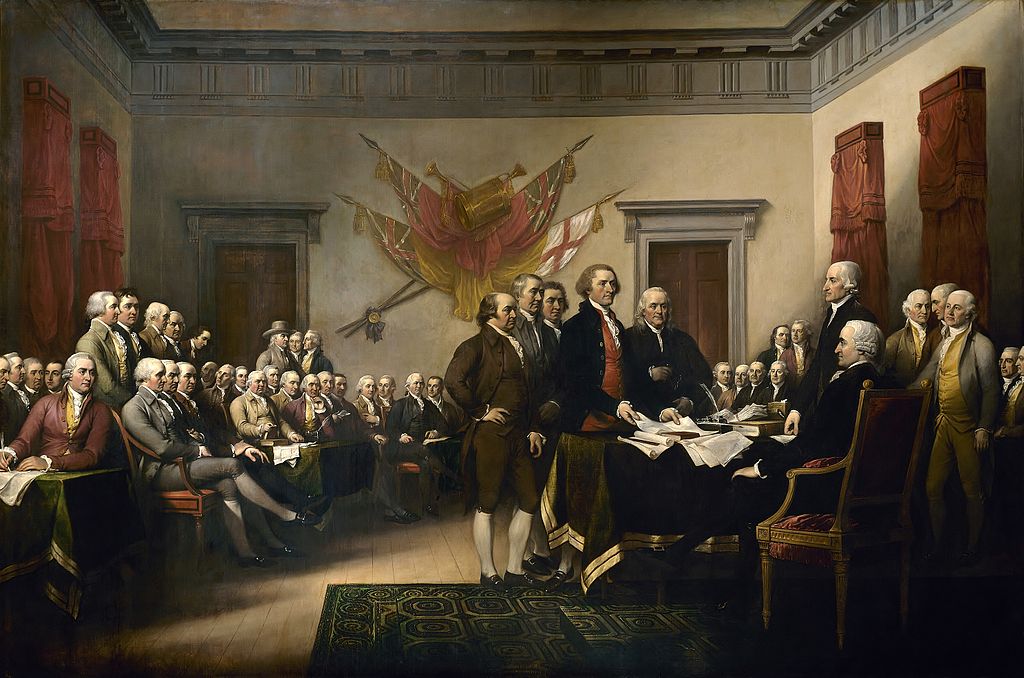
John Trumbull's famous painting is often identified as a depiction of the signing of the Declaration, but it actually shows the drafting committee presenting its work to the Congress

The Declaration of Independence refers to Native Americans as "the merciless Indian Savages".

One of the 26 known copies of the United States’ Declaration of Independence was purchased for $2.48. The man purchased an ugly painting for the frame at an Adamstown, Pennsylvania flea market in 1989 and found the declaration behind the painting. He sold it at auction for $2.42 million on June 4, 1991. It was later sold in 2000 for $8.14 million.

The British Parliament still has a copy of the original American Declaration of Independence in its archives.

The house where Thomas Jefferson wrote the Declaration of Independence was replaced with a hamburger stand.

Sunday, 14 September 2014

Dead Sea Scrolls

 In 1947 the first of the Dead Sea Scrolls were discovered by an Arab shepherd boy in a cave on the shore of the Dead Sea where they had been hidden in around 68 AD by a Jewish monastic community.

Over the following nine years a search of the surrounding caves led to a total of around 850 documents being found.

There was a copper scroll found among the Dead Sea Scrolls in 1952 that is not a literary work like the others. Instead it lists the locations of valuable treasures such as silver and gold that have been buried or hidden.

The Dead Sea Scrolls are a group of ancient scrolls and fragments of all of the Old Testament books except the Books of Esther and Nehemiah plus other historical texts and they date from around 150 BC to 68 AD, a thousand years older than the earliest Hebrew manuscript of the Old Testament (AD 895).

A portion of the second discovered copy of the Isaiah scroll, 1QIsab.

Four of the Dead Sea Scrolls were offered up for sale in an advertisement in the 1 June 1954, Wall Street Journal. They were purchased by Israelis Professor Mazar and the son of Professor Sukenik, Yigael Yadin, for $250,000 on February 13, 1955 and brought to Jerusalem.

The Dead Sea Scrolls were made available to the public for the first time on September 22, 1991 by the Huntington Library.

The scrolls reveal how accurately the scribes carried out the copying of earlier Hebrew texts. It is interesting to note, for instance, that the 14 copies of the Book of Isaiah have produced only six minor changes to the text as previously known. 

Wednesday, 5 September 2012

Bill of Rights

Following the often bitter 1787–88 debate over the ratification of the American Constitution, Representative James Madison crafted a series of corrective proposals. Congress approved twelve articles of amendment on September 25, 1789, and submitted them to the states for ratification. Articles Three through Twelve were ratified as additions to the Constitution, and became Amendments One through Ten of the Constitution.  These first ten amendments to the United States Constitution, collectively known as the Bill of Rights, were ratified on December 15, 1791. 

Below is the first page of an original copy of the twelve proposed articles of amendment, as passed by Congress.


The Bill of Rights guarantees individual liberties such as freedom of speech, religion, and the press.

It also protects the rights of citizens to bear arms, receive due process of law, and to be protected from unreasonable searches and seizures.

The ratification of the Bill of Rights  is significant to church history because of its first Amendment: "Congress shall make no law respecting an establishment of religion, or prohibiting the free exercise thereof." This amendment was the result of long centuries of efforts by religious groups such as the Quakers and Baptists to obtain religious liberty. 

George Washington had a copy of the Bill of Rights created for each state. North Carolina's copy was stolen in 1865 by a Union soldier. It was recovered in 2003 by a FBI sting operation.

In 1941, President Franklin D. Roosevelt declared December 15 to be Bill of Rights Day, commemorating the 150th anniversary of the ratification of the Bill of Rights. 


There are several original engrossed copies of the Bill of Rights still in existence. One of these is on permanent public display at the National Archives in Washington, D.C.

Sunday, 21 August 2011

American Constitution

The leaders of the United States assembled in 1787 to write the constitution. Benjamin Franklin, who was the governor of Pennsylvania, called on the group to offer regular, daily prayer to ask for God’s assistance and blessings in their deliberations.

Page one of the original copy of the Constitution

The delegates that attended the American Constitutional Convention were not afraid to enjoy themselves after a day discussing the future of their country. One bill for a party for 55 people on September 15, 1787, two days before signing the Constitution itemized 60 bottles of claret, 54 bottles of Madeira, 8 bottles of whiskey, 22 bottles of cider, 12 bottles of beer, and 7 bowls of alcoholic punch.

The American Constitution has 4,543 words and takes a half hour to read, making it longer than the Declaration of Independence, which takes ten minutes to read.


The Constitution was signed by 39 delegates, but there were 55 delegates at the Constitution Convention with the goal "to form a more perfect union."

The Constitution does not use the word "democracy."

Signing the Constitution, September 17, 1787

Rhode Island boycotted the Constitutional Convention because it did not trust the idea of a powerful federal government.

In one of Thomas Jefferson's letters to James Madison in 1789 he stated that the Constitution and laws should expire after 19 years. This was to allow the new generations to learn from the past and change accordingly, it was also to prevent older generations from "binding" subsequent ones.

The Constitution may have been signed in 1787, but it was not until 1788 that it was ratified by the required number of states, as nine states were required.

The first ten amendments to the United States Constitution, collectively known as the Bill of Rights, were ratified on December 15, 1791.

The Bill of Rights,

The United States Constitution is the oldest written constitution in the world still in operation.

Every night, the American Constitution is lowered into a safe that is bomb proof.