A zip, also known as a zipper or zip fastener is a device for binding the edges of an opening of fabric or other flexible material. It is used mostly to hold clothes together. The zip can also be used for fastening luggage, bags, sporting goods and camping gear (e.g. tents and sleeping bags).
HISTORY
Elias Howe, the inventor of the sewing machine, also received a patent for an "Automatic, Continuous Clothing Closure" on April 29, 1851. This invention was an early version of what we now know as the zipper and was designed to be used as a fastening device on clothing and other textile products. However, despite receiving the patent, Howe never attempted to market his invention and the idea of the zipper was later developed by other inventors.
The zip fastener was invented by a Chicago engineer named Whitcomb L. Judson. He patented his device on August 29, 1893 and exhibited it at the 1893 World's Columbian Exposition in his home city. Whitcomb's fastener, which he called a "Clasp Locker or Unlocker for Shoes" was based on a string of hook-and-eye fasteners.
Judson's original 'clasp locker' patent, 1893
The design for the modern zip, the Talon Slide Fastener, was invented in 1913 by Swedish engineer Gideon Sundback, who was living in Meadville, Pennsylvania, Sundback substituted two parallel strings of metal teeth in place of Judson's hooks and eyes and called it the Hookless #2. Sundback received a patent for his zip, which he called a "Separable fastener" on March 20, 1917.
Sundback's invention was assured success when the US Navy bought 10,000 zips for use on new flying suits in World War I.
Sandback's 1917 patent
In the late 1920s and early 1930s slide fasteners started appearing on clothing for both men and women. The first dresses incorporating the zipper appeared in the 1930s.
ETYMOLOGY
The word zip originally referred to the sharp sound of a fast-moving object such as a mosquito (first recorded in 1875) or a bullet (1885).
The word 'zipper' was introduced by Goodrich's 1925 rubber galoshes called "Zipper Boots". The abbreviation zip was also first recorded in 1925.
The term zip-fastener was first seen in 1927 in the Daily Express.
The first use of the verb 'to zip' in the sense of doing up a zip, was in Aldous Huxley's 1932 novelBrave New World .
Zipper slider brings together the two sides By DemonDeLuxe (Dominique Toussaint)
FUN ZIP FACTS
Worldwide, the zip industry is estimated to be worth almost £10 billion a year
Although the zipper market in the 1960s was dominated by Optilon (Germany) and Talon Zipper (USA) and, Japanese manufacturer YKK grew to become the industry giant by the 1980s. By then, YKK was holding 45 percent of world market share, followed by Optilon (8 percent) and Talon Zipper (7 percent).
The "YKK" on your zippers stands for "Yoshida Kōgyō Kabushiki Kaisha," which is Japanese for "Yoshida Manufacturing Shareholding Company."
YKK, makes everything they use in their production processes, in-house. From the machines they use to make their zippers, to smelting their own brass - they even make the boxes they ship their zippers in.
Today, the chances are, the zip that keeps your valuables in place started life in a factory in Qiaotou, a dusty town in Zhejiang Province, China. According to a report in The Guardian in 2005, Qiaotou's zip plants manufacture 80 per cent of the world's zips, churning out 124,000 miles of zip each year (enough to stretch five times round the globe or halfway to the moon).
A Q-Tip dipped in shampoo and rubbed into the area where a zipper is caught on a jacket can get it unstuck.
Wool is the natural fibrous covering of the sheep, and also of the llama, angora goat, and other animals. The domestic sheep provides the great bulk of the fibres used in commerce.
Pixiebay
HISTORY
Human beings had been keeping sheep for 7,000 years before it occurred to anyone to use their wool.
One of the laws given to Moses and the Hebrews by God was that clothes of wool and linen must not be mixed. This may seem strange, but it is connected to the old fertility cult, which was widespread in the area they are conquering. The pagans believed that by mixing such things they were producing fertility. But this is just a superstition, God gives fertility and he is against superstition.
The Romans brought sheep into Spain, where long centuries of breeding produced the Merino sheep, which today produces most of the world's finest wool. The Romans also brought the craft of wool manufacture to Britain.
Women in Roman cities were encouraged to occupy their time working with wool. Their task was synonymous with being a virtuous wife and mother. In fact the Emperor Augustus was so eager to re-establish traditional Roman values that he wore woolen clothes made by his wife to encourage women to return to their looms.
The medieval English wool trade was one of the most important factors in the medieval British economy. By 1000 toll-records show German merchants buying raw wool in London.
In the mid-12th century, English wool trade was primarily with Flanders (where wool was made into cloth, primarily for sale via the Champagne fairs into the Mediterranean basin). German and Flemish merchants formed a London association (Hanse) and toured the English countryside for supplies of raw wool.
English Sheep, shown here in in 1240s or 1250s
Edward I of England's frequent military campaigns put a great financial strain on the nation. The king was granted a half-mark (6s 8d) customs duty per sack on the export of wool by the Parliament of 1275. But more money needed to be raised and an unpopular additional duty on wool, dubbed the maltolt or "bad tax" (in Norman-French) was levied between 1294-7.
"Ba, Ba Black sheep" is traditionally believed to refer to the 1275 wool tax. In the nursery rhyme, the black sheep admits to having three bags of wool which will be divided between "the master, "the dame" and "the little boy" (the little boy presumably being the taxman).
The English textile trade grew during the 15th century, to the point where export of wool was discouraged. The smuggling of wool out of the country, known as owling, was at one time punishable by the cutting off of a hand.
Half the population of Calais in the fifteenth century worked for the British wool trade. (Calais was an English possession at the time).
William Shakespeare's father, John, who was prosperous at the time of William's birth, was prosecuted for participating in the black market in wool.
In the 16th century, England invited wool craftsmen from other countries to settle there, and for a time the country became the world's leading wool-textile producer. However, the quality of English wools was in decline, perhaps partly due to a switch in focus to meat production for domestic urban markets, and European supremacy in the production of fine-wool passed to the Iberian peninsula and its Merino sheep.
One of the earliest depictions of a Merino sheep was El Buen Pastor (The Good Shepherd) by Bartolomé Esteban Murillo, ca. 1650 (see below)
A 1571 Statute in England ordered the wearing of a "cap of wool knit" to be worn by everybody over six years of age during holidays. This was to help out the ailing wool trade.
Sheep were brought to America by Spanish conquistador and explorer Francisco Vázquez de Coronado in 1540.
Early American settlers brought sheep to Jamestown in Virginia, and wove their own woolens, called homespuns.
George Washington was one of the first American scientific farmers. He improved his breed of sheep and obtained more than double the average yield of wool.
In 1797 the Merino sheep was introduced into Australia, which has become the world's largest producer of Merino wool: South Africa and South America are also large producers.
A World War I-era poster sponsored by the United States Department of Agriculture encouraged children to raise sheep to provide needed war supplies. (see below)
Since World War II blendings of wool with synthetic fibres have been developed.
FUN WOOL FACTS
In Britain there are today some 26 breeds of sheep, and the wool is classified as lustre.
Wools from crossbred sheep (usually a cross of one of the lustre class with a merino) are produced in New Zealand.
Wool absorbs and releases water vapour as humidity rises and falls, which is why it works so well as a natural insulator.
The word jersey originally meant any knitted item make from Jersey wool, especially stockings.
Peruvian alpaca wool comes in 22 natural colors, the most of any wool-producing animal.
Asbestos was originally believed to be the wool of the salamander.
The Wellington boot is a waterproof rubber boot that loosely covers the calves. They are commonly used for a range of agricultural and outdoors pursuits.
Sailing boot. By Helmardine
The Wellington boot is associated with Arthur Wellesley, the first Duke of Wellington, (the Iron Duke). In 1817, the Duke of Wellington instructed his shoemaker, Hoby of St James Street, London to modify his Hessian 18th century boots so that they fitted more closely around the leg. He also instructed that they be hard-wearing for riding, yet smart enough for informal evening wear. The result was a boot made in calfskin leather with the trim removed and cut to fit more closely around the leg. The heels were low cut and the boot stopped at mid-calf.
Wellingtons first appeared in 1817 and proved popular with the British troops because they were hard wearing for battle yet comfortable for evening wear.
The boot leather was treated with wax to make them softer and more waterproof.
The new boots became a very popular fashion accessory for British gentlemen such as the renowned dandy George "Beau" Brummell. Considered fashionable and foppish in the best circles, they remained the main fashion for men throughout the 1840's
Wellington is one of the two British Prime Ministers to have given his name to an item of clothing, the other being Sir Anthony Eden after whom the Anthony Eden hat is named.
On a sea voyage the vessel in which Wellington was in encountered a violent storm and seemed about to sink. The captain came to Wellington's cabin at dusk and said, "It will soon be all over with us." Wellington about to go to bed said, "Very well, then I shall not take off my boots."
The Duke of Wellington at Waterloo. By James Lonsdale portrayed wearing tasselled Hessian boots
In 1844 American chemist Charles Goodyear invented the modern chemical process to create and manufacture pliable, waterproof, moldable rubber, which was to be of great importance for vehicletires. Eight years later American industrialist Hiram Hutchinson met Charles Goodyear and acquired patent rights to the vulcanisation of rubber from him.
Hutchinson moved to France where he applied the new rubber vulcanisation process to the production of Wellington boots. In a country where 95% of the population were working on fields with wooden clogs, the introduction of the wholly waterproof, Wellington-type rubber boot was an instant success: farmers would be able to come back home with clean, dry feet. The name Wellington boot subsequently became associated with these waterproof rubber footwear rather than the leather boots.
In 1856, the Scotland-based North British Rubber Company (known today by the brand name Hunter Boots) began manufacturing rubber Wellington rain boots. Production of their waterproof boot was dramatically boosted with the advent of World War I and a requirement for footwear suitable for the conditions in Europe's flooded and muddy trenches. The North British Rubber Company produced a total of 1,185,036 pairs of Wellington boots to meet the British Army's demands.
Wellingtons were originally only available in one color: black. Other colors didn’t appear until 1955, the year Hunter Boots introduced green boots. In 1980, sales of their green wellies skyrocketed after Lady Diana Spencer (future Princess Diana) was pictured wearing a pair on the Balmoral estate during her courtship with Prince Charles.
In Australia and New Zealand wellies are called “gumboots” is a nod to the natural rubber that rain boots are made from. Natural rubber, which is obtained from trees, is called "gum rubber."
In North America, Wellingtons are usually called rubber boots, but sometimes galoshes, mud boots, rain boots, mucking boots, billy boots, or gum-boots.
A pair of Hunter 'Original Tall' Wellington boots.By Jan
The origin of wedding dress dates back to when Christianity spread to Europe in Roman times. The wedding ceremony was held in the church and a bride wore a wedding dress.
The veil worn by a bride originally symbolized the bride's virginity, innocence, and modesty. The veil can be traced back to ancient Roman times when it was a complete head-to-toe cover. It was later used as her burial shroud.
In ancient times, the traditional color of bridal gowns was red.
Green has long been a symbol of fertility and in the 1400s was the preferred color of choice for wedding gowns.
During the American Revolution, many brides wore red wedding gowns as a symbol of rebellion.
When Queen Victoria married her cousin Prince Albert of Saxe- Coburg and Gotha in 1840, brides of the time preferred bright colours. However, the queen surprised everyone when she wed in white lace — and began a tradition which continues to this day.
Queen Victoria re-wore her wedding veil on a number of occasions, including her funeral.
Portrait painted by Franz Xaver Winterhalter, 1847, of Victoria wearing her wedding clothes
Charlotte Brontë married her father's curate, the Reverend Arthur Nicholls in 1854. Charlotte wore a white muslin wedding dress with delicate green embroidery and a lace trimmed bonnet. It was said she looked like a "snowdrop".
Bereaved Victorian girls married in black bridal gowns.
Because Britain had not yet completely recovered from the devastation of World War II the then-Princess Elizabeth required ration coupons to buy the material for her wedding dress when she married Philip Mountbatten in 1947. The gown was designed by Norman Hartnell.
African American designer Ann Lowe made New York socialite Jacqueline Bouvier's wedding dress twice for her marriage to Massachusetts-born junior senator John F. Kennedy on September 12, 1953. A flood ruined the first ivory silk taffeta gown ten days before the date. Lowe hired extra staff to finish on time, barely avoiding bankruptcy. When asked who made the dress, Jackie said, "A colored woman."
When Lady Diana Spencer married Prince Charles in 1982 her wedding gown became one of the most famous outfits in the world. It was embellished with 10,000 pearls and a 25-foot train, which was badly crushed during the coach ride to the ceremony.
Wedding dress of Lady Diana Spencer
The world's most expensive wedding dress was a £7.4 million ($12 million) diamond-encrusted creation designed by Martin Katz Jewellers and Renee Strauss. Adorned with 150 carats worth of diamonds, it was created for a bridal show in 2006.
When Mariah Carey married Tommy Mottola in 1993, her wedding dress was an ivory-silk duchess satin gown designed by Vera Wang, with a 8.25 m train and matching satin pumps.
Twenty-three years later, Mariah Carey got engaged to Australian billionaire James Packer. The wedding dress she planned to wear was a gown by Valentino costing $250,000. Later in the year, the singer broke up her engagement and she dramatically set her gown on fire in her " I Don't" music video.
Catherine Middleton's dress from her 2011 wedding to Prince William had a price tag of £250,000 ($434,000). Sarah Burton for Alexander McQueen designed the classic gown, which had a 2.7 (8.8 ft) train and hand embroidered individual laceflowers.
Weaving is the production of textile fabric by means of a loom. The basic process is the interlacing at right angles of longitudinal threads (the warp) and crosswise threads (the weft), the latter being carried across from one side of the loom to the other by the shuttle.
Pixiebay
The basic principle of weaving has not changed since the late Stone Age, when humans first wove rushes and grasses into baskets and mats. These weavers probably placed the warp fibers on the ground and passed the weft fibers by hand between them.
Though weaving is mainly mechanised, now, hand looms are still used, for example in the manufacture of tweeds in the British Isles. They may be horizontal or vertical; industrial looms are generally vertical.
It is not known when or where spinning and weaving were first practiced but they were in use in Egypt and the Near East by the 9th millennium BC and there is evidence of silk weaving in China in the 2nd millennium.
Weaving probably began when reeds and canes were used to make baskets. Man then learned in about 7000 or 6000 BC how to obtain plant and animal fibres such as flax, cotton and wool and twist them into yarn. These wool and flax yarns were woven on a primitive loom into rectangles of cloth.
Weaving was probably part of the housewife's daily work in the homes of the European Lake Dwellers. These Stone Age people built their villages, presumably for safety, on wooden platforms over lakes and swamps. In the beds of the lakes modern searchers recovered spindle whorls and pieces of looms and of linen and woolen garments.
The woven lengths of cloth were not cut but were draped about the body. A tie fastened the cloth at the waist. This kind of draped garment was worn by the early Egyptians.
Fragments of patterned linen-weave have been found in Pharaonic tombs in Egypt, while ancient Egyptian pictures and Greek vase-paintings illustrate types of early looms which have been confirmed by archaeological finds.
Weaving in ancient Egypt
The earliest weaving was plain, to meet the need for warmth and clothing, and tapestry weaving was known in Egypt from the 2nd millennium BC.
One of first examples of weaving is featured in The Odyssey where Homer describes the shroud Odysseus' wife Penelope is forced to unravel each night to fend off unwanted suitors. He also describes Helen as working with a golden distaff, a silver wool basket on wheels, and wool of violet-blue.
Among Ancient Greeks, spinning, weaving, and decorating cloth were so much the responsibility of females that those skills became metaphors for “women's wiles.”
The Romans followed the cloth making practices of the Greeks. They did, however, abandon the old warp-weighted loom in favor of the more efficient two-barred loom.
The Romans established textile factories in the provinces, particularly in Gaul, where they had found a people already skilful at weaving.
People living in the first Millenium AD on the hot coastal strip of Peru created some of the world's most beautiful textiles. These Andean people who wove these textiles spun fine, smooth yarn of cotton or the wool of alpacas and llamas. They used most weaves known today and some too complicated for modern looms. They were expert dyers, with almost 200 hues at their command.
With their many-colored yarns the Andean civilizations worked out gay, elaborate designs. They wove cloth ingeniously into the shapes of garments and other articles, for they did not cut and sew.
Example of weaving characteristic of Andean civilizations By Adam Jones
King Edward III of England held a parliament at Rochester in 1337 at which an Act was passed encouraging Flemish weavers to come and settle in England under royal protection, bringing their superior cloth-making skills with them.
Weaving developed little until the flying shuttle was invented by John Kay in 1733, followed later in the 19th century by English clergyman Edmund Cartwright's power loom.
Of great importance in the handloom era was the Jacquard loom, which was used to make patterns in clothing material. The loom was invented by French technologist Joseph Marie Jacquard (1752-1834) in 1801 and simplified the process of making textiles with complex patterns. Jacquard went on to perfect his invention by using punched cards to control cams that directed pattern weaving. By the 1830s many were in use.
Close-up of the 8 × 26 hole punched cards on a Jaquard loom
Underwater basket weaving has been used as a pejorative term for excessively easy/useless/niche courses for at least since the early 1960s.
A waistcoat is a sleeveless upper-body garment. In Western countries it is often worn over a shirt and necktie, and below a jacket as a part of most men's formal wear. It is the third piece of the three-piece male suit.
In America the garment is often referred to as a vest. To some, a vest is considered an informal garment and a waistcoat a more formal garment to be worn with a tie.
Charlemagne, the first Holy Roman Emperor, wore a waistcoat during the winter made from otterskin which covered shoulders and chest.
The word "waistcoat" derives from the cutting of the coat at waist-level, since at the time of the coining, tailors cut men's formal coats well below the waist. It dates back to 1519.
Waistcoats were first introduced to England by Sir Robert Shirley (1581-1628), who had seen them worn at the Persian court of Shah Abbas.
King Charles I was recorded to have worn a waistcoat at his execution.
Waistcoats first became fashionable in England after being worn by King Charles II in the 1660s. His brightly coloured silk waistcoats popularised were inspired by exotic Turkish, Indian and Persian attire acquired by wealthy English travellers.
Samuel Pepys recorded in his diary on October 8, 1666 that King Charles II had started wearing a highly patterned waistcoat. Underneath his waistcoat he wore a Persian coat and lace cravats. The diarist and civil servant wrote: "The King hath yesterday in Council declared his resolution of setting a fashion for clothes, which he will never alter. It will be a vest, I know not well how." He went on: "It is to teach the nobility thrift, and will do good."
Man's sleeved waistcoat of silk woven to shape, 1747. By Anna Maria Garthwaite
The waistcoat of Toussaint Louverture (1743-1803), the leader of the Haitian revolution, had 18 buttons that were decorated with reproductions of Agostino Brunias's paintings.
Queen Victoria's husband Prince Albert originated a fashion for wearing a watch chain across a waistcoat from one pocket hole to the other.
Edward VII of the United Kingdom popularized the habit of leaving a waistcoat’s bottom button undone. Apparently, he grew so rotund that he was unable to fasten the bottom button of his waistcoat and jacket. To not offend the king, those associated with him started doing the same.
According to the sartorial rules of British Dressage, "A fitted waistcoat may be worn when permission has been granted not to wear coats."
Velcro is the trademark name for hook-and-loop fasteners, a nylon pile fabric that fastens to itself. They are typically tiny loops on strip of wooly fabric snag onto tiny hooks of an opposing strip of same material.
Velcro is often used in place of zippers, buttons, shoelaces and other fasteners, especially on children's clothing, athletic footwear, ski jackets, belts and in medical support devices.
In 1941 Swiss electrical engineer George de Mestral (June 19, 1907 – February 8, 1990) went on a hunting trip with his dog in the Alps. On returning home, he got annoyed at the struggle to remove the burdock burrs which had got attached to his socks, jacket and his dog's fur. His inventor's curiosity led him to study these hard-to-remove burrs under a microscope, in order to discover the secret of their stickiness. De Mestral discovered their natural hook-like shape and saw the possibility of binding two materials reversibly in a simple fashion if he could figure out how to duplicate the hooks and loops.
Burdock
It took de Mestral a decade to replicate the fastening phenomenon synthetically in order to create a mechanized process that worked. Eventually he came up with a new two-sided fastener: using nylon; One side with stiff "hooks" like the burrs and the other side with the soft "loops" like the fabric of his pants.
De Mestral submitted his idea for a patent for his hook-and-loop fasteners in Switzerland in 1951, which was granted in 1955 and then obtained patents in many other countries. In 1957 he branched out to the textile centre of Manchester, New Hampshire.
De Mestral trademarked his invention Velcro from the first syllables of the French words 'velours' (the French for loops, in clothing) and 'crochets' (hooks, on the burs).
A Montrealcompany, Velek, Ltd., acquired the exclusive right to market the product in North and South America, with American Velcro, Inc. of New Hampshire, and Velcro Sales of New York, marketing the "zipperless zipper" in the United States.
The Velcro fastener system was not an instant hit when it came to market in the early ‘60s. Then NASA started to look for a way to keep objects attached to walls while floating in orbit, and discovered Velcro was ideal. From then on the fashion industry went wild due to it now being space aged.
Underwear are clothes worn under others, often next to the skin. They keep outer clothes from being made dirty by sweat.
Pixiebay
HISTORY
In ancient Rome, both men and women were known to wear simply wrapped loin-cloths, made from wool, linen or a blend of both, under their outer garments. Only the upper classes would have been able to afford imported silk.
In addition, some women wore a breast band called a strophium or mamillare, made from linen or leather.
In the Middle Ages, the loincloth was replaced in the case of men by loose, trouser-like clothing called braies. Varying in length from upper-thigh to below the knee, the wearer stepped into and then laced or tied around the waist and legs. Braies were usually made of linen, most likely in its natural off-white color, but they could also be sewn from finely woven wool, especially in colder climes.
Braies were not only used as underwear, they were frequently worn by laborers with little else when doing hot work.
Medieval braies
Women wore a a loose-fitting, sleeveless undergarment called a chemise underneath their gowns or robes, sometimes with petticoats over the chemise. Elaborately quilted petticoats were sometimes displayed by a cut-away dress, in which case they served a skirt rather than an undergarment.
Early Spanish missionaries in Texas hoped to encourage the spread of European values by offering flannel underwear to Native Americans.
Until the mid-19th century many men didn't wear drawers. They simply wrapped their long shirt-tails under them like a nappy and tucked them in.
The 19th century Hungarian pianist Franz Liszt's performances were renowned for being theatrical. They were so showy, they induced hysterical women into throwing their underwear at him.
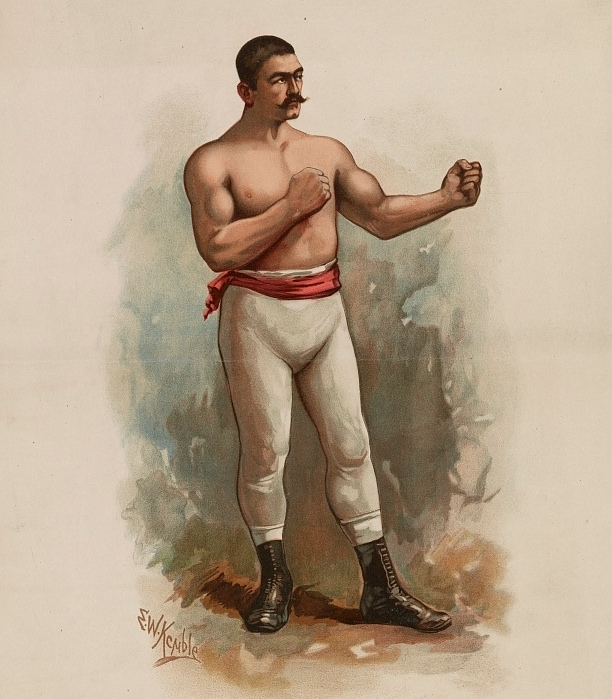
Long johns was a two-piece garment consisting of a long-sleeved top and long pants. They were named after American boxer John L. Sullivan who wore a similar garment in the ring during his prime in the 1880s.
John L. Sullivan
In the 1880s German Dr Gustav Jaeger popularized a combined long johns and vest all in one with buttons up the front and a back opening flap.
In Victorian England, "Pants" was considered a dirty word.
Working class women only begun to wear panties in the 1880s. Before then they had relied on layers of petticoats to keep warm.
The T-shirt was invented in 1904 Wisconsin-based Cooper Underwear Company in 1904 as a 'bachelor undershirt'.
Long johns with button crotches were the usual undergarment for men until the American Cooper Underwear Company, a family business based in Kenosha, near Chicago, caused a revolution in 1911. Their undergarment design called the Kenosha Klosed-Krotch featured overlapping fabric flaps designed to keep the crotch closed.
The first underwear print advertisement in the US appeared in The Saturday Evening Post in 1911.
The Cooper Underwear Co hired Joseph C. Leyendecker, illustrator for The Saturday Evening Post, to create the "Man on the Bag" image to market their "Kenosha Klosed Krotch".
A 19-year-old New York socialite named Mary Phelps Jacob created the first modern bra by tying two silk handkerchiefs together with some pink ribbon. She was granted a patent for the "Backless Brassiere" in November 1914.
Jacob's brassiere, from the original patent application.
When Clark Gable removed his shirt in the 1934 movie It Happened One Night revealing bare skin beneath rather than an undergarment - sales of vests reportedly showed a significant drop.
On January 19, 1935, during a blizzard, Coopers Inc. sold the world's first jockey briefs at the Marshall Field's State Street store in downtown Chicago. Designed by an apparel engineer named Arthur Kneibler, the briefs dispensed with leg sections. The day of its debut, Chicago's popular Marshall Field & Company sold out its stock of 600 packages by noon and sold 12,000 more in the following weeks.
Briefs with a Y-shaped overlapping fly were introduced later in 1935. The Jockey Y-Front brief became Cooper's most sought after item.
Boxer shorts are a type of undergarment typically worn by men. The term has been used in English since the mid-1940s for all-around-elastic shorts, so named after the shorts worn by boxers, for whom unhindered leg movement ("footwork") is very important.
Since the 1940s, the battle of boxer shorts vs briefs has swayed back and forth in western countries.
Calvin Klein was the first designer to make women’s underwear resembling men’s jockey shorts.
Underwear bomber Umar Farouk Abdulmutallab tried to bring down Northwest Airlines Flight 253 from Amsterdam to Detroit on Christmas Day in 2009. The bomber's al-Qaeda-backed plot failed because he wore the same underwear for two weeks straight and as a result the bomb's fuse became "damp".
FUN UNDERWEAR FACTS
Mormons wear special underwear called temple garments under their clothes as a source of protection from the evils of the world.
Sikh men believe that they should wear the panj kakaar (five articles of faith) at all times. One of the articles is a type of underpants called the kaccha, which are similar to boxer shorts.
Architect Gary Craig of Whitburn in South Tyneside, in North East England put on a record-breaking 211 pairs of underpants, one over the other, in 2010. Beginning with a 40 in pair (Large) and finishing with a 60 in pair (4XL), it took him 25 minutes to get them on. Two years later, his record was beaten when American Janine Keblish overtook him after pulling on 252 pairs of underwear. Later in 2012, the self- styled Geordie Pantsman managed a new record when he wore 302 pairs of underpants.
The average American woman owns approximately 21 pairs of underwear.
Trousers are a kind of clothing that are worn on the lower part of the body to cover both legs (instead of cloth stretching across both as in skirts and dresses). They are known as pants in Canada, South Africa and the United States.
Trousers are thought to have originated as a comfortable garment to wear when horse-riding. Asiatic riders realized that when they were clad in leggings, their movement was much less impeded than when they were wrapped in their traditional flowing garment.
A 3,300-year-old discovery in China was announced in June 2014 as the world's oldest trousers. They were found at the Yanghai cemetery in Turpan, Xinjiang, western China. Made of wool, the trousers had straight legs and wide crotches, and were likely made for horseback riding.
The Greek philosopher and mathematician Pythagoras was one of his first countrymen to start wearing trousers instead of the usual skirt. However, most of the ancient Greeks didn't wear trousers because they found them "ridiculous". using the word "thulakoi", ("sack"), as a slang term for the loose trousers of Persians and other Middle Easterners.
The Romans didn't wear trousers because it was seen as uncivilized and only Barbarians wore pants.
Germanic trousers of the 4th century found in the Thorsberg moor, Germany. By PBullenwächter
Instead of trousers, medieval men often wore long hosen or stockings, on their legs. In the British Isles, where Celts and Saxons had long worn pants called braies or braccae, these hosen were first popularized by the Norman invaders of 1066.
Hosen were typically made of wool, although some examples appear to have been made of linen (these may have been more popular in warmer climates, like Italy).
Shakespeare's only reference to trousers is when he talks about "strait strossers" in Henry V.
The word 'trousers' was first recorded in English in 1625. Slightly earlier, the terms 'trouse', 'trews' or 'strossers' were occasionally seen.
Pants and trousers are called pairs because they used to be separate. As early as the 16th century, you'd feed one leg in, tie the top around your waist and do the same with the other leg. The name stayed even when they started being made as a single item.
During the French Revolution, rebels in Paris identified themselves by wearing trousers instead of the knee-length ‘ culottes' of the bourgeoisie. Women rebels demanded the right to wear trousers as well, but were forbidden from doing so. France finally revoked the 214-year-old ban on Parisian women wearing trousers in 2013.
Early use of trousers in France: a sans-culotte by Louis-Léopold Boilly
In England, loose-fitting breeches were worn in preference to trousers until the 1810s after London resident George Bryan "Beau" Brummell began promoting the wearing of tailored trousers.
The fashion for longer trousers was not welcomed by all. In 1812, two Cambridge University colleges ordered that students appearing in pantaloons or trousers should be considered as absent, while the clergy of Sheffield were warned that any preacher who wore trousers would not be allowed to occupy a pulpit.
Levi Strauss received US patent No. 139,121 for an "Improvement in Fastening Pocket-Openings" in 1873. Levi Strauss & Co. began manufacturing the first of the famous Levi's brand of jeans in San Francisco.
In Victorian Britain, trousers were known as ‘inexpressibles' or ‘nether integuments'.
The French novelist George Sand (1804-1876) was notorious for wearing trousers. Her refusal to act like a "real woman" made her popular among the artists and intelligentsia of her time and helped ignite the woman's revolution.
The first woman to be recorded wearing trousers as an article of fashion in a photograph was French actressSarah Bernhardt in 1876.
During the 1920s and 1930s there was a widespread adoption of trousers by women. The bloomers of the preceding century evolved into lounging pajamas between the two World Wars. From the 1930s, slacks were worn for many leisure activities.
Joan Crawford
Pat Nixon was the first First Lady to wear pants in public.
Women were not allowed to wear trousers on the US Senate floor until 1993 when two senators defied the ban. Later that year the rule was amended to allow women to wear trousers.
According to a survey in 2010, men wear trouser waists at their highest points, just seven inches below the armpit, at the age of 57.
Sources Europress Encyclopedia, Comptons Encyclopedia, Daily Express, Daily Mail