Search This Blog

Showing posts with label Explorer. Show all posts

Monday, 23 April 2018

Henry Morton Stanley

EARLY LIFE

Henry Morton Stanley was born January 28, 1841 as John Rowlands in Denbigh, Denbighshire, Wales.

Stanley in 1872

John was the illegitimate and unloved son of a promiscuous housemaid and John Rowlands senior, an indulgent alcoholic.

His mother Elizabeth Parry was 18 years old at the time of his birth.

John never knew his father, who died within a few weeks of his birth.

As a toddler, John was shuttled between various relatives, before being eventually sent to the St. Asaph Union Workhouse for the Poor at the age of 5.

John spent a miserable childhood in the workhouse, then at the age of 18 he took a job as a cabin boy on a sailing ship bound for New Orleans.

EARLY CAREER

After arriving at New Orleans, Rowlands asked a wealthy trader called Henry Stanley — who had in fact long wished he had a son — "do you need a boy?", meaning hired help. Rowlands was adopted by Stanley and out of admiration, he took the trader's name.

Stanley enlisted in the Confederate Army at the outset of the American Civil War, enrolling in the Confederate States Army's 6th Arkansas Infantry Regiment.

Stanley fought in the 1862 Battle of Shiloh and was captured. He was a prisoner of war until he decided to switch sides to the Union Army in exchange for his release.

Stanley was discharged from the Union army 18 days later because of severe illness.

After recovering, Stanley served on several merchant ships before joining the US Navy in July 1864. He became a record keeper on board the USS Minnesota, which led him into freelance journalism.

Stanley and a junior colleague jumped ship on February 10, 1865 in Portsmouth, New Hampshire, and set out to tour the world. They got as far as Turkey where robbed, beaten, broke they had to rely on the generosity of the American consul for their passage home.

After the Civil War, Stanley turned to journalism first with the Missouri Democrat then the St Louis Weekly.

In 1867 Stanley was taken on by James Gordon Bennett Jr. the owner of the New York Herald as their special correspondent for the Abyssinian War.

SEARCH FOR DAVID LIVINGSTONE

In 1869 Stanley received instructions from The New York Herald to undertake a roving commission in the Middle East, which was to include the relief of Dr. David Livingstone, of whom little had been heard since his departure for Africa in 1866 to search for the source of the Nile.

1872 Carte de visite – Stanley and Kalulu.

According to Stanley's no doubt romanticized account, he asked James Gordon Bennett, Jr, how much he could spend. The reply was "Draw £1,000 now, and when you have gone through that, draw another £1,000, and when that is spent, draw another £1,000, and when you have finished that, draw another £1,000, and so on — BUT FIND LIVINGSTONE!"

Stanley traveled to Zanzibar and outfitted an expedition with the best of everything, including 111 porters.

As he hacked his way across the African continent, Stanley spent six months pondering how he ought to greet the object of his quest.

He located Livingstone on November 10, 1871, in Ujiji near Lake Tanganyika in present-day Tanzania.

On meeting Livingstone Stanley said "Dr Livingstone, I presume". ("Hello" wasn't in use at the time).


Stanley was given a sextant by Livingstone for finding him, while Queen Victoria rewarded him with a gold snuff box.
LATER CAREER

In 1874, the New York Herald and Britain's Daily Telegraph financed Stanley on another expedition to Africa. His objective was nothing less than to complete the exploration and mapping of the central African lakes and rivers, in the process circumnavigating Lakes Victoria and Tanganyika and locating the source of the Nile.

When Stanley visited King Mutesa I of Buganda he found Islam had preceded him. He wrote a letter to the Daily Telegraph appealing for Christian missionaries. Seven months later volunteers arrived at Zanzibar sent by the Church Mission Society. This led to the eventual establishment of a British protectorate in Uganda.

During Stanley's 999 day journey from East to West Africa between 1874-77, he explored Lake Tanganyika and traced the course of the River Congo to the sea, thus opening up the heart of Africa for the first time. He also established conclusively the source of the Nile, circumnavigated Lake Victoria for the first time and mapped the course of the Lualaba River.

Only half of Stanley's party survived the daunting dangerous trans-Africa trek.

Between 1879-84, Stanley worked for King Leopold II of Belgium as his agent with the aim of establishing the Congo Free State. He succeeded in opening up the Congo river for sea traffic by bludgeoning his way up the river and building roads through the jungle.

Stanley was called by the Africans "Sula Maturi" (The smasher of the rocks).

Henry M. Stanley in 1884

Stanley built 22 garrisoned stations along the Congo, established a fleet of steamboats and put in place a political and commercial infrastructure to allow the new nation of Congo to function.

In 1886, Stanley headed an expeditionary force to relief the besieged Emin Pasha, the governor of Equatoria in the southern Sudan. To relief Emin Pasta he had to cross Africa again, this time west to east, Congo to Ethiopia.

Stanley succeeded in relieving Emin Pasha and safely escorted him to Zanzibar. However, there was controversy when Stanley's relief column, a group of English officers, were left behind at the Congo to die, whilst Stanley forged on through the Ituri forest. His incident tarnished his reputation.

The deaths, dementia and paranoia of the unfortunate rear column left behind in the Congo inspired Joseph Conrad to write Heart of Darkness.

On return from Africa, Stanley entered Parliament as a Liberal Unionist member for Lambeth North, serving from 1895 to 1900.

Henry Morton Stanley 1890

He lived in considerable comfort after his return from Africa and became Sir Henry Morton Stanley when he was made a Knight Grand Cross of the Order of the Bath in the 1899 Birthday Honors, in recognition of his service to the British Empire in Africa.

Stanley retired in 1900 on account of his failing health.

WRITING

On his return from finding Livingstone, Stanley cashed in by publishing How I Discovered Livingstone in 1873.

Following his return from his second African expedition, Stanley published in 1878 Through the Dark Continent thus introducing the custom of referring to Africa as the “dark continent”.

In 1890, he published In Darkest Africa or the Quest Rescue and Retreat of Emin, Governor of Equatoria.

Stanley secretly became an American citizen in 1885 to protect his royalties for his books but in 1892 reassumed his British citizenship.


APPEARANCE AND CHARACTER

Stanley was 5ft 5ins. According to Queen Victoria he was, "a determined ugly little man-with a strong American twang."

Pugnacious, intelligent and determined, Stanley had a vain glorious and corrupt nature. Manically diligent, he was prone to violent rages.

RELATIONSHIPS

After his return from Africa, Stanley married the Welsh neoclassicist artist, Dorothy Tennant (March 22, 1855 – October 5, 1926) at Westminster Abbey in 1890. They adopted a child named Denzil.

Portrait of Lady Dorothy Stanley, by George Frederick Watts

Dorothy Tennant edited her husband's autobiography, reportedly removing any references to other women in Stanley's life.

After Stanley's death, Dorothy married, in 1907, Henry Jones Curtis, a pathologist, surgeon and writer.

DEATH 

Stanley died of pleurisy at his Richmond, London terrace home on May 10, 1904.

His grave, in the graveyard of St. Michael's Church in Pirbright, Surrey, is marked by a large piece of granite.


Source Independent magazine 1991

Wednesday, 15 November 2017

Robert Falcon Scott

EARLY LIFE 

Robert Falcon Scott was born on June 6, 1868, in Stoke Damerel, near Devonport, Plymouth, Devon.

Robert was the third of six children and elder son of John Edward, a brewer and magistrate, and Hannah (née Cuming) Scott.

Scott pictured by Daniel A. Wehrschmidt, 1905

In accordance with the family's tradition, Robert and his younger brother Archie were educated from a young age for careers in the armed services. Robert spent four years at a local day school before being sent to Stubbington House School in Hampshire, a cramming establishment that prepared candidates for the entrance examinations to the naval training ship HMS Britannia at Dartmouth.

EARLY CAREER 

Having passed his entrance examinations to the naval training ship HMS Britannia, Scott began his naval career in 1881, as a 13-year-old cadet.

In July 1883, Scott passed out of Britannia as a midshipman.Within three months, he was en route to South Africa to join HMS Boadicea, the flagship of the English Channel fleet at that time. After numerous postings around Britain and North America, Scott rose to become a lieutenant in 1891, specializing in torpedoes.

Scott as a young man

DISCOVERY EXPEDITION 

The British National Antarctic Expedition, 1901–04, generally known as the Discovery Expedition, was the first official British exploration of the Antarctic regions since James Clark Ross's voyages between 1839-1843. Scott was appointed leader of the expedition, and was promoted to the rank of commander before Discovery sailed for the Antarctic on August 6, 1901.

Ernest Shackleton, Scott, and Edward Wilson before their march south 

The food supplied to the ship was so bad that Scott and the crew were forced to eat seal (similar to beefsteak) and penguin (which has the flavour of jugged hare).

Robert Scott and his men were the first people penetrate the interior of Antarctica. Discovery returned to Britain in September 1904. The expedition caught the public imagination, and Scott became a popular hero.

Scott brought home a white samoyede dog, which had become the ship's pet and a white parrot picked up on voyage.

Scott was promoted to rank of captain in the navy after his successful trip to the Antarctic.

The ship he used for this trip The Discovery, is now at Victoria Embankment.

APPEARANCE AND CHARACTER 

Scott had a strong and determined face, clean shaven, tight firm lips, light blue eyes.

Robert Falcon Scott in full regalia

He had a placid and unconcerned demeanor but beneath it all he was a man of enormous enthusiasm.

PERSONAL LIFE 

Kathleen Bruce (1878-1947) was a young sculptor when she met Captain Scott on his return from his first Antarctic expedition. Kathleen had studied sculpture with Rodin, and socialized with the likes of Isadora Duncan and Pablo Picasso. They had little in common , but Scott was smitten. He wooed Kathleen, and they married at the Chapel of Hampton Court Palace on September 2, 1908.

.F.Scott & Kathleen Scott. Wikipedia

Scott's son, Peter (b 1909) became a famous conservationist and 1936 Olympic Bronze winner for yachting.

Scott and Kathleen lived at 174 Buckingham Palace Road, London where their son Peter was born, also at 56 Oakley Street, Chelsea.

TERRA NOVA EXPEDITION

In December 1909, Scott was released from the navy on half-pay, to take up the full-time command of the British Antarctic Expedition 1910, known as the Terra Nova Expedition from its ship, an old converted whaler. Scott stated that its main objective was "to reach the South Pole, and to secure for the British Empire the honor of this achievement".

On June 15, 1910, the Terra Nova set sail from Cardiff, south Wales. Scott meanwhile was fundraising in Britain and joined the ship later in South Africa.

Arriving in Melbourne, Australia in October 1910, Scott received a telegram from the Norwegian Roald Amundsen stating: "Beg leave to inform you Fram proceeding Antarctic Amundsen", indicating that faced a race to the pole."


Robert Scott took several footballs to the South Pole and a selection of board games.

The march south began on November 1, 1911 and the final dash to the Pole was made by a party of five, led by Scott.

They reached the South Pole on January 17, 1912, only to find a letter for him written by Roald Amundsen to deliver to King Haakon VII of Norway should the Norwegian expedition perish on their return journey. Amundsen and his men had beaten them by 33 days. Scott made his disappointment clear in his diary: "The worst has happened"; "All the day dreams must go"; "Great God! This is an awful place".

Scott and his men at the South Pole

Scott's insistence on first using Siberian ponies and then man-hauling his goods to the Pole, instead of making full use of sled dogs was the single most obvious difference between the two expeditions. Scott did use dogs, but only as far as the Beardmore Glacier, whereas Amundsen, a more experienced dog-driver, took them all the way to the Pole. Scott's diary made it clear that he believed the heavy manual labor of sledge-hauling was morally superior to the use of dogs, and this prejudiced him towards the more inefficient method.

Scott, writing his journal in the Cape Evans hut, winter 1911

The deflated party began the 800-mile (1,300 km) return journey on January 19, 1912. On the return journey, Scott and his four comrades died from exhaustion, starvation and extreme cold.

Captain Oates was in charge of the ponies and had frostbitten toes. He could no longer play his part in man-hauling the sledges and on March 16, 1912, he staggered into the blizzard uttering his famous remark about "going outside and being sometime." He sacrificed his life rather than slowing down his companions. Scott wrote in his diary "We all hope to meet the end with a similar spirit and assuredly the end is not far."

Captain Lawrence Oates during the British Antarctic Expedition of 1911-1913

With the nearest base only miles away Scott pitched his last tents on March 19, 1912. During the next nine days, as their supplies ran out, and with blizzards still raging outside the tent, Scott and his companions wrote their farewell letters.

His last diary entry read "It seems a pity, but I do not think I can write any more." Scott is presumed to have died on March 29, 1912.

The bodies of Scott and two companions were found in a tent by a search party on November 12, 1912.

While Amundsen set out only to reach the Pole and get back alive, Scott's entire expedition was primarily scientific. Even as they were dying, Scott and Wilson stopped to pick up geological samples, of which they were hauling over 30lb. when they passed away. Although the dual motivation necessarily compromised the already wafer-thin safety margins of the trek, the science was important.

Among the samples found with Scott was a lump of coal from the Trans-Antarctic mountain range, which proved that the continent must have had a warm climate in the distant past. This discovery was of major geological importance and added to the weight of evidence which eventually resulted in the modern theory of plate tectonics. The dying men also kept meteorological records until near the end.

Scott's diary became a best-seller and helped make him a hero.


A tin of Frank Cooper's Oxford marmalade taken by Scott on his 1911 Antarctic exhibition was found in his tent in 1960. It was still edible.

Tuesday, 27 June 2017

Walter Raleigh

EARLY LIFE

Little is known about Sir Walter Raleigh's birth. The date favored by the majority of historians is January 22, 1552.

He was born at a thatched house (now a farmhouse) near the village of East Budleigh, not far from Budleigh Salterton in Devon.

Walter was the youngest of five sons born to Catherine Champernowne in two successive marriages. Catherine Champernowne was a niece of Kat Ashley, Queen Elizabeth I's governess, who introduced the young men at court.


John Everett Millais, The Boyhood of Raleigh (1871)

One of his half brother's was Sir Humphrey Gilbert who founded the colony of Newfoundland.

CAREER

In 1569, Raleigh left for France to serve with the Huguenots in the French religious civil wars

Raleigh registered as an undergraduate at Oriel College, Oxford in 1572, but he left a year later without a degree.

Raleigh returned to London and proceeded to finish his education  at England's law school, the Inns of Court. Many English gentlemen spent a year or two there, especially if they expected to own landed estates in the future, because lawsuits were ubiquitous.

In 1578 Raleigh set out with his half-brother, Sir Humphrey Gilbert to raid Spanish ports in the West Indies but they ran into bad weather and turned back.

Between 1579 and 1583, Raleigh took part in the suppression of the Desmond Rebellions in Ireland. In 1580 he captained a force of 100 foot soldiers to put down a Munster revolt.

Raleigh was presented to Queen Elizabeth in 1581 and quickly became one of her favorites. In his role as Elizabeth's favorite, Raleigh was quick to seek benefits and rewards.

In 1585, Raleigh was knighted and was appointed warden the tin mines of Cornwall and Devon, Lord Lieutenant of Cornwall, and vice-admiral of the two counties. He sat in parliament as member for Devonshire in 1585 and 1586.


Raleigh also controlled Crown monopolies in wines and exports of cloth, which added to his considerable fortune.

Having been granted a royal charter to establish a colony in Virginia, Raleigh organised several expeditions, attempting to establish a settlement there. Raleigh himself never visited North America. Instead, he sent others to found the Roanoke Colony, later known as the "Lost Colony"

In 1588, England was threatened by the Great Armada of Spain, the largest fleet ever assembled in Europe, and Raleigh was given responsibility for the defense on land of the channel ports

After the Armada was defeated, Raleigh led a reprisal raid at Cadiz.

Raleigh temporarily fell out of favor with the Queen in 1593 and spent the mid 1590s travelling extensively, including an expedition to the Caribbean coast of South America searching for El Dorado, the legendary gold mines of Guiana.

In 1597 Raleigh was chosen member of parliament for Dorset, and in 1601 for Cornwall. He was unique in the Elizabethan period in sitting for three counties.

Sir Walter Raleigh by William Segar

From 1600 to 1603, as governor of the Channel Island of Jersey, Raleigh modernized its defenses.

Raleigh's last great adventure was a second search search for El Dorado in 1617 at the age of 65.

VIRGINIA

On March 25, 1584, Queen Elizabeth granted Raleigh a royal charter authorizing him to found a colony in North America in return for one-fifth of all the gold and silver that might be mined there. Raleigh and Elizabeth intended that the venture should provide riches from the New World and a base from which to send privateers on raids against the treasure fleets of Spain.

Raleigh put together a persuasive brochure encouraging Europeans to move to the New World. Eventually, a voyage was created, and the ships landed at Roanoke Island. They dropped the 225 settlers off on August 17, 1585 promising to return a few months later with supplies for them.


Ten months passed with no sign of the relief fleet. However, Sir Francis Drake was on his way home from a successful raid in the Caribbean, stopped at the colony and offered to take the colonists back home. Many accepted and on this return voyage, the Roanoke colonists introduced tobacco, maize, and potatoes to England.

Raleigh's First Pipe in England from Frederick W Fairholt's Tobacco, its history and associations

The relief fleet arrived shortly after Drake's departure with the colonists. Finding the colony abandoned, it returned to England with the bulk of his force, leaving behind a small detachment of fifteen men both to maintain an English presence and to protect Raleigh's claim to Roanoke Island

In 1587, Raleigh dispatched a new group of 115 colonists to establish a colony on Chesapeake Bay.
This time, a more diverse group of settlers was sent, including some entire families, under the governance of Raleigh's friend the artist John White, who had accompanied the previous expedition to Roanoke.

The group were ordered to stop at Roanoke to pick up the small contingent left there by Grenville the previous year, but when they arrived on July 22, 1587, the English garrison had disappeared.
Rather than proceeding to their original Chesapeake Bay destination, the colonists decided to establish the new colony on Roanoke.

Governor White attempted to re-establish relations with the Croatoan and other local tribes, but they refused to meet with him. The colonists persuaded White to return to England to explain the colony's desperate situation and ask for help. Left behind were the remaining men and women who had made the Atlantic crossing plus White's newly born granddaughter Virginia Dare, the first English child born in the Americas.

Roanoke Island has many bugs and mosquitoes and is covered with very thick woods. It was not the ideal spot to leave the colonists. Because of the continuing war with Spain, White was unable to mount another resupply attempt for an additional three years.

When the ships eventually returned to Roanoke Island on August 18, 1590 with supplies, they couldn't find any of the colonists, but there was no sign of bloodshed. Adding to the mystery, they found the word "CROATAN" carved into a tree.

APPEARANCE AND CHARACTER 

Walter Raleigh was 6 ft tall, and blessed with good looks. He had brown eyes, a lofty forehead and well into his middle age thick dark, curly hair.

Sir Walter Ralegh, by 'H' monogrammist (floruit 1588)

Walter Raleigh loved to wear the richest fabrics adorned with strings of pearls. His typical apparel was short, stiffly padded hoses, crisp ruff round his neck and shoes with small bows to match his suit.(44)

He once quipped: "No man is esteemed for gay garments, but by fools and women."

A renaissance gentleman, Raleigh was bold but quick tempered, proud, arrogant, outspoken, intellectual and reckless. He had the talent to dazzle, excite and persuade, but made many enemies because of his pride and arrogance.

Raleigh spoke in a broad Devonshire accent. The Queen called him "Water" teasing his accent and the way he pronounced his name.

BELIEFS 

Raleigh's family was highly Protestant in religious orientation and had a number of near escapes during the reign of Roman Catholic Queen Mary I of England. In the most notable of these, his father had to hide in a tower to avoid execution. As a result, Raleigh grew up with a hatred of the Catholic Church and when Protestant Queen Elizabeth I came to the throne in 1558, he was not reluctant to express his views.

Raleigh made many enemies because of his pride, arrogance and religious skepticism.

FOOD AND DRINK 

Raleigh has been widely speculated to be a key figure in introducing the potato to Ireland. It is said, he planted them at his Irish estates but the people were unimpressed. It was generally agreed that Raleigh's potatoes were a health hazard leading to consumption, flatulence and unnatural carnal lust.

The arrogant Raleigh only ate white bread as believed brown bread was only fit for lower orders.

RELATIONSHIPS 

In 1591, Raleigh seduced one of the Queen's ladies-in-waiting, Elizabeth "Bess" Throckmorton and got her pregnant. They got secretly married the same year (Nobody at court could marry without Elizabeth’s permission).

Portrait of Bess Raleigh, ca. 1600 by Robert Peake the Elder

Bess gave birth to a son, believed to be named Damerei, who was given to a wet nurse at Durham House, but he died in October 1592 of plague. Bess resumed her duties to the queen.

In 1592 the unauthorized marriage was discovered and the Queen ordered Raleigh to be imprisoned and Bess dismissed from court. Both were imprisoned in the Tower of London in June 1592. By early 1593 he had been released

Raleigh and his wife remained devoted to each other. They had two more sons, Walter (known as Wat) born in 1593 and Carew in 1605.

Raleigh and his son Walter in 1602

There is as a tradition that Raleigh first caught the attention of Queen Elizabeth by laying down his cloak over a large puddle for her highness to step over.

As a newly fledged courtier wanting to woo Elizabeth but not daring to Raleigh scratched with a diamond the following on the window of the Royal Palace "Fain would I climb, yet fear I to fall." The Queen completed the couplet "If thy heart fail thee, climb not at all."

Raleigh soon became close with the English monarch, who was attracted by his intelligence and knowledgeable conversation.

IMPRISONMENT

In 1580 Raleigh was twice arrested for duelling.

Raleigh was thrown into the Tower of London for a time in 1593 with Bessie Throckmorton by Elizabeth I due to his love affair with Bessie. He was released after one of his ships brought back a huge treasure from the captured Spanish vessel "Madre de Rios”.

After the death of Elizabeth I, James of Scotland came to the throne. The Scottish monarch was not impressed by Raleigh's anti Spanish sentiments and Raleigh was arrested on July 19, 1603, three months after the death of the queen.

When taken from the Tower of London to Winchester in 1603 to stand trial for treason the mob stoned Raleigh and jeered him all the way. (The trial would normally have been held in London itself but at that time plague was rife). Raleigh's sentence was later commuted to life imprisonment in the tower.

On one occasion during his imprisonment in the Tower of London, Raleigh grabbed a knife during dinner and plunged it into his chest. It glanced off his rib cage and he survived.

The Tower of London was Raleigh's home for thirteen years during which he lived in two small rooms. His wife and son were often permitted to stay there with him, coming and going freely and he was visited by many great scholars and poets.

Raleigh's cell, Bloody Tower, Tower of London. By Kjetil Bjørnsrud -

In 1616 Sir Walter Raleigh was freed from the Tower of London to allow him to lead a gold-seeking expedition in South America.

WRITINGS

Raleigh wrote prose on matters historical, nautical, geographical and military. His writings were amongst the most widely-read and best of his time.

His 1596 pamphlet Discovery of Guiana implanted in English minds the dream of El Dorado, the city of God.

Raleigh embarked on a History of the World whilst in the tower. He didn't complete it, he got as far as the Second Macedonian War in 130BC.

Raleigh was also a noted poet, including many poems written in the Tower.

HOBBIES AND INTERESTS

Wherever he traveled Raleigh took a large trunk of books with him.

Raleigh had a black greyhound named Hamlet.

HOMES

Raleigh's childhood home Hayes Barton was a typical Devon farmhouse of its period. It was built in 1484.

Raleigh received 40,000 acres in south Ireland, as a reward for putting down the Munster revolt. This made him one of the principal landowners in Munster, but he had limited success inducing English tenants to settle on his estates.

Raleigh made the town of Youghal his occasional home during his 17 years as an Irish landlord, frequently being domiciled at Killua Castle, Clonmellon, County Westmeath.

During his time as Warden of Cornwall Raleigh stayed at Raleigh Court, South Quay, Padstow.

In 1592, Raleigh was given many rewards by the Queen, including Durham House in the Strand and Sherborne Castle, a Dorset estate he had long coveted. Bess commissioned the latest craftsmen and architects to transform it into a masterpiece. It was probably the first house to be rendered on the outside.

Raleigh later lost Sherbourne Castle when he was in the Tower. King James gave it to one of his male favorites.

HEALTH 

Raleigh was fascinated by medicine and would often make up his own remedies.

Whilst exploring the River Orinoco in South America, Raleigh reported on the arrow poison which paralyzed the victim. It was a syrup from a creeper, an early anesthetic.

In his 50s whilst in the Tower of London Raleigh suffered a partial stroke and for a time he could barely walk.

LAST YEARS AND DEATH

Raleigh's 1616 expedition to the Orinoco failed miserably. The aged adventurer stayed in Trinidad sick whilst the rest of the expedition carried on and annoyed the Spanish, who killed Raleigh's son, Wat. King James I wanting to keep friendly with the Spanish put Raleigh back into the tower and reinstated the fifteen-year-old death sentence against him.

The day before his execution Raleigh wrote the following epitaph:

Ever such is time, that takes on trust
Our Youth, our joys, our all we have
And pays us but with age and dust
Who in the dark and silent grave
When we have wandered all our ways,
Shuts up the story of our days!
But from this earth, this grave, this dust
The Lord shall raise me up. I trust!

Raleigh was executed outside the Palace Yard, London on October 29, 1618. He defiantly took a pipe of tobacco to the scaffold against the wishes of the anti-smoking King James and just before his execution Raleigh had a smoke to settle his spirits. He actually died with a pipe in his mouth.

Raleigh just before he was beheaded – an illustration from circa 1860

On the scaffold Raleigh tested the axe's edge quipping "It is a sharp remedy but a sure one for all ills." Someone protested that the block should be placed so that his head should point towards the east. “What matter how the head lie, so that the heart be right” said Raleigh.

Raleigh led the crowd in prayer for a full 15 minutes. His last words were "I have a long journey to make and must bid the company farewell."

After his execution, Raleigh's widow Bess had his head embalmed and carried it in a red leather bag wherever she went until her death 29 years later. It was then buried at West Horsley.

Raleigh's body is buried on the south side of the altar at St Margaret’s church next to Westminster Abbey.

Sources A History of Fashion by J Anderson Black and Madge Garland, Food For Thought by Ed Pearce

Friday, 31 March 2017

Marco Polo

FAMILY ORIGIN 

Marco Polo was born in 1254 in Venice Republic. His exact date and place of birth are archivally unknown.

His father, Niccolò Polo, a merchant, traded with the Near East, becoming wealthy and achieving great prestige. He was descended from a Dalmatian family which had settled on the Grand Canal in 900.

Niccolò and his brother Maffeo set off on a trading voyage before Marco's birth. They passed through much of Asia, and met with Kublai Khan, a Mongol ruler and founder of the Yuan dynasty.

Almost nothing is known about the childhood of Marco Polo until he was fifteen years old, excepting that he probably spent part of his childhood in Venice and his mother died young, so an aunt and uncle raised him.

Marco received a good education, learning mercantile subjects including foreign currency, appraising, and the handling of cargo ships.

In 1269, Niccolò and Maffeo returned to their families in Venice, meeting young Marco for the first time.

Mosaic of Marco Polo displayed in the Palazzo Doria-Tursi, in Genoa, Italy

ASIAN TRAVEL

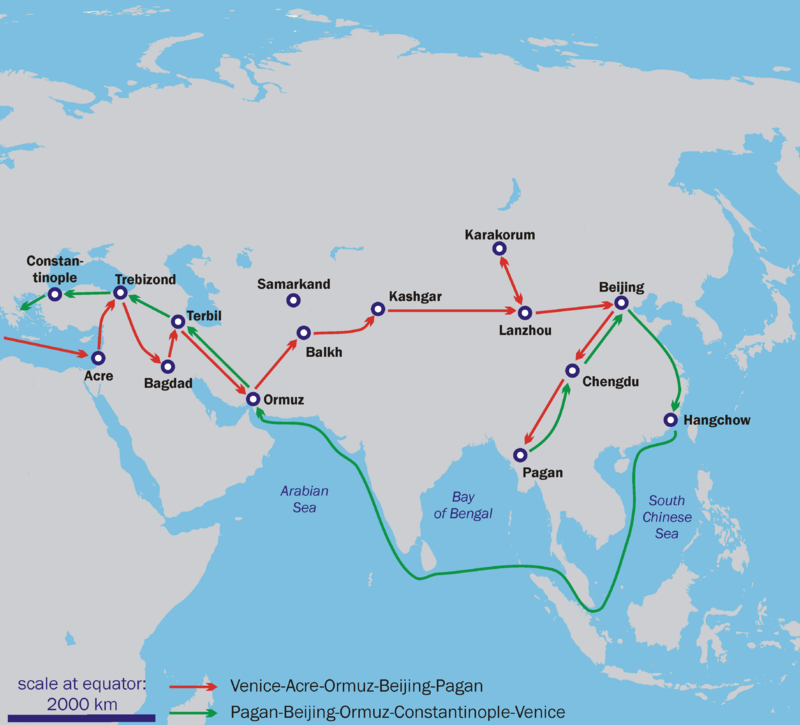
Niccolò and Maffeo set off again for China from the town of Layas, near Iskenderum, South East Turkey in 1271, with young Marco. Kublai Khan had been fascinated by what the Venetians had told him about the Christian message and he gave them a letter asking that the brothers to return to his palace with 100 Christian teachers and oil from a holy lamp in Jerusalem. However, all the pope gave them was two friars preachers along with the oil.

They planned to make their way overland to Ormuz, then sail to China but due to bad weather and sickness they had to travel by foot and horse all the way via Persia, Mongolia and North West China.

The journey was eased by the short term opening of continent wide trade routes. However they still went through a great deal of physical hardship travelling on horseback among many tribes, through extremes of hot and cold across deserts and mountains unknown to westerners.

While going through Armenia, they fell amid troops of the Mameluke Sultan Bibara the Arbelester, the two friars refused to go further, and the Venetians continued their journey alone.

In 1275 Marco Polo and his father and uncle arrived at the Khan's court in Cambulu without the Christian missionaries he had requested but with gifts including sacred oil from the sepulchre in Jerusalem. Kublai Khan thus had to rely on the limited theological knowledge of Marco and his family. The discouraged Khan turned instead to Buddhism.

Marco was introduced to the Khan by his father as "my son and your servant." The young Venetian readily adopted the Tatar custom and soon learned the four languages as well as the four writings of which they made use (probably Mongolian, Chinese, Persian, and Uighur).

A miniature from The travels of Marco Polo

Kublai took a likening to Marco and sent him on a mission six months' journey from his residence (probably to Annam). The information he brought back with regard to the countries met the ruler's approval.

For three years Marco was governor of the city of Yang-chow (Janguy), on which twenty-seven cities were dependent. Kublai also sent him to on many imperial visits to China's southern and eastern provinces, the far south and Burma.

His travels also brought him farther to the Bay of Bengal, and the island of Sri Lanka where their aim was to seize the tooth of Buddha, one of Buddhism’s most holy relics. Though the expedition was unsuccessful - Sri Lanka was not one to give up its treasures easily - Marco Polo was entranced by the land. He deemed Sri Lanka “the finest island of its size in all the world”.

One of the oddities which strike Marco Polo most forcibly was a marvellous black stone, useless for building with, which the Chinese dug up and burned. (It was one of the earliest references to coal).

The three Venetians returned home by way of SE Asia and South India carrying with them a fortune in gemstones.

Map of Marco Polo's travels. Wikipedia Commons

FOOD AND DRINK

Marco Polo brought back with him a recipe for making sorbets (fruit flavored water ice) by running a mixture of water and potassium nitrate over containers filled with the substance to be cooled.

Marco Polo observed in China that whilst the poor have to be content with meat steeped in garlic juice, the wealthier people ate meat that had been preserved in several of their spices.

While visiting Java and Nicobar, Marco Polo was the first European to encounter the coconut. He called it "the Pharaoh's nut", describing it as a fruit full of flavor, sweet as sugar, and white as milk.

Marco Polo told of the Asian nomads who boiled mare's milk, skimming the cream from the top, and then expose the milk to the hot sun until it dried. When it was ready to be used, they added water, and while riding their horses, this powdered milk mixture got violently shaken, producing a thick porridge for dinner.

RETURN 

Marco Polo returned to Venice with his father and uncle in 1295 after 25 years of adventures in China. His relatives failed at first to recognize the strangely clad, ragged folk in their tartar crimson satin robes, who told wild tales about numerous jewels and treasures.

Polo wearing a Tatar outfit, date of print unknown

The Polos became a sensation and attracted crowds of listeners, who had difficulties in believing their reports of distant China. Marco Polo was called "Messr Marco Milione" by his contemporaries for his tendency to exaggerate.

The Polos invited some of these doubters to a banquet. They entered dressed in their satin robes, discarded these for damask then for velvet. Finally they slit open their garments and out fell precious Chinese stones, which they presented to their guests.

Marco claimed to have broken the siege at Xiangyang but it is thought this was a case of "Marco Milione."

Marco Polo bought back the idea of Venetian blinds to Europe. From Venice, they then spread worldwide and hence they are now known by the name of that city.

His account of wild sheep in central Asia with mammoth horns were not believed by many. However when it was proved that these did exist they were named "Ouis Poli " in his honor.

Marco Polo became a commander of a war vessel against the Genoese traders. His galley was captured and Marco was taken to Genoa as a prisoner.

THE TRAVELS OF MARCO POLO 

Captured by the Genoese and languishing in a jail, Marco Polo met a writer from Pisa called Rusticiano, who insisted his yarns be written down. So Marco dictated his tales to the Pisa scribe.
His tales of the brilliance at Kublai Khan's court are told in a vivid style. They were originally written in rough French and were published in German in 1477.

A page from the Travels of Marco Polo from a manuscript believed to date between 1298–1299.

There are a number of gaping holes in Marco's account such as failing to mention the Great Wall of China or the cruel Chinese custom of foot binding for women.

Although the Polos were by no means the first Europeans to reach China overland (see for example Giovanni da Pian del Carpini), thanks to Marco's book their trip was the first to be widely known, and the best-documented until then.

The Travels of Marco Polo became the basis of one of the first accurate maps of China.

The Travels of Marco Polo was one of the first works of major journalism though not many editors would wait over 25 years for a piece to be submitted.


LATER LIFE AND DEATH 

By the age of 60 Marco Polo was living in luxury in a Venetian palace with his family.

By 1323, Polo was confined to bed, due to illness. Despite physicians' efforts, he died on January 8, 1324. His last words were " I have not told half of what I saw."

He was buried in the San Lorenzo church in the sestiere of Castello (Venice).

San Lorenzo church.. The photo shows the church as is today, after the 1592 rebuilding. By Didier Descouens

In the 1938 Hollywood movie Adventures of Marco Polo, the title character is played by that typical Italian, Gary Cooper.

Source Food For Thought by Ed Pearce


Monday, 27 June 2016

The Moon landings

In 1949, Gallup polled Americans on what scientific advances they thought would happen by 1999. 88% believed cancer would be cured, and 63% believed airplanes would be nuclear powered. Only 15% thought a man would walk on the moon.

During an address to a joint session of Congress on May 25, 1961, President John F. Kennedy proposed a national goal of "landing a man on the Moon and returning him safely to the Earth" by the end of the 1960s.

President Kennedy wanted to go to Mars not the Moon – but engineers told him it was 'a little bit too far'. Nasa told him it would take at least 15 years before we could put a man on the Moon after a weekend of intense calculations.

President Kennedy delivers his proposal to put a man on the Moon to Congress

After hearing President's Kennedy's "end of the decade" speech, an Englishman made a wager with a bookmaker of 10 pounds at 1000/1 "that a man will set foot on the surface of the moon before the first of January 1970." He thought it was "a common sense bet."

During a September 20, 1963 speech before the United Nations General Assembly, President Kennedy proposed that the United States and the Soviet Union join forces in their efforts to reach the Moon. Soviet Premier Nikita Khrushchev's son Sergei claimed Khrushchev was poised to accept Kennedy's proposal at the time of Kennedy's assassination. The Soviets did not trust Vice President Johnson, so Khrushchev rejected the plan.

Launched on December 21, 1968, Apollo 8 was the second manned mission of the Apollo space program. Commander Frank Borman, Command Module Pilot James Lovell and Lunar Module Pilot William Anders became the first humans to travel beyond Earth orbit and into an orbit around the Moon.

Apollo 8 crew. From left to right are: James A. Lovell Jr., William A. Anders, and Frank Borman

On December 24, 1968, the Apollo 8 astronauts gazed beyond the barren moonscape at the beauty and color of the earth rising, The crew were the first humans to witness Earthrise. As they saw from a distance the separations of day and night and of land and water described in Genesis 1, the three were inspired to read from the Bible the account of God's creation of the earth during a Christmas Eve television broadcast. At the time, the broadcast was the most watched TV program ever.

Taken by Apollo 8 crewmember Bill Anders on December 24, 1968

Apollo 10 was under-fueled on purpose, just in case the astronauts Thomas P. Stafford and Eugene A. Cernan got any cowboy ideas on trying to land on the moon. Craig Nelson wrote in his book Rocket Men that NASA was concerned they would attempt an unplanned landing, writing they said "Don't give those guys an opportunity to land, 'cause they might!"

Kennedy's goal was accomplished on the Apollo 11 mission when astronauts Neil Armstrong and Edwin “Buzz” Aldrin landed their Lunar Module on July 20, 1969, and walked on the lunar surface the following day.

Robert Goddard, the scientist who created the first liquid fueled rocket, which was launched in 1926, was ridiculed for his belief man could reach the moon. The New York Times even mocked his understanding of basic physics. They later published a correction the day after the launch of Apollo 11.


Apollo-11 trajectory to the Moon is named "Kondratyuk Route" after a self-educated Ukrainian who had calculated it 50 years before the lunar flight.

When Neil Armstrong and Buzz Aldrin became the first men to walk on the Moon in 1969, the third astronaut in the mission, Michael Collins, stayed in orbit 75 miles (121 km) above the surface. 

Right before Neil Armstrong became the first man to walk on the moon during the Apollo 11 mission in 1969, his fellow astronaut Buzz Aldrin, an elder at his Presbyterian church back on Earth, took communion on board the Lunar Module. He had prepared ahead of time a small wafer and wine. NASA made Aldrin maintain radio silence, but he still took the Eucharist elements and read John 15:5 ("I am the vine, you are the branches…") while Armstrong looked on. So, the first liquid poured on the moon, and the first food eaten there, was the wine and the bread!

Buzz Aldrin (pictured) walked on the Moon with Neil Armstrong, on Apollo 11, July 20–21, 1969

When Apollo 11 landed, it had only about 25 seconds of fuel left.

The first words spoken on the moon were said by Neil Armstrong: “That's one small step for man, a giant leap for mankind."  The speech, as written by his wife, read "That's one small step for a man, a giant leap for mankind." Unfortunately he forgot the a in the between for and man, thus changing the meaning.

Like two children playing on the beach, Armstrong and Aldrin bounced up and down on the lunar surface. Armstrong said: "It’s fun … you’ve got to be careful you lean in the direction you want to go, or you seem inebriated."

The first meal eaten on the Moon included bacon squares, sugar biscuits, tinned peaches, a pineapple and grapefruit juice drink and coffee.

Neil Armstrong planted the US flag on the moon. However, he was not claiming the moon for the US because of the 1967 Outer Space Treaty that made the moon into a 'global commons' .

The Lunar Flag Assembly was designed to survive a Moon landing and to appear to "wave" as it would in a breeze on Earth. However, the flag fell over when the Lunar Module Eagle took off.

The walls of the Moon-landing craft were so thin-to save wight- that Buzz Aldrin said he could pierce them with the tip of a biro.

Buzz Aldrin "McGuyverd" a broken circuit breaker on the Apollo 11 lander with a felt-tip pen, without which he and Armstrong would have died on the moon. A switch to the circuit breaker had broken off in all the too-ing and fro-ing in the cramped environment. The circuit breaker was the one that activated the ascent engine that would lift them off the moon to rendezvous with Michael Collins, who was orbiting overhead in the Columbia.

Armstrong and Aldrin left behind on the Moon a white pouch containing a silicon disc slightly bigger than a silver dollar. Inscribed in microscopic font on the disc are 73 messages, each from a different country, expressing wishes of goodwill and peace.

Michael Collins had spinal fusion surgery in 1968 and was removed from the crew of Apollo 8. It caused a rotation in astronaut assignments that landed him into a prime position on the Apollo 11 moon landing.

While orbiting the moon aboard Apollo 11, Mission Control detected a problem with the environmental control system and told Michael Collins to implement Environmental Control System Malfunction Procedure 17. Instead he just flicked the switch off and on. It fixed the problem.

After his epic journey, Collins retired from NASA and became director of the Smithsonian Air and Space Museum in Washington.

Apollo 11 crew,: commander Neil Armstrong, CM pilot Michael Collins, and LM pilot Buzz Aldrin

The average age of a NASA mission control engineer for Apollo 11 was 26.

When Apollo 12 astronaut Pete Conrad, the third man in history to go on the moon, his first words when he landed were "Whoopee! Man, that may have been a small one for Neil, but that's a long one for me."

The Apollo 12 astronauts took a color TV camera to the Moon's surface, but one of them broke it by pointing it at the sun.

Before the landing of Apollo 14, its landing radar failed to function. Astronauts fixed the problem by turning it off and on again.

While on Apollo 16, command module pilot Ken Mattingly lost his wedding ring—another astronaut caught it days later as it floated out a door during a spacewalk.

During their second day on the moon on July 31, 1971, Apollo 15 astronauts David Scott and James Irwin drove the first ever off-Earth vehicle, the Lunar Roving "moon buggy".

Lunar Roving Vehicle used on Apollos 15–17

Eugene Cernan, the last man to walk on the moon, wrote his daughter's initials in the lunar dust. They should still be legible in 50,000 years.

The Apollo astronauts left behind 96 bags of urine, feces and vomit on the moon. The bags were left behind to make room for lunar dust and rocks the astronauts brought home to Earth.

NASA originally planned to fly moon missions up to Apollo 20, but budget cutbacks ended at Apollo 17 and left three Saturn V rockets unused. Two wound up in museums, and the other one was repurposed to launch the Skylab space station.

American conspiracy theorist Bart Sibrel made a film called Astronauts Gone Wild, where he confronted nine astronauts by asking them to swear an oath on the Bible that they really walked on the moon. Buzz Aldrin punched him, and only Gene Cernan and Edgar Mitchell swore the whole oath. Mitchell then kicked him on the rear.

The surface of moon has been more thoroughly explored than most of the deep oceans on earth.

Technology in 1969 wouldn't allow for an accurate simulation of the moon landing. Faking it would have cost nearly triple the amount of actually going to the moon.

The Apollo Lunar Module had no seats, its occupants stood during transit to and from the moon.

The Odysseus robotic lander of the IM-1 mission performed the first commercial soft landing on the Moon on February 22, 2024. It touched down near Malapert A, a crater located about 186 miles (300 km) from the Moon's south pole, at 6:23 PM Eastern Standard Time (23:23 UTC). This landing was a historic milestone, marking the first time a private company successfully achieved a soft landing on the Moon, as distinct from previous government-led missions like Apollo.

NASA launched the lunar flyby mission Artemis II , the first crewed mission past low Earth orbit since Apollo 17 on April 1, 2026.

Sources Daily Express, Christianheadlines.com