Search This Blog

Showing posts with label Planet. Show all posts

Friday, 8 February 2019

Venus (planet)

Venus is the second planet in distance from The Sun, orbiting it every 224.7 Earth days.

Venus in approximately true colour, a nearly uniform pale cream

HISTORY

Though Venus is an elusive planet - by turns it is the morning and the evening star - its path was calculated by the Mayas thousands of years ago with an error of only fourteen seconds a year.

The ancient Romans named it after their goddess Venus. Venus is the only planet in our Solar System named after a woman.

On July 8, 1941 the Australian cruiser HMAS Sydney along with the rest of her squadron attempted to shoot down the planet Venus thinking it was a high altitude bomber. Venus managed to survive the engagement.

Venus was the first planet beyond Earth visited by a spacecraft when NASA's Mariner 2 flew past in 1962.

The Venera series of space probes were developed by the Soviet Union between 1961 and 1984 to gather data from Venus. When Venera 3 crashed on Venus in 1966, it became the first spacecraft to land on another planet's surface.

The following year Venera 4 performed in-place analysis of the environment of Venus and became the first spacecraft to land (rather than crash land) on another planet, although it stopped working before that.

On December 15, 1970 Venera 7 successfully landed on Venus becoming the first successful soft landing on another planet and send information back to earth. The probe transmitted information back home for 53 minutes, which included 23 minutes from the surface before succumbing to heat and pressure.

Reproduction of descent vehicle of the Venera-7. By Stanislav Kozlovskiy 

The first detailed maps of Venus did not emerge until the arrival of the Magellan orbiter in 1991.

FUN VENUS FACTS

A transit of Venus across the Sun takes place when the planet passes directly between the Sun and Earth. It is one of the rarest predictable astronomical phenomena and happens in pairs eight years apart that are separated from each other by 105 or 121 years. The last transit before 2012 was in 2004, and the next pair of transits will occur in 2117 and 2125.

Venus is the brightest thing in the night sky except for the Moon. The second brightest object on the image below is Jupiter.

By Brocken Inaglory - File:Venus with reflection.jpg, 

Venus is the only planet that rotates clockwise.

It takes 243 Earth-days for Venus to rotate about its axis, yet it takes 225 Earth-days for Venus to orbit the sun. That means that, on Venus, a day takes longer than a year.

Venus rotates so slowly, you could watch the sunset forever just by walking.


Much of the Venusian surface appears to have been shaped by volcanic activity. The planet has several times as many volcanoes as Earth, and it has 167 large volcanoes that are over 100 kilometers (62 mi) across.

Venus has 'snow-capped' mountains but it has been found the 'snow' is actually metal. It's made from lead sulfide and bismuth sulfide, more commonly known as the minerals galena and bismuthinite.

Venus is the hottest planet in the solar system, with an estimated surface temperature of 471°C (880 degrees Fahrenheit) due to its dense atmosphere. This is hot enough to melt lead or zinc.

Venus's average temperature (471°C) is hotter than Mercury's daytime temperature (430°C) despite being more than twice the distance from the sun

Winds in the middle cloud layer on Venus can reach speeds of 450 mph.

The pressure on Venus' surface is 92 times that of Earth or roughly the pressure found 900 m (3,000 ft) underwater on our planet. No man-made object has survived on Venus for more than 127 minutes.


Venus' atmosphere (air) is 96% carbon dioxide with clouds of sulphuric acid, a chemical that is extremely poisonous to humans.

Astronomers reported in September 2020, the detection of phosphine, a possible signature of organic life, in the atmosphere of Venus. The detection of phosphine in Venus's atmosphere was not linked to any known abiotic method of production present, or possible under Venusian conditions. 

Because it is obscured by thick sulfuric acid clouds, the only way scientists are able to see the surface of Venus is by using infrared and ultraviolet cameras and radar. Plans have been proposed for rovers or more complex missions, but they are hindered by Venus's hostile surface conditions.

Your voice would be deeper on Venus. The planet's dense atmosphere would cause your vocal cords to vibrate more slowly.

Sources Kmmsam, Isaac Asimov's Book Of Facts

Saturday, 12 January 2019

Uranus

Uranus is the seventh planet from the Sun. It is named after the Greek god Uranus, who was a god of sky.

Uranus pictured as a featureless disc by Voyager 2 in 1986

German-born British astronomer and composer William Herschel discovered Uranus in 1781 while in the garden of his house in Bath, Somerset, England, thinking it was a comet.

Uranium was discovered eight years later by the German chemist Martin Heinrich Klaproth and he named the element after the newly discovered planet.

On March 10, 1977, astronomers using NASA's Kuiper Airborne Observatory, an observatory aboard a highly modified jet aircraft, discovered a faint planetary ring system around Uranus.

In 1986 the Voyager space probe reached Uranus, detecting 11 rings in all, and finding 10 small moons in addition to the five visible from Earth. It is the only space probe that tried to investigate the planet from a short distance.

Uranus has a diameter of 51,000 km, 31,700 miles and a mass roughly 14.5 times that of Earth. 63 Earths could fit inside of Uranus.

Size comparison of Earth and Uranus

It orbits the sun every 84 years at an average distance of 2,817 million km (1,780 million miles). The intensity of sunlight on Uranus is about 1/400 that on Earth.

It is the coldest planetary atmosphere in the Solar System, with a minimum temperature of 49 K (−224 °C; −371 °F).

Uranus only has two seasons - summer and winter. Each lasts 42 Earth years.

There are violent storms. Wind speeds can reach 250 metres per second (900 km/h; 560 mph).

Uranus has a small rocky core (about 55% the mass of Earth) overlain by ice with a deep atmosphere containing mainly hydrogen, helium plus some methane which gives the planet a greenish tinge.


Uranus is covered in blue clouds. The top clouds are made of methane and the lower clouds are thought to be frozen water.

The rings are charcoal black, and are probably debris of former "moonlets" that have broken up.

Thirteen distinct rings are known which is far fewer than the rings of Saturn but more than those around Jupiter and Neptune.

Uranus smells like flatulence because its atmosphere consists largely of hydrogen sulfide.

The spin axis of Uranus is tilted at 98 degrees, so that at times it's poles point towards the Sun, giving extreme seasons.

Uranus has a peculiar magnetic field, whose axis is tilted at 60° to its axis of spin, and is displaced about one third of the way from the planet's center to its surface. Because the magnetic field is so off-kilter with its rotational axis that magnetic lines will snap apart and reconnect as it rotates. According to one astronomer, "Uranus is a geometric mess."

Observations of the magnetic field show that the solid body of the planet rotates every 17.3 hours. The rotation rate of the atmosphere varies with latitude, from about 16 hours in mid southern latitudes to longer than 17 hours at the equator.


Uranus has 27 known moons. 24 are named after characters from the works of Shakespeare and three from Alexander Pope's. The largest moon, Titania, has a diameter of 1,610 km  (1,000 miles).

Friday, 27 October 2017

Saturn

THE PLANET 

Saturn is named after the Roman god of agriculture. Its name equated to the Greek Cronus (the Titan father of Zeus), the Babylonian Ninurta and the Hindu Shani.

Saturn’s nickname is “the jewel of the solar system" because many astronomers consider it the most beautiful planet in the solar system.

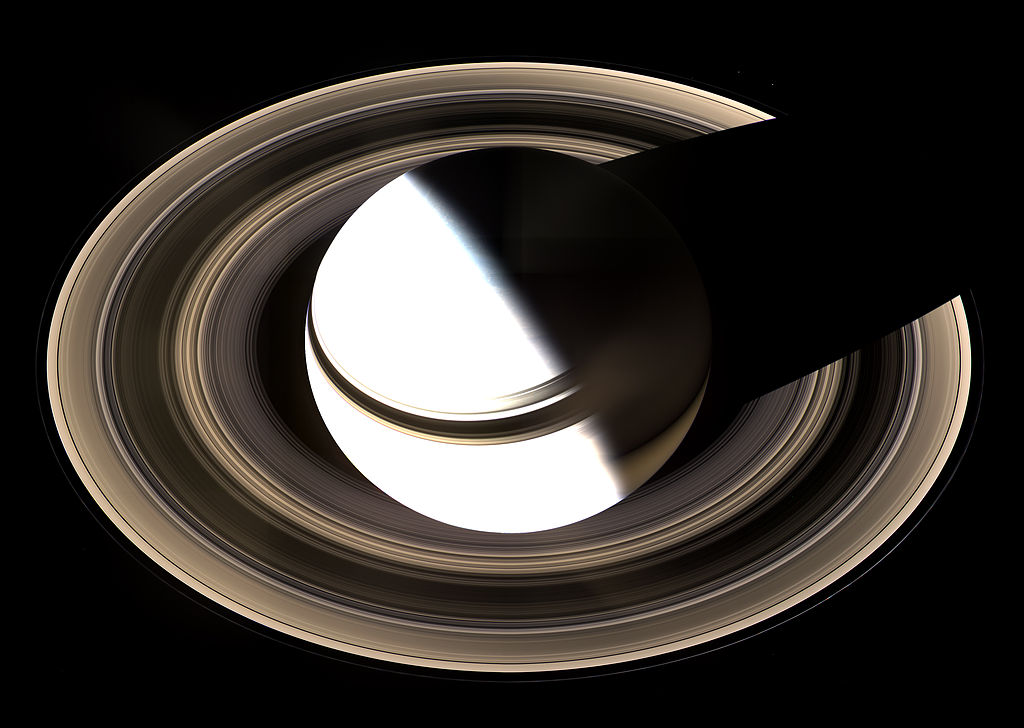
A natural color view of Saturn created from images collected by Cassini 

Saturn is a gas giant. Together, with Jupiter, Uranus and Neptune these four planets are sometimes referred to as the Jovian planets, meaning "Jupiter-like".

The American space probe Pioneer 11 was launched on April 6, 1973. In September 1979, it became the first spacecraft to visit Saturn when it passed the planet at a distance of 21,000 kilometres (13,000 mi).

Saturn is the sixth planet from the Sun in the Solar System.

It is the second largest planet after Jupiter.

The interior of Saturn is probably a core of iron, nickel, silicon and oxygen compounds, surrounded by a deep layer of metallic hydrogen, then a layer of liquid hydrogen and liquid helium and finally, an outer gaseous layer.

Ammonia crystals give the upper atmosphere a pale yellow hue.

Electrical currents within the metallic hydrogen layer is thought to give rise to the planetary magnetic field.

Winds on Saturn can reach 1,118 miles per hour, while the fastest winds on Earth reach only about 250.

A global storm girdles the planet in 2011.

The wind speeds are higher than on Jupiter, but not as high as on Neptune.

THE RINGS

Saturn is best known for its rings which were first seen by Galileo Galilei in 1610 with his telescope.

They are the most massive and conspicuous rings in the Solar System.

The rings extend from 6,630 km to 120,700 km outward from Saturn's equator.

The rings of Saturn (imaged here by Cassini in 2007)

These rings which are only 20 metres thick and 120,700 km wide, are made of ice, rocks and dust.

Saturn's rings are only temporary – over time they will either disperse or be sucked into the planet.

THE MOONS 

Saturn has hundreds of moonlets and at least 82 moons, which orbit the planet; fifty-three are officially named.

The largest moon Titan was discovered on March 25, 1655 by the Dutch astronomer Christiaan Huygens.

Titan is larger than the planet Mercury. It is the second-largest moon in the Solar System and the only one with a thick atmosphere.

Its thick atmosphere is orange due to a dense organonitrogen haze.

Its thick atmosphere is orange due to a dense organonitrogen haze.

Titan in natural color

Titan is the only world in the solar system that has surface liquid in the form of lakes, rivers and oceans.

Ice-encrusted and 310 miles wide, Enceladus is Saturn’s sixth-largest moon and — owing to its underground ocean — one of the most likely places to find extraterrestrial life, says NASA.

It was announced in October 2019 that a team had discovered a haul of 20 new moons orbiting Saturn using the Subaru telescope on Maunakea, Hawaii. This brings the total to 82 overtaking Jupiter who has 79 natural satellites.


FUN SATURN FACTS

In the time it takes Saturn to complete one orbit of the Sun, or one Saturn year, the Earth has orbited 29.6 times, or 29.6 years on Earth.


Although it has only one-eighth the average density of Earth, Saturn is over 95 times more massive.

Saturn's density is lower than water. If you were to place the planet in a big enough bowl of water, it would float.

The rings of Saturn have captured the imagination of writers, artists, and filmmakers for centuries, and have been featured in many works of fiction. They include:

The science fiction novel Ringworld by Larry Niven, which is set on a giant ring-shaped structure around a star, inspired by Saturn's rings.
The film Interstellar, which features a dramatic scene in which the protagonists visit a planet orbiting a black hole, with Saturn and its rings visible in the background.
The video game Destiny, which takes place in a science fiction universe where Saturn's moon Titan has been terraformed and serves as a hub for human civilization.

Friday, 17 March 2017

Pluto

Pluto is a dwarf planet orbiting the Sun, with about a sixth of the mass of the Moon and a third of its volume.

HISTORY

The astronomer Percival Lowell was convinced that a celestial body lay beyond Uranus and Neptune, as he believed that the two planets were displaced from their predicted positions by the gravity of an unseen Planet X. Lowell started a search program in 1906.

Pluto was photographed for the first time on March 19, 1915, 15 years before it was officially discovered by Clyde Tombaugh.

24-year old astronomer Clyde Tombaugh discovered Pluto on February 18, 1930, while studying photographs taken at the Lowell Observatory After nearly a year of searching, Tombaugh noticed a possible moving object on photographic plates taken the previous month. News of the discovery was telegraphed to the Harvard College Observatory on March 13, 1930.

Clyde Tombaugh, discoverer of Pluto here shown with his homemade 9-inch telescope.

The name Pluto, after the god of the underworld, was proposed by Venetia Burney (1918–2009), a then eleven-year-old schoolgirl in Oxford, England, who was interested in classical mythology. She suggested it in a conversation with her grandfather Falconer Madan, former Science master at Eton, who had come up with the name for the two moons of Mars, Deimos and Phobos half a century earlier.

Pluto was not only named after the god of the underworld, but the first two letters were also a homage to Percival Lowell, the scientist who initiated the search for a celestial body beyond Neptune.

Pluto was originally considered to be the ninth planet from the Sun, but the International Astronomical Union came up with a new definition for planets in 2006 that excluded Pluto after many other similar icy objects were found, including Chiron and Eris.

Venetia, the young girl who suggested the name in 1930, lived to see the planet demoted to "dwarf planet" status in 2006.

In 2009, the US State of Illinois voted to continue regarding Pluto as a planet. This was mainly because Clyde Tombaugh was from Illinois.

It's law in New Mexico that Pluto is still a planet when it passes over the state.

A spacecraft visited Pluto and its moons for the first time on July 14, 2015. NASA's New Horizons probe performed a flyby and took detailed measurements and images.

The images and data from New Horizons have revolutionized our understanding of Pluto. We now know that Pluto is a much more complex and interesting world than we ever imagined. It has mountains, valleys, glaciers, and even a heart-shaped region on its surface. Pluto also has five moons, including Charon, which is about half the size of Pluto itself.

When NASA's New Horizons spacecraft passed by Pluto, the trip took about 1 minute less than predicted or in a decade-long journey, NASA's forecast was 99.99998% accurate or the equivalent of forecasting a trip from New York to Boston and being accurate to within four-millionths of a second.

Pluto in near-true color, imaged by New Horizons

Clyde Tombaugh, the astronomer who discovered Pluto, had some of his ashes placed aboard the New Horizons space probe.

GEOLOGY

Like other Kuiper belt objects, which are generally outside Neptune's orbit, Pluto is primarily rock and ice.

The plains on Pluto's surface are composed of more than 98 percent nitrogen ice, with traces of methane and carbon monoxide.

The mountains are made of water ice.

Pluto is one of the most contrastive bodies in the Solar System, with colors varying between charcoal black, dark orange and white.

High-resolution image of Pluto in enhanced color to bring out differences in surface composition

ORBIT

Pluto has an elongated and highly inclined orbit that takes it from 49 astronomical units (7.4 billion km) away from the Sun down to 30, closer than Neptune.

Pluto last moved inside the orbit of Neptune in 1979. Mathematical calculations suggest that it was on July 11, 1735 when Pluto previously moved inside the orbit of Neptune.

Pluto never made a full orbit around the sun from the time it was discovered to when it was declassified as a planet. It won't complete a full orbit until March 23, 2178.

MOONS 

On June 22, 1978, the largest known moon of Pluto was discovered by James W Christy of the US Naval Observatory in Washington DC. He named it Charon, after the boatman of Greek mythology who ferried people’s souls to Hades, which was ruled by the god Pluto.

Charon, taken by New Horizons late on 13 July 2015. 

Charon is about half as wide as Pluto.

Pluto has five known moons: Charon, Styx, Nix, Kerberos, and Hydra. They are all named from Greek underworld myths - Pluto was ruler of the underworld.

FUN FACTS

A round trip to Pluto would be 7 billion billion miles.

Pluto is about the same area as Russia.

The mass of Pluto is less than one quarter of one per cent of that of Earth.

Light from the Sun takes about 5.5 hours to reach Pluto at its average distance.

The sky is so dark on Pluto that a person would be able to see stars during the day.


It is believed Walt Disney’s cartoon dog Pluto was named after the planet. He was created in 1930, just after Pluto was discovered.

Source Daily Express

Thursday, 9 March 2017

Planet

PLANETS IN OUR SOLAR SYSTEM

The ancient Chinese named the five visible after their primary elements. Jupiter was the wood star, Mars the fire star , Saturn the earth star, Venus the metal star and Mercury the water star. Once they realized that the Earth was also a planet, they called it Diqiu, meaning "ball of earth."

The tradition of naming planets after mythological gods was passed down to us after Roman names for the five extraterrestrial planets they were aware of.

Venera 1 became the first man-made object to fly-by another planet by passing Venus on May 19, 1961. The Russian probe had lost contact with Earth a month earlier and did not send back any data.

Mockup (1:1) of the spacecraft Venera 1 at Memorial Museum of Astronautics (Moscow).

The Mariner 4 flyby of Mars took the first close-up photos of another planet on July 14, 1965.

Neptune and Uranus are not "Gas Giants" as is commonly believed, but belong to a separate category of giant planets called "Ice Giants." This is because less than 20% of their mass is made up of hydrogen and helium. True gas giants like Jupiter and Saturn are over 90% hydrogen and helium.

A "sysygy" occurs when all the planets of the our Solar System line up.

DWARF PLANETS

Eris, the largest known dwarf planet in the solar system, was discovered in January 2005 by the team of Michael E. Brown, Chad Trujillo, and David L. Rabinowitz using images originally taken on October 21, 2003, at the Palomar Observatory.

Eris (center) and Dysnomia (left of center), taken by the Hubble Space Telescope

The issue of a clear definition for planet came to a head in 2005 with the discovery of the trans-Neptunian object Eris, a body larger than the smallest then-accepted planet,

Mathematical calculations suggested that it was on July 11, 1735 that dwarf planet Pluto moved inside the orbit of Neptune for the last time before 1979.

On August 24, 2006 The International Astronomical Union redefined the term "planet" as a body that orbits the Sun, is massive enough for its own gravity to make it round, and has "cleared its neighbourhood" of smaller objects around its orbit. Under this new definition, Pluto, along with the other trans-Neptunian objects, does not qualify as a planet.

Pluto

The term dwarf planet was adopted in 2006 as part of a three-way categorization of bodies orbiting the Sun, brought about by an increase in discoveries of objects farther away from the Sun than Neptune that rivaled Pluto in size.

Eris is the most massive and second-largest known dwarf planet in the Solar System. It was discovered through image analysis on January 5, 2005 by a team of astronomers at the Palomar Observatory in California. In September 2006 it was named after the Greek goddess of strife and discord,

There is a dwarf planet, Sedna at the far outer reaches of the solar system which takes 10,000 Earth years to complete its journey around the sun.

EXO PLANETS

Radio astronomers Aleksander Wolszczan and Dale Frail announced on January 9, 1992 the discovery of two planets orbiting the pulsar PSR 1257+12, the first definitive detection of extrasolar planets.

The first confirmed discovery of an extrasolar planet orbiting a major star occurred on October 6, 1995, when Michel Mayor and Didier Queloz of the University of Geneva announced the detection of an exoplanet around 51 Pegasi.

Artist impression of the exoplanet 51 Pegasi. By ESO/M. Kornmesser/Nick Risinger (skysurvey.org)

Three independent observing campaigns announced in 2006 the discovery of OGLE-2005-BLG-390Lb through gravitational microlensing, the first cool rocky/icy extrasolar planet around a main-sequence star.

Kepler-186f is an exoplanet orbiting the red dwarf Kepler-186, 492 light-years from the Earth. It is the first planet with a radius similar to Earth's to be discovered in the habitable zone of another star. NASA's Kepler spacecraft detected it using the transit method, along with four additional planets orbiting much closer to the star. The results were presented initially at a conference on March 19, 2014. The public announcement was on April 17, 2014.

Artist's concept of a rocky Earth-sized exoplanet in the habitable zone of its host star, compatible with Kepler-186f’s known data 

Our Milky Way galaxy is home to the darkest planet ever discovered, TrES-2b, is a coal-black planet that reflects less than 1% of the starlight falling upon it.

There is a planet that is covered in burning ice. It is called Gliese 436 b. Its surface is at a constant 800ºF, but the ice remains as ice because the gravity of the planet is so incredibly powerful that it compresses all of the water vapor into a solid state. It is actually called ice-ten/ice X.

Astronomers discovered a bizarre rogue planet wandering the Milky Way. The free-range planet,  named SIMP J01365663+0933473, was first discovered back in 2016. It is nearly 13 times the mass of Jupiter and does not orbit a star, and also displays stunningly bright auroras that are generated by a magnetic field four million times stronger than Earth's.

The oldest planet ever discovered is PSR B1620-26 b, also known as "Methuselah". It's estimated to be around 12.7 billion years old, making it nearly three times older than Earth. This ancient planet orbits a pair of stars in a globular cluster, providing valuable insights into the early universe and the formation of planetary system.

There are an estimated 17 billion Earth-sized planets in the Milky Way, based on data from Nasa’s Kepler telescope.

Superhabitable planets is a recent definition/category of planets or moons that must meet much more criteria than just being in the "Habitable Zone/Goldilocks Zone". No planet or moon has met these criteria as of yet, although the planet Kepler-442b is the closest to this definition. A rocky near-Earth-sized exoplanet, it is 1206 light-years away from Earth and orbits within its star's habitable zone. 

Here is a list of songs with planets in the title.

Saturday, 27 August 2016

Neptune

HISTORY

Galileo Galilei was the first astronomer to observe the planet Neptune on January 28, 1613, although he mistakenly cataloged it as a fixed star.

Neptune was officially discovered 233 years later on September 23, 1846 when using mathematical predictions by French mathematician Urbain Le Verrier and Cornwall-born astronomer John Couch Adams, German astronomer Johann Gottfried Galle became the first person to observe Neptune and recognize it as a hitherto unknown planet. He found Neptune, within one hour of searching and within one degree of Verrier's prediction.

Neptune

Neptune was the first planet to be discovered by mathematical calculations before it was actually seen by a telescope.

The planet Neptune has barely completed one orbit since it was discovered in 1846.

Neptune has a faint and fragmented ring system, which was first detected in 1968 by a team led by Edward Guinan. On August 25, 1989 the Voyager 2 spacecraft made its closest approach to Neptune and provided definitive proof of the existence of the planet's rings.

Neptune's rings

THE PLANET

Summer lasts 40 years as the planet takes nearly 165 years to orbit the Sun. Even so, the average temperature on the planet is minus 328f (minus 200c).

The strongest winds found on any planet in our solar system are found on Neptune. Wind speeds there reach up to 1,340 miles per hour. They are so fast they break the sound barrier.

Even though it is only a small part of the atmosphere, methane gas is what gives Neptune its blue hue. Methane absorbs red light, so when we look at Neptune, all we see is the blue that is not absorbed.


Neptune is the only planet not visible to the naked eye. This is due to the planet's extreme distance from the Earth.

Neptune is so far from the sun that high noon on the big blue planet would seem like dim twilight to us. The warm light we see here on our home planet is roughly 900 times as bright as sunlight on Neptune.

The planet Neptune emits more light than it receives from the Sun.

One year on Neptune is equal to about 165 Earth years. This fact makes Neptune the planet with the longest year.

MOONS

Neptune has 14 known moons. Triton is the largest Neptunian moon, comprising more than 99.5% of the mass in orbit around Neptune, and it is the only one massive enough to be spheroidal.

Triton's surface temperature is at least −237.6 °C, making it the coldest place in our solar system. Its cold temperature is because the moon's nitrogen ice is in the warmer, hexagonal crystalline state, and the phase transition between hexagonal and cubic nitrogen ice occurs at that temperature.

A Voyager 2 mosaic of Triton

Triton has a weird, backward orbit that has it inching closer to Neptune each year. When the two finally collide, the moon will be shredded into beautiful rings that may rival those of Saturn. The collision won't occur for another 10 million to 100 million years.


Saturday, 7 May 2016

Mercury (planet)

The Romans named the planet after the swift-footed Roman messenger god, Mercury (Latin Mercurius), which they equated with the Greek Hermes, because it moves across the sky faster than any other planet. The symbol for Mercury is based on Hermes' staff.

On March 29, 1974, NASA's Mariner 10 became the first ever space probe to fly by Mercury. Launched on November 3, 1973, it first flew to Venus and then, using Venus' gravity to modify its trajectory, swung around to visit Mercury.

Mariner 10, the first probe to visit Mercury

Mariner 10 mapped about 45% of the planet’s surface from 1974 to 1975. The second probe to visit Mercury, the MESSENGER spacecraft, finished mapping the planet in March 2013.

Mercury is the smallest planet in the Solar System with a radius of 2,439.7 kilometers (1515.9 miles). Saturn's moon Titan and Jupiter's moon Ganymede are both larger than Mercury.

Mercury is made of about 70% metallic and 30% silicate material meaning it has a greater mass than the largest moons in the solar system.

It is thought to be the almost-exposed core of a planet that was four-and-a-half times bigger before a collision with another proto-planet that blew away most of Mercury's crust and mantle.

Mercury's density is the second highest in the Solar System at 5.427 g/cm³, only a little bit less than Earth’s.

Mercury has a large iron core, which gives off a magnetic field about 1% as strong as that of the Earth.

A day on Mercury is twice as long as its year.

Full-color image of Mercury from first MESSENGER flyby

Surface temperatures can be anywhere from about −183 °C to 427 °C, (−297 °F to 801 °F), with the subsolar point being the hottest and the bottoms of craters near the poles being the coldest.

Mercury has the greatest temperature change from day to night: 840°F in the day, plummeting to -275°F at night.

Even though Mercury is the closest planet to the Sun, it is not the warmest. This is because it has no atmosphere, so any heat that the Sun gives to it quickly escapes into space.

The craters on Mercury are named after various composers, writers, artists and suchlike, the only stipulation being that they had to be famous for at least 50 years and dead for more than three years prior to nomination.

Interior of Abedin crater

The Japanese for Wednesday translates as 'Water day' as the planet Mercury was known as the 'water star'.

Mercury probably smells like moist, metallic burps, since its atmosphere consists of magnesium, calcium, sodium, and water.

Thursday, 31 March 2016

Mars

HISTORY

The recorded history of Mars observation dates back to the era of the ancient Egyptian astronomers in the 2nd millennium BC. Detailed observations of the position of Mars were made by Babylonian astronomers, and ancient Greek philosophers and Hellenistic astronomers developed a geocentric model to explain the planet's motions. Indian and Islamic astronomers estimated its size and distance from Earth.

The Egyptians bestowed the Red Planet with its first recorded name, Har dècher, which means "The red one." The Babylonians likewise called the planet Nergal, or "Star of death," while the Greeks and Romans both named the planet after their respective gods of war, Ares and Mars respectively. The Hebrews called it Ma'adim, or "One who blushes."


The first telescopic observation of Mars was by Galileo Galilei in 1610.

In Gulliver's Travels Jonathan Swift described the two moons of Mars, Phobos and Deimos, giving their exact size and speeds of rotation. He did this more than 100 years before either moon was officially discovered.

The first crude map of Mars was published in 1840.

When astronomers mistakenly thought they had detected the spectroscopic signature of water in the Martian atmosphere, the idea of life on Mars became popular.

In HG Wells's The War of the Worlds, Martians landed in Woking, Surrey, 23 miles south west of London.

During the 1920s, the range of Martian surface temperature was measured; it ranged from -85 °C (-121 °F) to 7 °C (45 °F). The planetary atmosphere was found to be arid with only trace amounts of oxygen and water.

Since the 1960s, multiple robotic spacecraft have been sent to explore Mars. Mariner 4 sent the first photograph of Mars on July 14, 1965 —it took eight hours to arrive.

The first digital image from Mars

The Viking 1 lander became the first spacecraft to successfully land on the planet on July 20, 1976 and perform its mission.

Landing on Mars had been planned for July 4, 1976, the United States Bicentennial, but imaging of the primary landing site showed it was too rough for a safe landing. The landing was delayed until a safer site was found.

Spirit, a NASA Mars rover, landed successfully on Mars at 04:35 UTC on January 4, 2004. The rover got stuck in a "sand trap" in late 2009 at an angle that hampered recharging of its batteries; it made its communication with Earth the following March.

Opportunity was the second of the two rovers launched in 2003 to land on Mars and begin traversing the Red Planet in search of signs of past life.  Opportunity landed on Mars the following year to begin missions planned to last three months, but far exceeded expectations and kept going for 15 years. Its mission ended in 2018 when a massive global dust storm blocked sunlight from reaching its solar panels. 

The last message Opportunity sent was, "My battery is low and it's getting dark."  NASA sent recovery commands along with one last song: Billie Holiday's "I'll Be Seeing You."

Viking 1 held the record for the longest Mars surface mission of 2307 days until that record was broken by the solar-powered Opportunity on May 19, 2010.

Viking Lander model. By Mark Pelligrino - Wikipedia Commons

Mars made its closest approach to Earth in nearly 60,000 years on August 27, 2003, passing 34,646,418 miles (55,758,005 km) distant. This was the closest Mars has been to Earth since September 24, 57,617 BC. 

The next time Mars will come this close to Earth will be on August 28, 2287.  The reason why Mars's closest approach to Earth varies so much is because the orbits of Mars and Earth are not perfectly circular. They are both slightly elliptical, which means that their distance from the Sun varies over time. When Mars is at its closest point to the Sun (perihelion), it is also at its closest point to Earth. And when Mars is at its farthest point from the Sun (aphelion), it is also at its farthest point from Earth.

FUN MARS FACTS

Despite being known as the Red planet, the color of Mars is closer to butterscotch.

Mars' reddish color is a result of iron oxide, which is known as rust and has the consistency of talcum powder. The iron oxide forms a rust dust that floats in the atmosphere and creates a coating across much of the landscape. The metallic rocks on Mars are literally rusting.

Exposure of silica-rich dust uncovered by the Spirit rover

Mars has the highest known volcano in the Solar System, the 13.6 miles (nearly 22 km) high Olympus Mons, is about two and a half times as tall as Mount Everest.

It is half the size of Earth, has two polar ice caps and has similar seasons to our planet. The Martian day is only 41 minutes longer than the day on earth.

Gravity on Mars is only about 40% that of Earth's, so a person would be 60% lighter.

The average temperature on Mars is -63C.

The highest recorded surface temperature on Mars is 35C.

Mars has the largest and most violent dust storms in our entire solar system, often with winds winds topping 125 mph. The storms can last for weeks and can cover the entire planet.


On September 29, 2008, the Phoenix lander, which had landed near the Heimdall crater on Mars in May 2008, took pictures of snow falling from clouds approximately 4.5 kilometers (2.8 miles) above its landing site. This observation was made during the late Martian summer when the planet's polar regions were experiencing seasonal changes.

The snowfall was notable because it was the first direct evidence of water ice in the Martian atmosphere. However, it's important to note that the snow vaporized before reaching the Martian surface, a phenomenon known as "virga." Mars has a very thin atmosphere composed mostly of carbon dioxide, and its low atmospheric pressure and frigid temperatures make it challenging for water ice to reach the surface in its solid form.

Mars has barely any atmosphere - about one per cent of the density of the atmospheric blanket around Earth. That's not enough to protect the surface from dangerous space radiation.

Because Mars has almost no atmosphere, its sunrises and sunsets appear blue.

India's Mars mission cost less than the movie Gravity.

The Outer Space Treaty states that robots and humans can't get close to water sources on Mars for fear of contaminating it with Earth life.

Source Latinpost.com

Monday, 12 October 2015

Jupiter

THE PLANET

Jupiter was known to the ancient Romans. They named it for the Roman god Jupiter.

It has a mass of about 317.8 Earths and two and a half times the mass of all the other planets in the Solar System put together.

Jupiter is a gas giant that didn't have enough mass to become a star. It would have needed a mass of 60-80 times its present amount to have become a star.

Jupiter is the third brightest object in the night sky. Only the Earth's moon and Venus are brighter.

It is the fastest spinning planet in our Solar System rotating on average once in just under ten hours.

Jupiter has a hurricane which has been going on for over 300 years. It can be seen as a red spot on the planet. This hurricane on Jupiter is three times bigger than the Earth itself.

Jupiter’s Great Red Spot is so loud, it’s acoustic sound waves heat up the surrounding atmosphere to almost 2400 degrees Fahrenheit

An image of Jupiter taken by the Hubble Space Telescope

The temperature in the clouds of Jupiter is -234f (-145c. The temperature near the planet’s center is thought to be about 43,000f (24,000c) —– hotter than the surface of the Sun.

It gives off more heat than it receives from the Sun. Because of this release of heat energy, Jupiter is shrinking at a rate of about 0.8 inches (2 centimetres) each year.

Jupiter is hit by impacting meteors big enough to generate fireballs visible from Earth an average of 6.5 times per year.

Jupiter is sometimes called a "cosmic vacuum cleaner" because of frequent impacts from asteroids and comets 

Someone who weighs 150 pounds on Earth would weigh a whopping 354 pounds on Jupiter.

Jupiter can have a triple eclipse, in which three moons cast shadows on the planet simultaneously.


MOONS

There are 67 confirmed moons of Jupiter. 59 of these moons are very small at less than 3 miles (5 km) wide

Jupiter has the largest retinue of moons with reasonably secure orbits of any planet in the Solar System.

Galileo first discovered Jupiter's third largest moon, Io, in 1610. Its name comes from Greek mythology, as do the names of all of Jupiter's moons.

Io is the most volcanically active body known. It's volcanoes throw out enough material every 10,000 years to cover the entire surface with a layer about 3 feet (1 metre) thick. So Io is continually turning itself inside out.

Source: Microsoft Encarta '96 

Sunday, 23 November 2014

The Earth

THE EARTH IN HISTORY

Earth's name comes from the Anglo-Saxon word erda which means ground or soil.

The Earth is the only planet in the solar system not named after a Greek or Roman god.

In the days of Moses it was taught that the Earth was carried around on a great big strong man's back and when he sneezed this created an earthquake. Later as time went on it was taught the Earth was carried around on the back of a turtle.

Though ancient people believed that the Earth was flat and you could fall off the edge of the globe, the Old Testament has several verses indicating it was round.  (Job 26:7 — "He stretcheth out the north over the empty place, and hangeth the earth upon nothing, " Isaiah 40:22 — "It is he that sitteth upon the circle of the earth, and the inhabitants thereof are as grasshoppers; that stretcheth out the heavens as a curtain, and spreadeth them out as a tent to dwell in.")


Parmenides of Elea, a Greek philosopher who lived in the 5th century BC, is thought to be the first person to realise that the Earth is a sphere.

Aristarchus of Samos (3rd century BC) was the first to argue that the Earth orbits the Sun rather than the other way around.

A Greek called Eratosthenes (276-194 BC), who was the head librarian of the Library of Alexandria,  estimated the Earth’s circumference to an accuracy of about 2 per cent.

English Benedictine monk Bede (673-735 AD) referred to the Earth as an “orb” and wrote that “it is not merely circular like a shield or spread out like a wheel, but resembles more a ball.” This idea was repeated by philosophers, mathematicians, and astronomers throughout the Middle Ages.

The fact that the Earth is round was evident to most people of Columbus' time, especially other sailors and navigators. The myth that they thought earth is flat back, picked up steam in the 1800s, right around the same time the idea of evolution was rising in prominence — and religious and scientific interests clashed.

One of the first photographs clearly showing the curve of the earth’s surface was taken from a balloon 72,395 ft above South Dakota on November 11, 1935.

The first photograph of the Earth from outer space was taken abroad The  V-2 No. 13 rocket on October 24, 1946. The famous photograph was taken with an attached DeVry 35 mm black-and-white camera.

The first photo of Earth from space, taken aboard the V-2 No. 13.

The Blue Marble is a photograph of Earth taken on December 7, 1972, from a distance of around 29,400 kilometers (18,300 miles) from the planet's surface. It is one of the most reproduced images in history, and has been used for a variety of purposes, including inspiring environmentalism and promoting international cooperation.

The Blue Marble photograph was taken by the crew of the Apollo 17 spacecraft as they were en route to the Moon. It shows the Earth as a pale blue dot against the black backdrop of space, with the continents and oceans clearly visible. The image is remarkable for its scale and clarity, and it has a profound impact on viewers. It is one of the most widely distributed photographic images in existence.

The Blue Marble—Earth as seen by Apollo 17 in 1972

The Pale Blue Dot photograph of planet Earth was taken on February 14, 1990, by the Voyager 1 space probe from a record distance of about 3. 7 billion miles (6 billion kilometers). In the photograph, Earth's apparent size is less than a pixel; the planet appears as a tiny dot against the vastness of space, among bands of sunlight scattered by the camera's optics.

Seen from about 6 billion kilometers, Earth appears as a tiny dot (the blueish-white speck approximately halfway down the brown band to the right) within the darkness of deep space

The last time all living humans were on Earth together was November 2, 2000. The International Space Station has been continuously occupied ever since.

EARTH RECORDS

Juan Sebastian del Cano: (?-1526) was the first man to circumnavigate the Earth. In 1519 he sailed with Magellan in command of the Concepción. After Magellan's death in the Philippines, he safely navigated the Victoria home to Spain, arriving in 1522.

The first solo circumnavigation of the Earth was completed by Joshua Slocum from Briar Island, Nova Scotia in 1898.

Wiley Post became the first person to fly solo around the world in 1933 traveling 15,596 miles (25,099 km) in 7 days, 18 hours and 45 minutes.

Australian adventurer Ben Carlin became the first (and only) person to circumnavigate the world by amphibious vehicle when he arrived in Montreal, Canada on May 13, 1958. Carlin had traveled over 17,000 kilometers (11,000 miles) by sea and 62,000 kilometers (39,000 miles) by land during a ten-year journey.

The United States Navy nuclear submarine USS Triton completed the first submerged circumnavigation of the globe on April 25, 1960. The 30,000 mile journey took 60 days.

Captain Beach traces the route of Triton's submerged circumnavigation

British yachtsman Sir Robin Knox-Johnston became the first person to complete a solo non-stop circumnavigation of the Earth on April 22, 1969, when he won the Sunday Times Golden Globe Race. The race, which was organized to commemorate the 50th anniversary of the first solo crossing of the Atlantic, challenged sailors to sail non-stop around the world alone, without any outside assistance. Knox-Johnston completed the race in just over 312 days, sailing his yacht Suhaili around the world and returning to the starting point in Falmouth, England.

American world trekker Steven Newman became on April 1, 1987 the first man to walk around the world. It was a four year, 15,000-mile trek.

Steven Newman By Sherab - Own work, Wikipedia Commons

On July 12, 1994 English adventurer Jason Lewis set off to complete the world's first human-powered circumnavigation of the Earth. He successfully ended his 4,833-day expedition on October 6, 2007, having traveled 46,505 miles (74,842 kilometers).

Deepsea Challenger, a submersible vehicle, completed the first solo voyage to reach the Challenger Deep in the Mariana Trench, the deepest point on Earth in 2012.

FUN EARTH FACTS

The Earth resonates at B flat.

The length of a day on Earth is increasing by about 17 milliseconds per century.


Deserts represent about one-fifth of the Earth's total surface.

70.8 per cent of the Earth’s surface is covered by water.

The earth's inner core is moving faster than the Earth's surface.

If you drilled a tunnel through the center of the Earth and decided to jump in it, you would emerge on the other side in about 42 minutes.

The Earth is almost a perfect sphere: its diameter at the Equator is about 27 miles more than the pole-to-pole diameter.

Because of the Earth's bulge, if you weigh 150lb at the Equator you’ll weigh 151lb at the North Pole.

The polar diameter of the Earth is almost exactly half a billion inches.

The longest walkable distance on Earth spans 14,334 miles starting from Cape Town, South Africa to Magadan, Russia. At a normal pace of 12.5 miles per day, it would take three years to complete.

The most remote position on Earth is Point Nemo in the South Pacific Ocean, 2,688 km (1,670 mi) from the nearest lands: It's so isolated, the closest humans are often the astronauts aboard the International Space Station.

If there was no space between any of its atoms, the Earth would be the size of a baseball.

If a billiard ball and the earth were the same size, earth would be smoother than the ball.


The Earth weighs 5,980,000,000,000,000,000,000 tonnes (about 6 million, billion, billion kilograms).

The Earth gets 40,000 tons heavier every year due to falling meteoroids — space dust, gravel and rocks — according to NASA

The main elements in the composition of the Earth are iron, oxygen and silicon (in that order), which together comprise 77 per cent of its mass.

Our magnetic core protects the Earth from the sun's cosmic rays that would otherwise strip away the atmosphere.

The usual date of Earth’s aphelion, when its orbit takes it furthest from the Sun, is July 4.

The Earth travels through space at 660,000 mph (1,062,167 km/h). .

The Earth has traveled more than 5,000 miles in the past five minutes.

If the Earth stopped for one second and you weren't belt-buckled to the Earth, you would fall over and roll 800 mph due east.

If the earth didn't have the moon, our days would only be 6 -8 hours long and there’d be between 1,100-1,400 days in a year.

The Earth spins at 1,000 mph.

90% of the world's people live in the Northern Hemisphere.

If you were to spread a map of the world flat the town of Ludbreg in Croatia would be in the centre.

The average temperature on Earth is between 14-16 degrees Celsius.

There are estimated to be at least 8.7 million species of life on Earth, of which 86 per cent on land, and 91 per cent in the oceans, have not yet been fully described or classified.

7% of the Brazilian population - or 11 million people - believe the Earth is flat.

Source Daily Express