Search This Blog

Showing posts with label Scientist. Show all posts

Wednesday, 31 July 2019

Christopher Wren

Christopher Wren was born on October 20, 1632 at East Knoyle in Wiltshire, England.

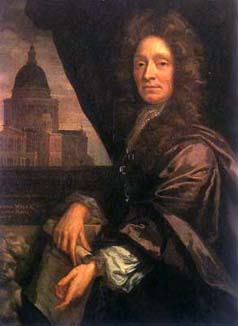
Wren, portrait c.1690 by John Closterman

FAMILY

His father, also Christopher Wren, was at that time the rector of East Knoyle.

In 1635, Christopher Wren snr was appointed Dean of Windsor by Charles I and the family moved to Windsor.

His mother Mary died in 1643 sometime after giving birth to Christopher's youngest sister Francesca.

The family were staunch royalists and Christopher's father saved the records of the Order of the Garter and King Edward III's sword when Windsor chapel was ransacked by Cromwell's men in the Civil War.

Christopher's royalist family were hit badly by the Civil War. His Uncle Matthew, who was Bishop of Ely, was held for 18 years in the Tower of London.

CHILDHOOD

Young Christopher spent his early years at Windsor Castle where his father was Dean. He used to play there with the future Charles II.

Christopher attended Westminster School for an unknown period of time. His headmaster there, realizing he had a boy genius, let him do his own thing as he realised he didn't need to be taught.

In his school holidays Christopher set to work as an inventor. He devised among other things an instrument for turning salt water into fresh water and a pen for writing in the dark.

Christopher entered Wadham College, Oxford on June 25, 1650, where he studied Latin and Aristotelian physics.

Wadham College, By Andrew Gray -

He graduated B.A. in 1651, and two years later Christopher received his M.A.

SCIENTIFIC CAREER 

One of the greatest minds of his age, Wen was killed in astronomy, geometry, and physics. In his younger days Wren was known more as a celebrated mathematician.

His academic career was centred at Oxford, where he was a member of both Wadham and All Soul's Colleges.

In 1657 Wren was appointed Professor of Astronomy at Gresham College, London and four years later he was elected Savilian Professor of Astronomy at Oxford. In 1662, he was one of the founding members of the Royal Society.

As an Astronomer, Wren observed Saturn for many years. He also made a globe of the Moon, which he presented to Charles II.


Christopher Wren was interested in medicine. His experiments at Oxford included anatomical dissection, looking for veins and arteries. His experiments involving vivisection of dogs seem horribly cruel. Wren produced one of the first anaesthetics by injecting opium into the pooches prior to dissecting them. However, by doing this he proved that organs could be removed from the body without endangering life.

As an anatomist Wren prepared the drawings for Thomas Willis' Cerebri Anatome, He was also a geometer (Issac Newton classed him among the best), a physicist who impacted studies, a meteorologist, and a surveyor. In addition, Wren also made microscopic studies of insects.

ARCHITECTURAL CAREER 

Wren developed an interest in architecture following his studies of physics and engineering. His first architectural design was the chapel at Pembroke College, Cambridge, which he was commissioned to do by his uncle the Bishop of Ely in 1663.(His Uncle Matthew had been freed from the Tower of London following the Restoration).

Wren was sent to the French capital by King Charles II to take a look at the grand rebuilding of Paris. During his visit he studied "the most esteem’d fabricks of Paris" in particular the French and Italian baroque styles.

Nine days after the Great Fire of London in 1666 Wren prepared a plan for rebuilding the city which he presented to King Charles II. In it he removed the crowded alleyways which were a fire and health hazard. All new streets would have one of three widths - 90,60 or 30 feet.

Wren's plan for rebuilding after the Great Fire of London

The plan didn't proceed any further but in 1669, the King's Surveyor of Works died and Wren was promptly installed. He was given responsibility for rebuilding the city, a post he held for over 45 years. Wren rebuilt 52 London churches including St Paul's Cathedral. His favourite church design of the ones he did was St Paul's, Piccadilly.

King Charles II rejected Christopher Wren's first plan for St Paul's, it was deemed too modest and Wren was so upset at it being turned down he wept. The king also rejected his second scheme as it was not thought "stately enough" but accepted Wren's third design in the English Baroque style.


The 1677 monument designed by Wren and Robert Hooke to mark the Great Fire is still Europe’s highest freestanding stone column.

Among Wren's other designs were the library at Trinity College, Oxford, the Royal Naval College, Greenwich, Chelsea Hospital and the south front of Hampton Court Palace.

Wren often worked with the same team of craftsmen, including master plasterer John Groves and wood carver Grinling Gibbons.

The the oldest academic building still in continuous use in the United States: the College of William and Mary's Wren Building, was modeled by Sir Christopher Wren.

LATER CAREER 

Wren was knighted on November 14, 1673, following his departure from the Savilian chair in Oxford. In honor of Wren's knighthood, Edward Pierce carved a famous bust of the great architect.

He served twice as a MP. Wren sat for Plympton Erle during the Loyal Parliament of 1685 to 1687. Over a decade later he was elected unopposed for Weymouth and Melcombe Regis at the November 1701 general election. He retired at the general election the following year.

Wren did not grow rich despite serving seven monarchs.

Christopher Wren by Godfrey Kneller 1711

MARRIAGES 

Wren's appointment as Surveyor of the King's Works in early 1669 persuaded him that he could finally afford to take a wife. On December 7, 1669 the 37-year-old Wren married his childhood playmate, the 33-year-old Faith Coghill at London's Temple Church.

Faith bore him two children, Christopher and Gilbert (who died in infancy in 1674).

Faith died of smallpox on September 3, 1675.

Wren got remarried in 1677 to Jane Fitzwilliam, but she died two years later of tuberculosis in September 1680, having born him two children Jane and William. "Poor Billy" born June 1679, was developmentally delayed.

Jane was buried alongside Faith and Gilbert in the chancel of St Martin-in-the-Fields. Wren was never to marry again.

BELIEFS 

Wren was a freemason and devout Anglican who always put humanity at the heart of his worldview. He was also a staunch royalist.

DEATH 

The 90-year-old Wren caught a chill which worsened over the next few days. He died on February 25, 1723 seated in a chair after dinner (taking his afternoon rest) at his house in St James Street, London. A servant who tried to awaken Wren from his nap found that he had passed away.

Wren was entombed inside St Paul's. His epitaph engraved by his son Christopher contains the words "Si Monumentum requins circumspice".  (If you seek his monument look around).
Crypt of St. Paul's Cathedral, Wren's memorial on the left


Friday, 19 April 2019

James Watson

American molecular biologist and zoologist James Watson was born in Chicago, Illinois on April 6, 1928.

Dr. James D. Watson
As a child Watson was fascinated with bird watching, a hobby shared with his father and for years he considered majoring in ornithology. After reading Erwin Schrödinger's book What Is Life? in 1946, Watson changed his professional ambitions from the study of ornithology to genetics.

Educated at the University of Chicago and Indiana University, Watson met British scientist Francis Crick at the University of Cambridge's Cavendish Laboratory in England.

James Watson announced with Francis Crick to the press in the Eagle pub near Cavendish Laboratory on February 28. 1953 that they had "discovered the secret of life" after they came up with their proposal for the structure of DNA, the chemical that carries the instruction that determines heredity.

In mid-March 1953, Watson and Crick deduced the double helix structure of DNA. Their discovery was formally announced on April 25, 1953 in Nature magazine.

DNA model built by Crick and Watson in 1953, on display in the Science Museum, London

Watson was a fervent atheist. Ironically in the Cavendish Laboratory where the zealously atheistic scientist worked he daily passed an inscription of Psalm 111: 2 "Great are the works of the Lord", carved across the laboratory's front door.

Watson, Crick, and Maurice Wilkins, who also contributed to the discovery of DNA's structure, were awarded the 1962 Nobel Prize in Physiology or Medicine "for their discoveries concerning the molecular structure of nucleic acids and its significance for information transfer in living material".

Watson wrote of the discovery of the double helix structure of DNA in his autobiographical book, The Double Helix (1968). He penned The Double Helix in a fiction like style to attract young people in science. The intimate first-person memoir about scientific discovery was unusual for its time and in 1998, the Modern Library placed The Double Helix at number 7 on its list of the 100 best nonfiction books of the 20th century.

Watson originally wanted to title his memoir Honest Jim, and then Base Pairs, but Francis Crick had issues with it.

Watson was on the faculty of the Harvard University Biology Department for twenty years from 1956, promoting research in molecular biology.

From 1968 Watson served as director of Cold Spring Harbor Laboratory (CSHL) on Long Island, New York. At CSHL, Watson shifted his research emphasis to the study of cancer, along with making it a world leading research center in molecular biology.

Between 1988 until April 10, 1992, Watson was associated with the National Institutes of Health, where he helped establish the Human Genome Project, an international scientific research project with the goal of mapping out the total genes of the human genome from both a physical and functional standpoint.


Watson controversially stated in 1973 that because most birth defects were not discovered until birth, he believed that babies shouldn't be considered alive until three days after they enter this world. This would mean that if the baby is sick, disabled, deformed, or deemed otherwise unacceptable, the infant can be legally left to die or euthanized.

In 2014, Watson auctioned off his Nobel prize medal for US$4.1 million (£2.6 million), saying he had financial problems because "no one really wants to admit I exist" — after he suggested that people of African descent were less intelligent than white people. The medal was subsequently returned to Watson by the purchaser, Russian tycoon Alisher Usmanov. He was the first living Nobelist to sell his medal.

Watson died aged 97 in East Northport, New York, on November 6, 2025. He spent his last week in hospice care following treatment for an infection. 

Tuesday, 11 September 2018

Margaret Thatcher

EARLY LIFE

Margaret Thatcher was born on Friday, October 13, 1925 in Grantham, Lincolnshire, to Alfred Roberts, who was a grocer, Methodist lay preacher and local mayor and Beatrice Ethel (née Stephenson).

By work provided by Chris Collins of the Margaret Thatcher Foundation 

Margaret spent her childhood in Grantham, where her father owned two grocery shops.

As a child Margaret was fond of the music of Gilbert and Sullivan and enjoyed reading Rudyard Kipling.

Margaret Roberts attended Huntingtower Road Primary School and won a scholarship to Kesteven and Grantham Girls' School, a grammar school. She was head girl there in 1942–43.

Portrait of Margaret Roberts aged 12 or 13

EARLY CAREER

She developed an early interest in politics and, when studying chemistry at University of Oxford's Somerville College, Thatcher became president of the Oxford Conservative Association. 

In her final year at Oxford, Thatcher studied X-ray crystallography under Dorothy Hodgkin, who later won the Nobel Prize.

She graduated in 1946 and worked for as a research chemist for BX Plastics and food manufacturer J. Lyons and Co.

Tasked with whipping more air into ice cream by J. Lyons and Co, Thatcher produced a type of 'soft-scoop' cream which could be pumped through a machine. It heralded Mr Whippy vans and the '99' cone.

Thatcher studied law when not in work and she qualified as a barrister in 1953 specializing in taxation. 

MP AND MINISTER

Margaret Thatcher first stood for Parliament in 1950 as the Conservative candidate for the safe Labour seat of Dartford.
Thatcher won her first election campaign in October 1959, when she was elected as MP to represent the North London constituency of Finchley, which she held until she retired in 1992.

Edward Heath appointed Thatcher Secretary of State for Education and Science in his Conservative government in 1970.

Margaret Thatcher said in 1973 that she didn't think there would be a female Prime Minister in her lifetime. 


On February 11, 1975, Margaret Thatcher beat four male candidates to become the first woman to lead a major political party in Britain. It was only because Keith Joseph was ruled out of the contest for party leadership over a controversial speech suggesting that mothers in social classes 4 and 5 have too many children, that Mrs Thatcher stepped into his shoes.

After being elected Conservative leader, a chance meeting with Laurence Olivier led to Thatcher using his voice coach to lower her pitch to its famous authoritative tone.

PRIME MINISTER 

Margaret Thatcher became UK Prime Minister on May 4, 1979 following the defeat of James Callaghan's incumbent Labour government in the previous day's general election. 

Margaret Thatcher was Great Britain's first female prime minister and served longer than any other British prime minister in the 20th century. 

Margaret Thatcher in 1983

While in office, she initiated what became known as the "Thatcher Revolution," a series of social and economic changes that dismantled many aspects of Britain's postwar welfare state. Mrs Thstcher succeeded in bringing down inflation but not unemployment.

A Soviet journalist dubbed Thatcher the Iron Lady, a nickname that became associated with her uncompromising politics and leadership style. 

In 1979, Japan offered new British prime minister Margaret Thatcher 20 "karate ladies" for protection at an economic summit. She declined.

Margaret Thatcher famously declared in a speech at the Conservative Party conference on October 10, 1980: "To those waiting with bated breath for that favorite media catchphrase, the u-turn, I have only one thing to say: You turn if you want to. The lady's not for turning."

After Argentinian forces occupied the Falkland Islands in April 1982. Thatcher directed British troops in 1982 to get back the British Crown Colony. British administration was restored two months later at the end of the Falklands War.

Argentine magazines presented Mrs Thatcher to their readers as total evil during the Falklands War. She appeared in Tal Cual magazine as a pirate, a vampire and a Nazi with a Hitler mustache, with the cover headline: "La Thatcher Worse Than Hitler." One issue claimed that "even Denis has discovered she’s a monster."

On October 12, 1984, Margaret Thatcher narrowly escaped injury from an IRA bomb at the conservative party conference in Brighton, which killed five people and injured 34. Thatcher's response to the attempt on her life helped to bolster her popularity halfway through a year-long miners' strike, which had split the nation.

The Brighton Grand Hotel after the IRA bomb. 

Margaret Thatcher became the first Prime Minister to win a third successive term on June 12, 1987 since Robert Jenkinson in 1820

The only medical problems the seemingly indestructible Margaret Thatcher suffered as Prime Minister were varicose veins and a sore hand that required a minor operation. 

Margaret Thatcher made do with four hours sleep a night as PM. 

On November 28 1990, a tearful Margaret Thatcher left Downing Street for the last time as Prime Minister. She was the longest-serving prime minister of the 20th century, having been in the job for 138 months.


BELIEFS 

Brought up as a staunch Methodist, Margaret Thatcher retained her Christian faith throughout her political career and won the approval of the local Chequers (her country residence) vicar because of her diligent attendance at church.

On one occasion Thatcher gave an address to the General Assembly of the Church of Scotland in which she gave a theological justification for her political philosophy quoting St. Paul in 2 Thessalonians 3v10 "If a man will not work, he shall not eat."

The tiny Methodist chapel in which Alf Roberts had preached in Grantham was moved stone by stone to Baker University, Kansas and Mrs Thatcher went there in 1996 to speak about the role of Methodism in her life.

PERSONAL LIFE 

She first met Denis Thatcher, a director of the family paint and preservatives business, Atlas Preservatives,  in February 1949, at a Paint Trades Federation function in Dartford, Kent. They married on December 13, 1951, at Wesley's Chapel in City Road, London.

Denis & Margaret Thatcher in 1984

They had two children, the twins Carol and Mark, who were born on August 15, 1953, six weeks premature. "Typical of Margaret. She produced twins and avoided the necessity of a second pregnancy," said Denis Thatcher.

Denis Thatcher, died in 2003 from pancreatic cancer.

Margaret Thatcher used a dark red lipstick to emphasize her impressive cupid's bow. 

Whilst at Downing Street, Margaret Thatcher had a pet cat called Wilberforce whom she doted on. She even bought him back a tin of sardines after a visit to Moscow. 

Margaret Thatcher only traveled by train once in her nine years as Prime Minister.

Margaret Thatcher was offered passport no. 007, but turned it down.

Mrs Thatcher had a hatred of insects and snakes which bordered on phobia.

LAST YEARS, DEATH AND LEGACY 

Thatcher returned to the backbenches as a constituency parliamentarian after leaving the premiership. 

Thatcher touring the Kennedy Space Center in early 2001

Aged 66, she retired from the House at the 1992 general election, saying that leaving the House of Commons would allow her more freedom to speak her mind.

After retiring from the Commons in 1992, she was given a life peerage as Baroness Thatcher (of Kesteven in the County of Lincolnshire) which entitled her to sit in the House of Lords. 

Carol Thatcher first revealed that her mother had dementia in 2005. She was first struck by her mother's dementia when, in conversation, Thatcher confused the Falklands and Yugoslav conflicts.

Margaret Thatcher died from a stroke on April 8, 2013 in her suite in London's Ritz Hotel. She had been living there since December 2012 after having difficulty with stairs at her Chester Square home in Belgravia. 

In line with Margaret Thatcher's wishes she received a ceremonial funeral, including full military honors, with a church service at St Paul's Cathedral on April 17, 2013. Queen Elizabeth II and Prince Phillip attended the ceremony, the second time in the Queen's reign that she had attended the funeral of a former prime minister.

Thatcher's coffin being carried up the steps of St Paul's Cathedra By Österreichische Außenministerium

The "Make 'Ding Dong the Witch is Dead' #1 the week Thatcher dies" Facebook campaign was originally set up in 2007 as a mocking memorial to the British prime minister. Following Baroness Thatcher's death the campaign kicked into gear and Judy Garland's Wizard of Oz song "Ding dong! The witch is dead!" reached #2 in the UK charts.

Every year, Margaret Thatcher Day is celebrated in the Falkland Islands on January 10, the anniversary of her first visit in 1983.

Sources Europeanhistory, Daily Mail

Thursday, 6 September 2018

Nikola Tesla

Nikola Tesla was born on  July 10, 1856 in Smiljan, Austrian Empire (modern-day Croatia).

Tesla, aged 34, circa 1890. Photo by Napoleon Sarony

Nikola's father, Milutin Tesla, was a priest in the Serbian Orthodox Church. His mother was a housewife who was of Serbian descent. 

Tesla was born at midnight during a fierce thunderstorm. The midwife thought the storm was a bad omen, saying he would be a child of darkness. His mother replied, "No. He will be a child of light."
He was the fourth child out of five. He had one older brother, Dane, two older sisters, Angelina and Milka, and one younger sister, Marica.

The picture below shows Tesla's house (parish hall) in Smiljan where he was born, and the rebuilt church, where his father served. During the Yugoslav Wars, several of the buildings were severely damaged by fire. They were restored and reopened in 2006. 

By I, MayaSimFan, Wikipedia

Nikola was able to do integral calculus in his head, leading his teachers to believe he was cheating.
Nikola Tesla had a photographic memory.

Nikola Tesla's childhood cat, Macak, played a role in his famous contribution to science. decades later, he reflected upon the experience of static electricity after he stroked his black moggy. In a 1939 letter to a 12-year-old he wrote, "Is Nature a gigantic cat? If so, who strokes its back? Day after day I have asked myself, what is electricity?"

Tesla got his first job in Budapest in 1882, working at a telephone company before moving to the United States two years later to work for Thomas Edison.

Edison once offered $50,000 to Tesla if he succeeded in improving the efficiency of his prototypical dynamos. Despite Tesla making a great deal of progress, Edison claimed that the offer was a joke.

They quarreled and soon Tesla started working on his own with other people investing in his work. He set up laboratories and companies to develop a range of electrical devices. On May 16, 1888 Nikola Tesla delivered a lecture describing the equipment which would allow efficient generation and use of alternating currents to transmit electric power over long distances.

Nikola Tesla's AC dynamo-electric machine  in an 1888 U.S. Patent 390,721

Five years later, Nikola Tesla gave the first public demonstration of radio in St. Louis. In 1898, at the Electrical Exhibition held at Madison Square Garden, Nikola Tesla successfully demonstrated a radio-controlled boat. He was awarded U.S. patent No. 613,809 for a "Method of and Apparatus for Controlling Mechanism of Moving Vessels or Vehicles."

Nikola Tesla installed the first hydroelectric plant at Niagara Falls in 1896. Around this time Tesla disavowed coal and oil in favor of renewable energy sources.

Nikola Tesla developed the idea for smartphone technology in 1901. By 1909, he'd conceptualized the first integration of data signals with telephony.

Tesla was 6 feet 2 inches (1.88 m) tall and weighed 142 pounds (64 kg) with dark, deep-set eyes, He had almost almost no weight variance from 1888 to about 1926.

He was also an elegant, stylish figure in New York City, a fastidious dresser who was fascinating company when he felt like being social. However, much of Tesla’s personal life remains a mystery, and he never married.

Nikola Tesla, c. 1896

The French actress Sarah Bernhardt was romantically interested in Tesla; however, he rejected her on the grounds that she distracted him from his work. 

Nikola Tesla and Mark Twain were good pals. They met at a club in New York and struck up a friendship. Tesla even helped Twain with some gastrointestinal issues by having Twain stand on an oscillating platform for 90 seconds, causing him to run for the bathroom!

He openly expressed disgust for overweight people. Once, Tesla fired his secretary solely because of her weight.

Nikola Tesla could not stand the sight of pearls, to the extent that he refused to speak to women wearing them.

Tesla was an advocate of sterilizing criminals and people with mental problems, and he believed that by 2100 people that aren't "desireable parents" shouldn't be able to breed.

Tesla was very fond of pigeons and took to feeding them at the window of his hotel room and bringing the injured ones in to nurse back to health.

Nikola Tesla once spent over $2,000 on an injured white pigeon. The amount includes building a device that comfortably supported her so her bones could heal. "I loved that pigeon as a man loves a woman, and she loved me. As long as I had her, there was a purpose to my life," he said of her. 

In 1922, Nikola Tesla imagined that his favorite pigeon told him that she was dying. When she actually did shortly after, he said that "something went out of his life and he knew his life's work was finished".

Having spent most of his money, Tesla lived in a series of New York hotels, leaving behind unpaid bills. He died of coronary thrombosis in a hotel room in Manhattan, New York City on January 7, 1943.

During World War II,  the Japanese built a death ray inspired by ideas from Nikola Tesla. The problem was that enemies would have to stand perfectly still for 10 minutes before it would work. 

Nikola Tesla once paid an overdue hotel bill with a 'working model' of his 'death beam'. He warned the management never to open it without taking proper precautions to avoid detonation. After his death, the box was pried open and they found nothing but a bunch of old lab components.

Tesla's work fell into relative obscurity after his death. However in 1960 the General Conference on Weights and Measures named the SI unit of magnetic flux density the tesla in his honor. Since then his reputation has experienced a comeback in popular culture.


The statue of Nikoli Tesla in Silicon Valley provides free WiFi.

Friday, 10 November 2017

Scientist

Early Egypt recorded the names of the architects who built the great pyramids. The first great architect, Imhotep, who lived almost 5,000 years ago, is also the first scientist known by name today.

Statuette of Imhotep in the Louvre. By Unknown - Hu Totya,  Wikipedia

Thales of Miletus (c. 624 - c. 546 BC) was a Greek philosopher and mathematician who is considered as one of the first scientists in history. He departed from supernatural explanations and instead sought rational causes for natural phenomena through observation and reasoning.

Thales proposed an elemental theory, asserting that water served as the fundamental substance from which all matter derived. According to his viewpoint, various forms of matter were essentially manifestations of water. This concept marked a significant departure from the prevailing mythological explanations of the time.

In addition to his philosophical ideas, Thales engaged in experimental investigations. He conducted experiments involving magnets and amber, discovering their ability to attract iron and light objects, respectively, when subjected to rubbing. These findings contributed to the understanding of magnetic and electrostatic phenomena.

During the Islamic Golden Age, scientists were paid the equivalent of what pro athletes are paid today.

The English philosopher and Franciscan friar Roger Bacon, was an early advocate of experimental science; he believed that science and mathematics could serve the Christian faith. In 1268 Roger Bacon published Opus Magnus, his compendium of all branches of knowledge.

Sir Francis Bacon argued for the possibility of scientific knowledge based only upon inductive reasoning and careful observation of events in nature. He was the first ever scientist to be knighted.

Before the 17th century began, science and scientists were not truly recognized. At first, people like Sir Isaac Newton were called natural philosophers, because there was no concept of the word "scientist" at the time.

Sir Isaac Newton was the first scientist to be buried in Westminster Abbey.

Newton in a 1702 portrait by Godfrey Kneller

Caroline Herschel, the younger sister of astronomer William Herschel, was the first female scientist to ever be paid for her work—King George III paid her £50 a year for her discoveries.

The founder of the Smithsonian, James Smithson, was a British scientist who died on June 27, 1829. He willed his fortune to his nephew and in the event his nephew died with no heirs, to the US government to found an "Establishment for the increase and diffusion of knowledge among men," having never visited the US.

English philosopher and historian of science William Whewell coined the term "scientist" in 1833, and it first appeared in print in Whewell's anonymous 1834 review of Scottish polymath Mary Somerville's On the Connexion of the Physical Sciences published in the Quarterly Review. He used the word "scientist" because the usual term "man of science" didn’t apply and Somerville wasn’t just a physicist, geologist, or chemist - she was all three. The word was generally adopted after 1840.

William Whewell, c. 1860s

Wilhelm Eberhard Bunsen, the German chemist behind the Bunsen burner, was born in 1811. The scientist refused to take a patent out on the invention because he did not feel he should make a profit from science, in the pursuit of which he lost an eye in a laboratory blast.

The Big Bang theory was formulated in 1927 by Georges Lemaitre, a Belgian Catholic priest and likely one of the greatest scientists you’ve never heard of, Lemaître was also the first to present the idea of an expanding universe, derived from General Relativity and later known as Hubble's law.

Sir James Chadwick, CH, FRS (October 20, 1891 – July 24, 1974) was an English physicist who was awarded the 1935 Nobel Prize in Physics for his discovery of the neutron in 1932. Chadwick intended studying mathematics, but he was interviewed by a physicist who assumed Chadwick wanted to study physics. He was too shy to contradict him, so ended up enrolling as a physics major.

James Chadwick

The scientist who analyzed the plutonium for the first atomic bomb was called Mr Doom.

During the Siege of Leningrad in World War II, nine Soviet scientists died of starvation while protecting the world's largest seed bank, refusing to eat what they saw as their country's future.

In 1952 Albert Einstein was offered the Presidency of the State of Israel. He declined, saying that as a scientist trained to deal with objective facts, he lacked the aptitude and experience to deal with people.

Leonard Nimoy met many fans who became scientists because of Spock's example, and talked to the Star Trek actor as if he were a fellow researcher. Nimoy always nodded and told them, "Well, it certainly looks like you’re headed in the right direction."

90% of all the scientists that have ever existed are alive today.

Scientists alive today outnumber all the scientists who ever lived up to 1980.

Sources Isaac Asimov's Book Of Facts, 1342 QI Facts To Leave You Flabbergasted (Quite Interesting)

Thursday, 9 November 2017

Science

Science (from Latin scientia, meaning "knowledge") is a systematic enterprise that builds and organizes understanding about the natural world. in the form of testable explanations and predictions about the universe.

Facts about the natural world have been described since classical antiquity. Aristotle wrote that the truth can be found through observation and induction. This was his scientific method. Socrates' example of applying philosophy to the study of human things, including human knowledge itself was a turning point in the history of early philosophical science.

The School of Athens by Raphael. Aristotle is pictured in blue in the centre arch

Scientific methods have been used since the Middle Ages. The English philosopher and Franciscan friar Roger Bacon, for instance, placed considerable emphasis on the study of nature through empirical methods.

The dawn of modern science is often traced back to the early modern period and in particular to the scientific revolution that took place in 17th-century Europe. During this period centuries scientists began to formulate knowledge in terms of laws of nature such as Sir Isaac Newton's laws of motion.

Robert Boyle, John Wilkins, Christopher Wren and other leading scientists founded a learned society now known as the Royal Society at London's Gresham College on November 28, 1660.

Not surprisingly, active Christians, with their interest in God's creation, brought the society into existence. In fact, its membership was overwhelmingly Puritan in makeup. It grew out of the meetings of the "Invisible College" who gathered in the late 1640s at the home of the chemist Robert Boyle's favorite sister, Katherine. She supported the Parliamentarians (and Puritans) in the revolt against Charles I. Of deep intelligence herself, Boyle welcomed the group into her house so that she might share the new findings.


When the Royal Society was chartered by King Charles II of England on July 15, 1662, it was the first scientific society in history.

The first joint Secretary of the Royal Society, Henry Oldenburg, published the first issue of Philosophical Transactions of the Royal Society, the world's longest-running scientific journal on March 6, 1665.

Title page of 1st edition of the Philosophical Transactions of the Royal Society, by Henry Oldenburg

Over the course of the 19th century, the word "science" became increasingly associated with the scientific method itself, as a way to study the natural world, including physics, chemistry, geology and biology.

The term `biology' was coined around 1800, by, amongst others, Gottfried Reinhold Treviranus, a professor at Bremen, and the French naturalist Jean-Baptiste Lamarck.

The term scientist was first used by theologian, philosopher and historian of science William Whewell in 1840. He meant it to distinguish those who sought knowledge on nature from those who sought other types of knowledge. Previously, people investigating nature called themselves "natural philosophers".

"Zohnerism", the use of true fact(s) to lead a scientifically ignorant public to a false conclusion, was coined in 1997 after 14-yr-old Nathan Zohner gathered petitions to ban the ''dangerous chemical dihydrogen monoxide'' (water) from school as the basis of his science project, titled "How Gullible Are We?"

Modern science is usually divided into separate areas of study, such as astronomy, biology, chemistry, geology, mathematics and physics.

Scientists in a laboratory of the University of La Rioja.

The Bible described many scientific truths in the Old Testament, thousands of years before man discovered them. Here are some examples:

Scientific Fact or Principle Bible reference Date of discovery by man

Life originated in the sea Genesis 1 19th Century
Man was the last animal created Genesis 1 15th Century
The Earth is held in place by invisible forces Job 26:7 1650
The Earth is round Isaiah 40:22 15th Century

"The Blue Marble" is a famous photograph of the Earth 

Certain animals carry diseases harmful to man Leviticus 11 16th Century
Quarantine for disease control Leviticus 13 17th Century
Blood is necessary for life Leviticus 17:11 19th Century
Oceans have natural paths in them Psalms 8:8 1854
Mountain ranges on ocean floor Job 2 1950s
Light is a particle and has mass (a photon) Job 38:19 1932
Radio astronomy (stars give off signals) Job 38:7 1945
Infinite number of stars exist Genesis 15:5 1940
Stars move through space Job 38:32 19th Century
Plants use sunlight to manufacture food Job 8:16 1920.

Here is a list of songs about science.

Source Christianity


Wednesday, 27 September 2017

Ernest Rutherford

EARLY LIFE 

Ernest Rutherford was born on August 30, 1871 on a small farm at Brightwater near Nelson, New Zealand.

His father, James Rutherford, was a farmer, and his mother, Martha Thompson, a schoolteacher.

Ernest studied at Havelock School and then Nelson College and won a scholarship to study at Canterbury College, University of New Zealand.

After gaining his BA, MA and BSc, Rutherford did two years of research at the forefront of electrical technology, during which he invented a new form of radio receiver.

Rutherford aged 21

In 1895 Rutherford was awarded a scholarship to travel to England for postgraduate study at the Cavendish Laboratory, University of Cambridge. He originally was overlooked for the scholarship, but the successful candidate fell ill so the award was passed to him.

CAREER

Rutherford worked at the Cavendish Laboratory between 1895-98. During his time there, the New Zealander briefly held the world record for the distance over which wireless waves were detected.

In 1898 Rutherford was appointed Professor of Physics at McGill University in Montreal, Quebec.

In 1907 Rutherford returned to Britain to take the chair of physics at the Victoria University of Manchester.

Rutherford was knighted in 1914.

During World War I, Rutherford worked on a top secret project to solve the practical problems of submarine detection by sonar.

In 1919 he returned to Cambridge University’s Cavendish Laboratory succeeding J. J. Thomson as the Cavendish professor and Director.

Between 1925 and 1930 Rutherford served as President of the Royal Society.

He was raised to the peerage as Baron Rutherford of Nelson, of Cambridge in the County of Cambridge in 1931.


SCIENTIFIC RESEARCH 

Rutherford's work is the basis of all modern understanding of nuclear energy but he used very simple equipment for his experiments.

In 1896 French physicist Henri Becquerel discovered the principle of radioactive decay when he exposed photographic plates to uranium. Hearing of Becquerel's experience with uranium, Ernest Rutherford started to explore its radioactivity during his time at McGill University in Canada.

As a result of his experiments, Rutherford proved that radioactivity involved the nuclear transmutation of one chemical element to another. He coined the terms alpha ray and beta ray to describe the two distinct types of radiation on May 8, 1899.

Ernest Rutherford at the McGill University in 1905

In 1908 Rutherford was awarded the Nobel Prize in Chemistry "for his investigations into the disintegration of the elements, and the chemistry of radioactive substances".

Rutherford pioneered modern atomic science. In 1911 the New Zealand physician's famous gold foil experiment, which involved the scattering of alpha particles by a thin foil, revealed that atoms had almost all their mass concentrated in a very small central positively charged nucleus, around which the electrons move.

During World War 1, Rutherford joined the Admiralty Board of Invention and Research and devised ways to detect submarines by deploying underwater signals and microphones.

In 1919, Rutherford made the world's first artificial nuclear reaction by bombarding some nitrogen gas with helium atoms and turning it into a different chemical thereby creating a nuclear reaction between nitrogen and alpha particles.

Rutherford also discovered (and named) the proton. After returning to Cambridge, he spent several years directing the development of proton accelerators (atom smashers). In 1932 Cockcroft and Walton of Rutherford’s group used the first workable atom smasher to artificially disintegrate lithium into helium.

As late as 1933 Rutherford saw no practical use for nuclear power. He saw no source of power in the transformation of atoms.

PERSONAL LIFE

A tall man, Rutherford was notoriously clumsy.

Ernest Rutherford 

Rutherford’s booming voice was said by colleagues to be three times louder than most.

In 1900, Rutherford returned to Christchurch, so he could marry Mary Georgina Newton (1876–1954 to whom he had become engaged before leaving New Zealand.

They married at St Paul's Anglican Church, Papanui in Christchurch.

Rutherford and Mary had one daughter, Eileen Mary (1901–1930), who married British physicist and astronomer Ralph Fowler. Eileen died after the birth of her fourth child.

LAST YEARS, DEATH AND LEGACY

Rutherford had a small hernia, which he had neglected to have fixed. It eventually became strangulated, causing him to be violently ill. Four days after an emergency operation in London, the father of nuclear physics died on October 19, 1937 of what physicians termed "intestinal paralysis", at Cambridge.

Rutherford was buried in Westminster Abbey, near Isaac Newton and other illustrious British scientists.

 Statue of a young Ernest Rutherford at his memorial in Brightwater, New Zealand.

Rutherford is a hero in his native New Zealand and his face appears on the country’s $100 note. The Rutherford banknote went into circulation on November 3, 1992.

Both the unit of radioactive disintegration-the "Rutherford" and the chemical element rutherfordium are named after "The Father of the Atom".