Search This Blog

Showing posts with label Architect. Show all posts

Saturday, 3 August 2019

Frank Lloyd Wright

EARLY LIFE 

Frank Lloyd Wright was born Frank Lincoln Wright in the farming town of Richland Center, Wisconsin, United States, on June 8, 1867.


His education included attending Madison High School. Wright turned to architecture on seeing their newly erected wing of the Wisconsin state capitol collapse.

Wright briefly studied civil engineering at the University of Wisconsin, but left before obtaining a degree.

CAREER 

One of the outstanding architects of the 20th century, Wright influenced design over the world by his freedom from convention and rule. Among his buildings are his Wisconsin home (1925), Falling Water, Pittsburgh (1936) and the Guggenheim Museum, New York (1959). Wright designed in total more than 1,000 structures and completed 532 works.

Wright moved to Chicago in 1887 following his time at college. The city was still reeling from the Great Chicago Fire of 1871 and needed developers. He quickly found a job as a draftsman for the architectural firm of the famed Joseph Lyman Silsbee.

When Wright learned that the Chicago firm of Adler & Sullivan needed draughtsmen he demonstrated in an interview that he was a competent impressionist of Louis Sullivan's ornamental designs and was taken on as an official apprentice in the firm.

Sullivan took Wright under his wing and gave him large design responsibility. Wright would later refer to Sullivan as Lieber Meister (German for "Dear Master").

Frank Lloyd Wright built his home and studio in Oak Park, Illinois in 1889 with a $5,000 loan from Louis Sullivan. The home was extensively remodeled in 1895 and 1898.

Wright's home in Oak Park. By John Delano of Hammond, Indiana, 

While working on residential projects for Adler & Sullivan, Wright also designed houses on his own time. In 1893 he left Louis Sullivan's firm and established his own practice on the top floor of the Sullivan-designed Schiller Building on Randolph Street in Chicago.

Wright's early work spearheaded the Prairie School; he designed houses influenced by the Arts and Crafts movement and characterized by horizontal lines, overhanging roofs, asymmetrical composition, and use of regional materials (Ward Willits House, Highland Park, Illinois. (1902); Taliesin, Spring Green, Wisconsin (1911)).

Two Berlin publications of his work in 1910-11 spread Wright's influence to Europe.

The second phase of Wright's career (1918-36) saw only one major building, the Imperial Hotel, Tokyo (1916-22). Finding little work during the Great Depression, Wright designed experimental projects, published An Autobiography (1932), and established the Taliesin Fellowship, a program under which he was to train numerous young architects at his winter home in Phoenix, Arizona, Taliesin West.

Wright in 1926

Wright also lectured widely. When the actor Anthony Quinn (1915-2001) studied architecture under Wright, the architect advised him communication was an important part of the job — so Quinn joined an acting group, and ended up preferring that.

In his prolific third phase (1936-59), Wright designed many of his most famous buildings including his most famous work, Fallingwater (1935). Fallingwater was a summer-house designed for the Kaufmann family over a waterfall in Mill Run, Pennsylvania. In 1991, members of the American Institute of Architects named the Fallingwater house the "best all-time work of American architecture".

He also designed the Solomon R. Guggenheim Museum on Fifth Avenue in New York City with its interior similar to that of the inside of a seashell. It took Wright 700 draft sketches until the final design was created.Wright worked on this project for 16 years before the building opened on October 21, 1959.  It is probably his most recognized masterpiece.

Solomon R. Guggenheim Museum, New York City (1959) Wikipedia

During his prolific final period Wright also pioneered urban planning in the United States through the compact "Usonian" house. A group of approximately sixty middle-income family homes, they began in 1934 with the Malcolm Willey House located in Minneapolis, Minnesota.

The Grady Gammage Memorial Auditorium in Tempe, Arizona (1967) is considered to be the last public building he designed.

PERSONAL STYLE AND CONCEPTS 

A gifted designer - he designed most of the interior details and even the furniture of many of his projects - Wright was uniquely influential through his love of natural textures (he favoured unplaned wood and rough-quarried stone) and conception of architectural space and open planning.

Wright believed in designing structures which were in peace with humanity and its environment. He called his belief organic architecture, which he said, "develops from within outward." He used this technique for his design for Fallingwater.

Fallingwater. By Sxenko,

Ondol, which means "warm stone," involves the use of stones and underground ducts to help transport warm air from the kitchen to the rooms in the house. Wright discovered ondol in the early 1900s and used it in many of his building designs.

Wright's earliest style was called "prairie architecture." His homes had low-lying roofs which seemed to hover over the house and give it added protection. Windows no longer were mere glass holes in walls. They formed bands which extended the full length of the wall.

His floor plans were informal, based upon the needs of the individual family. Rooms extended out from a central area. This design let light into each room from three different directions.

In 1979, The New York Times printed Frank Lloyd Wright's views on air conditioning from his 1954 book The Natural House. He was not a fan, calling it a "dangerous circumstance."

Autocratic, opinionated, often infuriating, Wright never saw some of his more grandiose visions - such as a mile-high building - beyond the drawing board; but even his drawings came to be treasured as works of art.


PERSONAL LIFE 

Wright was married three times, first to Catherine Wright, then to Miriam Wright, then finally to Olgivanna Wright.

Wright fathered seven children, four sons and three daughters. One of his daughters, Catherine, was the mother of the Oscar-winning actress Anne Baxter.

His second son, John Lloyd Wight, invented Lincoln Logs, a children's toy consisting of square-notched miniature logs used to build small forts and buildings.

On August 15, 1914, while Wright was working in Chicago, a disgruntled Barbadian servant, Julian Carlton, set fire to the living quarters of the architect's Wisconsin home. Seven people, including Wright's mistress, were trapped inside the dining room and Carlton took an ax to victims who tried to escape. All seven were killed.

Phoenix was Frank Lloyd Wright's home and architectural canvas from the late 1920s until his death. Projects of his in Phoenix include his winter home, Taliesin West and the David and Gladys Wright House (built for Wright’s son and his wife).


Wright was a fan of Japanese Art and collected them throughout his career. He used Japanese art prints to help him pay for loans.

DEATH AND LEGACY 

The Norman Lykes House,  a residence at 6836 North 36th Street in the Biltmore Area of Phoenix, Arizona, was the last house Wright designed shortly before his death.

Wright died on April 9, 1959, while undergoing surgery in Phoenix to remove an intestinal obstruction.

His third wife, Olgivanna, ran the Fellowship after Wright's death, until her own death in Scottsdale, Arizona, in 1985.

Paul Simon wrote the song "So Long, Frank Lloyd Wright" for Simon and Garfunkel. Art Garfunkel had majored in architecture at Columbia University. Simon, knowing that his musical partner was a big fan of Wright, used his name in the title.

Wright was recognized in 1991 by the American Institute of Architects as "the greatest American architect of all time."

Sources Europress Family Encyclopedia 1999, Compton's Encyclopedia
Wednesday, 31 July 2019

Christopher Wren

Christopher Wren was born on October 20, 1632 at East Knoyle in Wiltshire, England.

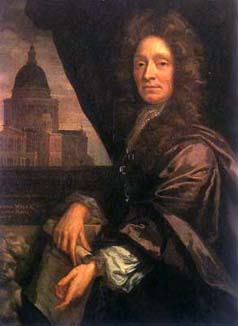
Wren, portrait c.1690 by John Closterman

FAMILY

His father, also Christopher Wren, was at that time the rector of East Knoyle.

In 1635, Christopher Wren snr was appointed Dean of Windsor by Charles I and the family moved to Windsor.

His mother Mary died in 1643 sometime after giving birth to Christopher's youngest sister Francesca.

The family were staunch royalists and Christopher's father saved the records of the Order of the Garter and King Edward III's sword when Windsor chapel was ransacked by Cromwell's men in the Civil War.

Christopher's royalist family were hit badly by the Civil War. His Uncle Matthew, who was Bishop of Ely, was held for 18 years in the Tower of London.

CHILDHOOD

Young Christopher spent his early years at Windsor Castle where his father was Dean. He used to play there with the future Charles II.

Christopher attended Westminster School for an unknown period of time. His headmaster there, realizing he had a boy genius, let him do his own thing as he realised he didn't need to be taught.

In his school holidays Christopher set to work as an inventor. He devised among other things an instrument for turning salt water into fresh water and a pen for writing in the dark.

Christopher entered Wadham College, Oxford on June 25, 1650, where he studied Latin and Aristotelian physics.

Wadham College, By Andrew Gray -

He graduated B.A. in 1651, and two years later Christopher received his M.A.

SCIENTIFIC CAREER 

One of the greatest minds of his age, Wen was killed in astronomy, geometry, and physics. In his younger days Wren was known more as a celebrated mathematician.

His academic career was centred at Oxford, where he was a member of both Wadham and All Soul's Colleges.

In 1657 Wren was appointed Professor of Astronomy at Gresham College, London and four years later he was elected Savilian Professor of Astronomy at Oxford. In 1662, he was one of the founding members of the Royal Society.

As an Astronomer, Wren observed Saturn for many years. He also made a globe of the Moon, which he presented to Charles II.


Christopher Wren was interested in medicine. His experiments at Oxford included anatomical dissection, looking for veins and arteries. His experiments involving vivisection of dogs seem horribly cruel. Wren produced one of the first anaesthetics by injecting opium into the pooches prior to dissecting them. However, by doing this he proved that organs could be removed from the body without endangering life.

As an anatomist Wren prepared the drawings for Thomas Willis' Cerebri Anatome, He was also a geometer (Issac Newton classed him among the best), a physicist who impacted studies, a meteorologist, and a surveyor. In addition, Wren also made microscopic studies of insects.

ARCHITECTURAL CAREER 

Wren developed an interest in architecture following his studies of physics and engineering. His first architectural design was the chapel at Pembroke College, Cambridge, which he was commissioned to do by his uncle the Bishop of Ely in 1663.(His Uncle Matthew had been freed from the Tower of London following the Restoration).

Wren was sent to the French capital by King Charles II to take a look at the grand rebuilding of Paris. During his visit he studied "the most esteem’d fabricks of Paris" in particular the French and Italian baroque styles.

Nine days after the Great Fire of London in 1666 Wren prepared a plan for rebuilding the city which he presented to King Charles II. In it he removed the crowded alleyways which were a fire and health hazard. All new streets would have one of three widths - 90,60 or 30 feet.

Wren's plan for rebuilding after the Great Fire of London

The plan didn't proceed any further but in 1669, the King's Surveyor of Works died and Wren was promptly installed. He was given responsibility for rebuilding the city, a post he held for over 45 years. Wren rebuilt 52 London churches including St Paul's Cathedral. His favourite church design of the ones he did was St Paul's, Piccadilly.

King Charles II rejected Christopher Wren's first plan for St Paul's, it was deemed too modest and Wren was so upset at it being turned down he wept. The king also rejected his second scheme as it was not thought "stately enough" but accepted Wren's third design in the English Baroque style.


The 1677 monument designed by Wren and Robert Hooke to mark the Great Fire is still Europe’s highest freestanding stone column.

Among Wren's other designs were the library at Trinity College, Oxford, the Royal Naval College, Greenwich, Chelsea Hospital and the south front of Hampton Court Palace.

Wren often worked with the same team of craftsmen, including master plasterer John Groves and wood carver Grinling Gibbons.

The the oldest academic building still in continuous use in the United States: the College of William and Mary's Wren Building, was modeled by Sir Christopher Wren.

LATER CAREER 

Wren was knighted on November 14, 1673, following his departure from the Savilian chair in Oxford. In honor of Wren's knighthood, Edward Pierce carved a famous bust of the great architect.

He served twice as a MP. Wren sat for Plympton Erle during the Loyal Parliament of 1685 to 1687. Over a decade later he was elected unopposed for Weymouth and Melcombe Regis at the November 1701 general election. He retired at the general election the following year.

Wren did not grow rich despite serving seven monarchs.

Christopher Wren by Godfrey Kneller 1711

MARRIAGES 

Wren's appointment as Surveyor of the King's Works in early 1669 persuaded him that he could finally afford to take a wife. On December 7, 1669 the 37-year-old Wren married his childhood playmate, the 33-year-old Faith Coghill at London's Temple Church.

Faith bore him two children, Christopher and Gilbert (who died in infancy in 1674).

Faith died of smallpox on September 3, 1675.

Wren got remarried in 1677 to Jane Fitzwilliam, but she died two years later of tuberculosis in September 1680, having born him two children Jane and William. "Poor Billy" born June 1679, was developmentally delayed.

Jane was buried alongside Faith and Gilbert in the chancel of St Martin-in-the-Fields. Wren was never to marry again.

BELIEFS 

Wren was a freemason and devout Anglican who always put humanity at the heart of his worldview. He was also a staunch royalist.

DEATH 

The 90-year-old Wren caught a chill which worsened over the next few days. He died on February 25, 1723 seated in a chair after dinner (taking his afternoon rest) at his house in St James Street, London. A servant who tried to awaken Wren from his nap found that he had passed away.

Wren was entombed inside St Paul's. His epitaph engraved by his son Christopher contains the words "Si Monumentum requins circumspice".  (If you seek his monument look around).

Crypt of St. Paul's Cathedral, Wren's memorial on the left


Tuesday, 5 July 2016

William Morris


EARLY LIFE 

William Morris was born at Elm House in Walthamstow, Essex, on March 24, 1834.

He was named after his father, a financier who worked as a partner in the Sanderson & Co. firm, bill brokers in the City of London.

Educated at Marlborough College, William studied for holy orders at Oxford University , but renounced the Church, and changed to architecture.

William Morris self-portrait, 1856; Morris grew his beard that year, after leaving university

In 1856, Morris became an apprentice to Gothic revival architect G. E. Street. That year he founded the Oxford and Cambridge Magazine

PERSONAL LIFE

William Morris married Jane Burden in a low-key ceremony held at St Michael's Church, Ship Street, Oxford on April 26, 1859. They honeymooned in Bruges, Belgium, and settled temporarily at 41 Great Ormond Street, London.

They had two daughters, Jane Alice "Jenny", born in January 1861, and Mary "May" (March 1862 – 1938), who later edited her father's works. Morris was a caring father to his daughters, and years later they both recounted having idyllic childhoods.

Jane Burden's shock of hair, palely severe features and Cupid's bow of a. mouth featured in dozens of paintings by the poet and artist Dante Gabriel Rossetti.

Jane Burden Morris portrayed by Dante Gabriel Rossetti as Dante Alighieri's muse Beatrice, 1869

Jane became increasingly close to Rossetti. It is unknown if their affair was ever sexual, but their relationship caused problems in her marriage to Morris.

From 1871 Morris and Jane rented the rural retreat of Kelmscott Manor, Oxfordshire.

The author Henry James described Morris as "short, burly, corpulent, very careless and unfinished in his dress ... He has a loud voice and a nervous restless manner and a perfectly unaffected and businesslike address.”

Portrait of William Morris, aged 53

CAREER

After his marriage Morris began his career as a decorator. He disliked the elaborate furniture of his day and after designing and furnishing his marital home, he founded the design firm of Morris, Marshall, Faulkner & Co in partnership with Dante Gabriel Rossetti and the artist Edward Burne-Jones, to make such furniture as Morris chairs.

The first one-stop design stop,  Morris, Marshall, Faulkner & Co also made curtains, rugs, tapestries, wallpaper, and stained glass and were able to provide a complete home design service to their clients.

Excess of decoration was a fault of many early 19th-century wallpapers. One of William Morris's aims was to reinstate a sense of beauty into everyday life and forge close links between art and craft.

Design for Trellis wallpaper, 1862

Morris' firm of interior decorators was dedicated to the principles of medieval craftsmanship.  His passion for the medieval fed his unique style of domestic interior decoration. It revolutionized the art of house decoration and furniture in England.

In 1875, Morris assumed total control of the company, which was renamed Morris & Co.

Morris' belief that the excellence of medieval arts and crafts was destroyed by Victorian mass-production and capitalism. This led him to join the Social Democratic Federation in 1883, and he subsequently organized the Socialist League.

LITERARY WORKS

By the end of the 1880's, Morris had broken with the Socialist League over goals and methods. He devoted much of the rest of his life to the Kelmscott Press, which he founded in 1891. The 1896 Kelmscott edition of the Works of Geoffrey Chaucer is considered a masterpiece of book design.

Kelmscott Press typefaces and colophon, 1897

Morris wrote and published poetry, fiction, and translations of ancient and medieval texts throughout his life. He was best known in his lifetime as a poet, and it was only posthumously that he became better known for his designs.

Morris' best-known works include The Defence of Guenevere and Other Poems (1858), The Earthly Paradise (1868–1870). the utopian News from Nowhere (1890), and the fantasy romance The Well at the World's End (1896).

DEATH

William Morris died on October 3, 1896 when he was 62 years old.  He died of tuberculosis, which was a common cause of death during that era.


His funeral was held two days later,  during which his corpse was carried from Hammersmith to Paddington rail station, where it was transported to Oxford, and from there to Kelmscott, where it was buried in the churchyard of St. George's Church.

Source Europress Encyclopedia

Monday, 23 May 2016

Ludwig Mies van der Rohe

Ludwig Mies van der Rohe (born as Maria Ludwig Michael Mies, was born on March 27, 1886, the son of a stonemason, in Aachen, Germany. He is commonly referred to, and was addressed, as Mies, his surname.

Mies. Wikipedia

Mies began his architectural career as an apprentice at the studio of Peter Behrens from 1908 to 1912. He served as construction manager of the Embassy of the German Empire in Saint Petersburg under Behrens. He developed there a style that was simple in design, where elegant form was always backed up by versatile function.

Mies worked alongside Le Corbusier and Walter Gropius, and was later also involved with them in the development of the Bauhaus. A design school that operated from 1919 to 1933 in Germany, Bauhaus promoted modernism and is widely regarded as the most influential art school of the 20th century.

After The First World War, as a young architect and designer in Berlin, Mies foreshadowed modern architecture with innovative designs for tubular-steel furniture (the cantilevered Barcelona chair (1929)) and steel and glass skyscrapers which demonstrated his interest in technological innovation and beautiful form.

Mies' starkly simple German Pavilion at the International Exposition in Barcelona in 1929 crystallised public acceptance of modern architecture.

Barcelona Pavilion 1929 reconstruction. By Hans Peter Schaefer - Own work

Mies served as director of the Bauhaus in Dessau between 1930-33, which he closed after Nazi threats.

After Nazism's rise to power, and with its strong opposition to modernism, Mies went to the United States in 1937. He accepted the position to found and head the architectural school at the Illinois Institute of Technology, in Chicago. He designed the institute's master plan and a number of campus buildings.

Though he had built only 19 buildings, Mies was internationally famous when he moved to the USA. His most notable designs there include the glass Lake Shore Drive Apartments, Chicago (1948-51), the bronze-and-glass Seagram Building in New York (with Philip Johnson, 1954-58), and the Museum of Fine Arts, Houston (1958, 1973).

860–880 Lake Shore Drive, Chicago. By User:JeremyA

Mies celebrated contemporary technology and materials; under his influence, skyscraper construction switched from masonry to metal and glass. His rising, rectangular structures were characterized by accessible, simple designs devoid of applied ornament and were composed of spaces rather than masses. Mies sought to make the buildings of his day as distinct and unique to their era as Classical and Gothic designs.

Mies was famous for a design statement he made "less is more" meaning that less visual clutter makes for a more satisfying environment.

"God is in the details" was another of Mies' favorite aphorisms.


In 1913, Mies married Adele Auguste (Ada) Bruhn (1885-1951), the daughter of a wealthy industrialist. The couple separated in 1918, after having three daughters: Dorothea, Marianne and Waltraut. During his military service in 1917, Mies fathered a son out of wedlock.

Mies later carried on a high-profile relationship with German designer Lilly Reich, which ended when he moved to the United States.

From 1940 until his death, artist Lora Marx (1900-1989) was his primary companion.

Mies van der Rohe died on August 17, 1969. After cremation, his ashes were buried near Chicago's other famous architects in Chicago's Graceland Cemetery.

Source Europress Family Encyclopedia 1999.

Monday, 16 May 2016

Michelangelo

EARLY LIFE 

Michelangelo was born Michelangelo di Lodovico Buonarroti Simoni on March 6, 1475 in Caprese a tiny Florentine village in Tuscany. (Today, Caprese is known as Caprese Michelangelo.)

His father was Ludovico de Leornardo Buonarroti, the resident magistrate and mayor of Caprese.

Several months after Michelangelo's birth, the family returned to Florence, where Michelangelo was raised.

His mother, Francesca di Neri del Miniato di Siena, died when young Michelangelo was six-years-old.

At later times, during his mother's prolonged illness and after her death, Michelangelo lived with his wet nurse and her husband, who was a stonecutter. Their home was in the town of Settignano, where his father owned a marble quarry and a small farm. It was here where Michelangelo gained his love for marble.

As a child, Michelangelo was sent to grammar school in Settignano to be taught by Francesco of Urbino.

Young Michelangelo used to spend much of  his time drawing and as a result he was often beaten by his father and other members of his family.

Michelangelo once said to the biographer Giorgio Vasari, "What good I have comes from the pure air of your native Arezzo, and also because I sucked in chisels and hammers with my nurse's milk."

CAREER 

When the young Michelangelo announced he was going to be a painter he was beaten by his father. When he later announced his wish to become a sculptor his family were even more outraged as it was generally thought that the heavy manual labor involved rendered sculpture inferior to painting.


Against his father's wishes, Michelangelo chose to be the apprentice of the artist Domenico Ghirlandaio for three years starting in 1488. Impressed, Domenico recommended him to the ruler of Florence.  Lorenzo de' Medici. Ghirlandaio said, “This boy knows more than I do”.

The Torment of Saint Anthony is the earliest known painting by Michelangelo, painted in around 1487–1488 when he was only 12 or 13 years old.

The Torment of Saint Anthony

From 1490 to 1492, Michelangelo studied at sculpture school in the Medici gardens with the help of the patronage of Lorenzo de Medici. He was influenced there by many prominent people who modified and expanded his ideas on art and even his feelings about sexuality.

While working as an apprentice, a fellow student Pietro Torrigiano took such a dislike to the arrogant Michelangelo that he punched his nose so hard he virtually flattened it. Torrigiano later boasted that he left his signature on the great man's face.

 In his early days, Michelangelo's work was unappreciated by the critics of his day. So he aged a statue of "Eros" he had made and buried it amongst some old ruins. Soon an excavating party found the statute and the critics were enthralled. The general consensus was that it was a priceless work. When Michelangelo confessed he was the man behind it, the critics had to admit they were wrong and Michelangelo was in fact an artist of rare ability. Afterwards the commissions started flowing in.

In 1527, the Florentine citizens, encouraged by the sack of Rome, threw out the Medici and restored the republic. A siege of the city ensued, and Michelangelo went to the aid of the besieged Florence by working on its fortifications. Between 1528 and 1529., he worked by day on the city's fortifications and by night on his paintings and statues.

After the last republic of Florence fell to the Medici in 1530, Michelangelo went into hiding for three months. Nobody knew where he had disappeared to until a 6.5 feet/ 2 meter wide hiding hole was discovered under the Medici mausoleum in 1975. The walls were full of sketches drawn by Michelangelo.

Michelangelo kept corpses in his studio which he peeled and probed. He made many anatomical sketches using colored chalk and water in order to master anatomy. The sculptor was accused of performing dissections on living people as part of his anatomical studies.

Michelangelo's work celebrated the human body, which for the previous 1000 years had been reviled.

By the end of his life, Michelangelo  had enough money to afford the luxurious lifestyle of other famous artists of the day, but instead he lived like a poor man. Though he rarely accepted gifts, he often gave away artwork to friends and in later years he provided dowries for poor girls otherwise unable to marry.

In 1546, Michelangelo succeeded Antonio da Sangallo the Younger as the architect of St. Peter's Basilica. The artist transformed the plan, with the western end being finished to his design, and the dome being completed after his death, with some modification.

Michelangelo's dome of St Peters became the model for domes all over the western world including the majority of American state buildings.

The dome of St Peter's BasilicaThe dome of St Peter's Basilica

A perfectionist, Michelangelo was forever altering his work, the prime example being the tomb of Pope Julius II on which he worked periodically for 40 years and never finished.


WORKS 

The workaholic Michelangelo tended to have just a little bread when working with a proper meal in the evening when finished.

Sometimes, Michelangelo rose in the middle of the night to work, wearing a paper hat with a candle in the middle of it so that he could see while keeping his hands free.

The Pieta sculpture, carved for St Peter’s Basilica between 1498 and 1500, made Michelangelo famous.

Michelangelo's Pietà, St Peter's Basilica (1498–99)

In 1501, the city government of Florence commissioned Michelangelo to create a statue of the Old Testament king of Israel, David. Michelangelo completed his 13 foot high stone carving in 1504.

Michelangelio's David astounded the public with it's realism. Every muscle and vein of its subject is shown.

In 1505, Michelangelo was invited back to Rome by the newly elected Pope Julius II. He was commissioned to build the Pope's tomb, which was to include forty statues and be finished in five years.

Having paid up front for the marble, Michelangelo was understandably upset when the pope refused to see him about paying him back. Michelangelo stormed off to Florence.

Having made up with Julius II, the sculptor was commissioned to paint the ceiling of the Sistine Chapel. Michelangelo was unenthusiastic about the project (he thought of himself as a sculptor), but was unable to refuse the Pope. He even wrote a poem about how much he hated doing it.

Michelangelo engaged five of his colleagues from the shop of Ghirlandajo and began with them to paint the "Drunkenness of Noah" above the entrance to the chapel. However, the sculptor had little patience with his less gifted associates, dismissed them and continued alone.

He spent nearly five years working on the project perched on a high scaffold with his head thrown back and paint dripping in his eyes. It left Michelangelo with a crick in his neck and he was close to be permanently crippled.

Michelangelo completed the Sistine Chapel frescoes on All Saints Day, November 1, 1512. "I've finished that chapel I was painting. The Pope is quite satisfied," the artist wrote in a letter to his father.

Michelangelo's Sistine Chapel frescoes was unveiled to show God's Creation of the World. He covered the ceiling with mainly nude figures telling the Old Testament story from Genesis to the Flood.

Michelangelo painted the ceiling of the Sistine Chapel
Michelangelo experienced constant interruptions to his work on Pope Julius' tomb in order to accomplish numerous other tasks. Although Michelangelo worked on the tomb for 40 years, it was never finished to his satisfaction.  According to the sculptor an unfinished work like this expressed the struggle between soul and matter.

Michelangelo's The Creation of Adam was completed in 1512 and 478 years later, an American  physician realized that God's shroud is in the shape of the human brain.

Shortly before his death in 1534, Pope Clement VII commissioned Michelangelo to paint a fresco of The Last Judgement on the altar wall of the Sistine Chapel. His successor, Paul III was instrumental in seeing that Michelangelo began and completed the project. Michelangelo labored on the fresco from 1534 to October 1541.

The Pope's master of ceremonies had irritated Michelangelo by constantly pestering him to let him see The Last Judgement fresco before the artist was ready to reveal it to the world. When he eventually revealed his masterpiece it was noted that Michelangelo had included the irritating official among the damned in hell being tormented by demons.

Michelangelo ignored the usual artistic conventions in portraying Jesus, and showed him a massive, muscular figure, youthful, beardless and naked. The depiction of Christ and the Virgin Mary without clothes was considered sacrilegious, but the Pope resisted having the fresco censored.

The Last Judgement (1534–41)

At the Council of Trent, shortly before Michelangelo's death in 1564, it was decided to obscure the genitals on the Last Judgement fresco. Daniele da Volterra, an apprentice of Michelangelo, was commissioned to make the alterations.

Michelangelo  put his own image in his works, including The Last Judgment fresco, in which St Bartholomew holds a piece of flayed skin, thought to be the artist’s face.

Michelangelo designed the dark blue, yellow and red uniforms that are worn by the Swiss Guards who guard the Vatican. His design is still worn by them to this day.

The Italian sculptor and painter was a fine lyric poet. Michelangelo wrote sonnets and madrigals, which are passionate, sarcastic and funny by turn. Some of them were inspired by his friendship in the last decade of his life with a noblewoman and poet Vittoria Colunnia.

300 of Michelangelo's letters and poems survive today.

BELIEFS 

Michelangelo sought to reconcile humanism and classicism with Christian orthodoxy. He believed he had a personal relationship with God, which meant from the Vatican's point of view, his beliefs were dangerously Lutheran.

In his old age, Michelangelo was discussing life, death and the universe with an aged friend. His friend commented "yes after such a good life, it's hard to look death in the eye." "Not at all" replied the sculptor "since life was such a pleasure, death coming from the same source cannot displease us."

APPEARANCE 

Michelangelo was short, 5ft 3 ins, and lean. While 5ft 3 is short by today's standards, it wasn't far from the norm when Michelangelo lived 500 years ago.

He had a muscular body and was wide shouldered and puggish. The artist was round faced with short black hair, forked beard. large ears, and a squashed nose.

Portrait of Michelangelo by Daniele da Volterra

Michelangelo cared little about his clothes and often wore the same ones for months at a time.

He often wore his boots for months without taking them off, so that when he finally removed them the outer layer of skin came off as well

Michelangelo smelled vile because he hardly ever washed. Michelangelo had his faults, but personal vanity was not one of them.

RELATIONSHIPS 

Michelangelo never married. His reason was "I have too much of a wife in this art of mine."

He had very little experience of the gentler sex and he never even kissed a woman and never drew from a female model. Some of Michelangelo's figures were shaped very oddly.

Fundamental to Michelangelo's sculpture, drawing and poetry is his love of male beauty, which attracted him both aesthetically and emotionally. Such feelings caused him great anguish, and he expressed the struggle between platonic ideals and carnal desire in his art.

Michelangelo had a number of young gay lovers throughout his life. Some were of high birth, like the sixteen year old Cecchino dei Bracci, a boy of exquisite beauty whose death, only a year after their meeting in 1543, devastated the artist. He spent a year writing passionate epitaphs for Bracci’s tomb.

Others were street wise and took advantage of the sculptor, Gherardo Perini, for instance in 1522, stole from him shamelessly.

Michelangelo distrusted his fellow artists and was jealous of Leonardo Da Vinci. They had a long-running feud. Leonardo mocked Michelangelo for his sculptures' exaggerated muscles, while Michelangelo taunted his foe over his inability to complete many of his works. He left Florence because of their rivalry.

PERSONAL LIFE 

Michelangelo lived in a two-storey house facing the great ruins of the Forum next to Trajan's column. There, he kept his marble and tools. His home contained little furniture and no books.

Michelangelo illustrated his shopping list because his servant was illiterate.

Michelangelo kept chickens and cats in the garden of his Rome home.

He preferred the city to the countryside. Michelangelo said; "I never felt salvation in nature. I love cities above all."

DEATH 

Michelangelo died in Rome on February 18, 1564, at the age of 88. Despite having a faith, Michelangelo refused to have a priest at his deathbed as throughout his life he'd distrusted dogma and hierarchy.

On his deathbed, Michelangelo told his friends "My soul I resign to God, my body to the Earth, my worldly goods to my next of kin."

His body was taken from Rome for interment at the Basilica of Santa Croce, fulfilling Michelangelo's last request to be buried in his beloved Florence.

Michelangelo's tomb in the Basilica of Santa Croce, Florence

Source  Christianitytoday.com

Saturday, 2 January 2016

Leonardo Da Vinci

Leonardo Da Vinci was born on April 15, 1452 in in a farmhouse about 1.9 miles (3 km) from the small Tuscan hill town of Vinci. The town is situated in the lower valley of the Arno river in what was the territory of the Medici-ruled Republic of Florence.

Casa Leonardo, where Leonardo da Vinci is believed to have been born

He was the illegitimate son of Piero Fruosino di Antonio da Vinci, a Florentine provincial lawyer and Caterina, a peasant woman. Leonardo had many half brothers and sisters.

As he was born before modern naming conventions developed in Europe, his full name was "Leonardo di ser Piero da Vinci", which means "Leonardo, son of Mister Piero, from Vinci" (as in Vinci, Florence).

Leonardo himself simply signed his works "Leonardo" or "Io, Leonardo" ("I, Leonardo"). Most authorities therefore refer to his works as "Leonardos", not "da Vincis". It is assumed he did not use his father's name because of his illegitimate status.

Leonardo spent his first five years in the home of his mother, then from 1457 he lived at his father's family estate in Vinci. Here, Leonardo started drawing and painting. His early sketches were of such quality that his father soon showed them to the artist Andrea del Verrocchio who subsequently took the fourteen-year old Leonardo on as an apprentice.

The young Leonardo studied many things, mastering them then putting them aside. After nine months of studying arithmetic he was baffling his master with questions. However his classroom education ended at the age of 15.  Leonardo never learnt to speak Latin or Greek which meant he was scoffed at by his contemporaries.

CAREER 

His illegitimacy barred him from a profession like that of his lawyer father. In 1466, at the age of fourteen, Leonardo was apprenticed to the artist Verrocchio,  the leading Florentine painter and sculptor of his day.

In 1472, at the age of twenty, Leonardo qualified as a master in the Guild of Saint Luke, the guild of artists and doctors of medicine. His attachment to Verrocchio was such that he continued to collaborate with him.

Between 1471-81 Leonardo had various independent commissions, and was accepted into the Painters Guild at Florence.

In 1482 Leonardo was appointed State Engineer, Court Painter and Director of Court Festivals to Lodovico Sforza (Duke of Milan) in Milan. It was there he painted his classic The Last Supper (see below).


When he was working for the Duke of Milan, one of Leonardo's responsibilities was playing the lute and singing to him.

In 1502, Leonardo entered the service of Cesare Borgia, the son of Pope Alexander VI. He spent a year acting as a military architect and engineer and travelling throughout Italy with his patron.

Between 1503-16, Leonardo had various independent commissions in Florence, Milan and Rome.

In 1516, Leonardo was in employment of King Francis I of France at 700 crowns a year. He was given the title of “First Painter, Architect and Mechanic of the King”.

Leonardo spent much of his time in King Francis’ employment studying ways and means of making the Loire River navigable.

PAINTING  AND SCULPTURES

His artistic genius was first noted when working as an apprentice to Andrea Del Verrocchio, Leonardo inserted a head of an angel of such perfection into Verrocchio's Baptism of Christ that his master vowed never to paint again.

Leonardo had a weakness for grotesque, curiously shaped heads and had a habit of following men and women with strange features. A hairy head would attract his attention for a whole day, then he would return home and reproduce it as a sculpture.

Truly ambidextrous, Leonardo could paint with one hand and draw with the other at the same time.

Leonardo's earliest known dated work is a drawing in pen and ink of the Arno valley, drawn on August 5, 1473.

The Arno Valley

Leonardo spent several years painting a representation of Jesus' last Passover meal for the Dominicans of Santa Maria delle Grazie on the wall of their convent in Milan. The Last Supper was completed on February 9, 1498.

Originally commissioned between 1503 and 1506, Leonardo finished his famous Mona Lisa (see below) painting a decade later while in the employment of King Francis of France, though he still didn’t consider it finished.


His model for Mona Lisa was one Lisa Del Giocana, whose silk merchant husband commissioned a portrait of her. Leonardo spent so long painting it that the husband terminated the sitting and refused to pay for the portrait.

According to Giogio Vasari's life of Leonardo, the legendary artist employed musicians and jesters to keep the smirking model merry and stop her fidgeting.

On one occasion Leonardo used his housekeeper to model a frightened woman. To help her achieve a petrified look he set himself on fire and painted the expression of horror on her face.

Leonardo invented in art "aerial perspective" whereby the misty atmosphere blurs and changes colors of the landscape as it dissolves into the distance. "All our knowledge has it's origins in our perceptions," he said.

In his time Leonardo was thought of as an also-run, a mere practitioner of the mechanical arts. Art was seen in his day as a craft on a par with baking and weaving.

Even in the nineteenth century not everyone rated him. The artist Renoir cattily said of Leonardo: "He bores me, he should have stuck to his flying machines."

Only 17 paintings that can definitely be attributed to Leonardo survive today, not all finished.

The only Da Vinci painting to be in private hands is The Madonna and the Yardwinder owned by the Duke of Buccleuch.  The painting has been lent to the National Gallery of Scotland (now the Scottish National Gallery) since 2009,

SCIENTIFIC, ENGINEERING AND INVENTIONS 

Leonardo's real interest was engineering and design. He was forever doodling with ideas sometimes to the detriment of his public commissions.

Leonardo designed a diving helmet of leather. It was furnished with spikes to protect the diver from monsters and a breathing tube stretched from the helmet to the surface with a cork float.

While working for the Duke of Milan Leonardo developed a keen interest in canal building. He worked out how to divert the River Arno. After 2000 workmen toiled for six months to no avail the project was aborted.

In 1510 Leonardo designed a horizontal water wheel which was a forerunner of the modern water turbine.

Leonardo was commissioned to make a mechanical lion which could walk forward, then open its chest to reveal a cluster of lilies. It is unknown for what occasion the mechanical lion was made but it is believed to have greeted King Francis I of France at his entry into Lyon and perhaps was used for the peace talks between the French king and Pope Leo X in Bologna.

Leonardo invented an early alarm clock, which woke the sleeper by gently rubbing his feet.

A pacifist, Leonardo booby-trapped his designs to prevent his militaristic patrons using him to wage war. For instance, he sketched a combat vehicle with some resemblance to a tank.with gearing that could never work in practice.

He sketched in his Codex Atlanticus dated to around 1485 a possible parachute. Leonardo said of it "If a man has a tent 12 braccia wide and 12 high covered with cloth, he can throw himself down from any great height without hurting himself."

The feasibility of Leonardo's parachute design was successfully tested in 2000 by Briton Adrian Nicholas and again in 2008 by Luigi Cani.


Leonardo da Vinci was the first to explain why the sky is blue.

ANATOMY, MEDICAL AND NATURE

The Pope once refused permission to Leonardo to study anatomy at a hospital in Rome. Later he dissected corpses, which at the time was still considered a taboo practice.

Da Vinci did the first accurate and detailed anatomical drawings including showing the function of the heart valves and cavities of the brain.

Leonardo's drawing of the Vitruvian Man (see below) is is based on the correlations of ideal human proportions with geometry described by the ancient Roman architect Vitruvius. It is regarded as a cultural icon,being reproduced on items as varied as the euro coin and T-shirts.


In his Codex on the Eye Leonardo suggested immersing a patient's eye in a water filled tube sealed with a lens for correcting sight defects.

Da Vinci had a rare brain condition known as "Double Hemisphere Action" which meant he could
simultaneously write different sentences with his right and left hand and carry on a quite unconnected conversation.

Leonardo was the first to record that the number of rings in the cross section of a tree trunk reveals its age. He also discovered that the width between the rings indicated the annual moisture.

JOURNALS AND NOTES 

Leonardo left 5,000 pages of jokes, dabblings, drawings, doodles, inventions and lists known as his note books.

Leonardo da Vinci used "mirror writing" (from right side of page to left) for his personal and private notes. This helped prevent others from stealing his ideas, protected his scientific theories from scrutiny by the Roman Catholic Church, and as a left-hander, also eliminated smudging.

The hidden treasures of Leonardo's notebooks languished unknown and unpublished for over 200 years after his death in trunks in outhouses.700 pages were found and 31 notebooks are preserved today.

The Codex Leicester, a collection of Leonardo's writings and drawings 1508-10 became the world’s most expensive book of any kind when it was sold for $30,802,500. to Bill Gates on November 11, 1994.

After Bill Gates purchased the Da Vinci Codex, he had it scanned for use as a wallpaper on Windows '95.

Page of the Codex Leicester

A volume of his drawings with Leonardo's legendary right to left writing is now in the Royal collection at Windsor Castle.

PERSONAL LIFE 

A strikingly handsome, tall man, Leonardo was described by people who knew him as "The most beautiful man who ever lived." As he got older, Leonardo developed an expansive grey beard.


Leonardo dressed as a dandy and wore the finest clothes. In his younger days he was proud of his rose colored tunics.

Reputedly a man of great strength. With his right hand, Leonardo could bend the ring of an iron door knocker or a horseshoe as if they were lead.

A charming man with a lovable disposition, he kept his servants well and fed and sheltered many friends. Strong willed, persuasive but Leonardo suffered from a  regal spirit and was full of airs and graces.

Leonardo kept his private life particularly secret, and there is no evidence that he was ever intimately involved with any woman, nor in a close friendship with one. He frequently drew bejeweled women with grotesquely ugly heads.

He surrounded himself with handsome young men throughout his life, and his art reflects an appreciation of androgynous beauty. It has, therefore, been assumed that Leonardo was a homosexual in a city (Florence) that was noted for it,

At the age of 23 Leonardo,along with three friends was accused of sodomy with a 17 year-old model, Jacopo Saltarelli, who was a notorious male prostitute. After two months in jail, he was acquitted as no witnesses had stepped forward. For some time afterwards, Leonardo and the others were kept under observation by Florence's Officers of the Night - a sort of Renaissance vice squad,

One of his loves may have been Gian Giacomo Caprotti da Oreno (nicknamed Salai (Little Devil)). Gian entered Leonardo's household around 1488 at the age of ten, becoming his servant and assistant. Though Salai was always introduced as Leonardo's "pupil", he never produced any work of artistic merit.

In 1506, Leonardo met Count Francesco Melzi, the fifteen year old son of a Lombard aristocrat. Salai eventually accepted Melzi's continued presence and the three undertook various journeys throughout Italy.

Leonardo had many other friends who are now figures renowned in their fields, or for their influence on history; these included Niccolò Machiavelli and Cesare Borgia.

Leonardo and Michelangelo had a long-running feud. Michelangelo taunted Leonardo over his inability to complete many of his works, while Leonardo mocked his foe for his sculptures' exaggerated muscles.

Rather than having one long sleep every night Leonardo tended to doze for twenty minutes every two hours.

Leonardo studied music and soon could improvise and play the lyre but he didn't stick at it.

In 1516 King Francis persuaded Leonardo to settle in France at the Château du Clos Lucé (or simply Clos Lucé) near Amboise in the Loire Valley. This red brick manor house is now a museum of his many achievements.

BELIEFS 

Leonardo once came up with a partially automated spit for roasting meat that turned over a fire as hot gases flow up a chimney, driven by a fan-like structure  The inventive artist and engineer was unlikely to develop the contraption for himself as he didn't eat meat. Indeed he was such a fervent vegetarian that he was known to buy caged birds from poultry vendors and set them free.

Leonardo was the first painter of religious subjects to show biblical characters looking like ordinary men without halos.

In his twilight years, Leonardo became increasingly devoutly religious and was tormented by an unnamed terrible sin. A brilliant man with a low boredom threshold, he was the embodiment of the Renaissance spirit having distinguished himself in a number of different fields from anatomy to aerodynamics. On his deathbed he confessed towards how greatly he had offended God by not working on his God given artistic talent more.

DEATH AND LEGACY  

Leonardo da Vinci died at his Château du Clos Lucé home in France on May 2, 1519, According to his wish, 60 beggars followed his casket. He was buried in the Chapel of Saint-Hubert in the castle of Amboise.

Francis I of France receiving the last breath of Leonardo da Vinci, by Ingres, 1818

Melzi was his principal heir and executor, but Salai was not forgotten: he received half of Leonardo's vineyard. Leonardo also remembered his servant Battista di Vilussis, who received the other half of Leonardo's vineyards, his brothers who received land, and a servant woman who received a black cloak "of good stuff" with a fur edge.

The actor Leonardo DiCaprio's first name derives from his German-born mother Irmalin's having experienced a sudden kick from her unborn boy while standing in front of a da Vinci painting in Italy.