Search This Blog

Showing posts with label Ceremony. Show all posts

Wednesday, 1 May 2019

Wedding

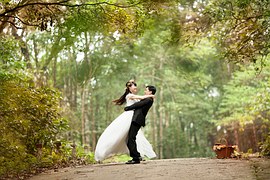
A wedding is a ceremony during which two people become married. It is usually between a man (the bridegroom) and a woman (the bride). In some places, same-sex weddings are legal. Traditionally, the wedding is held at the bride's church, temple, synagogue or other religious centre, or the home of her parents is the site of her wedding.

Roman Catholic white wedding (Philippines) By Judgefloro

WEDDINGS IN HISTORY

Bridal veils began in ancient Greece and Rome where a veil was said to protect against evil spirits.

In 29AD Jesus attended a wedding at Cana in Galilee and turned water into wine. Weddings in Jesus' day were week-long festivals. Banquets would be prepared for many guests, and the week would be spent celebrating the life of the married couple. Often the whole town was invited and everybody would come-it was considered an insult to refuse an invitation to a wedding. To accommodate many people, careful planning was needed. To run out of wine was more than embarrassing; it broke the strong unwritten laws of hospitality.

Ireland held Tailteann mass marriages where couples were allowed to wed and be married for a year to see if they were fit for each other. They could divorce by proceeding to the so called "separation hills" without leaving a mark on their reputation. This was legal until the 13th century.

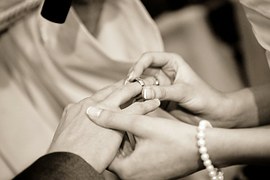
A ring has been included in wedding ceremonies since the 12th century. Pope Innocent III ordained that marriages had to take place in church and that a wedding ring should be exchanged during the service.

Pixiebay

King Richard II of England married Anne of Bohemia in Westminster Abbey on January 20, 1382. The king had to pawn the Crown Jewels to pay for the wedding.

The first association of diamonds with weddings comes from an account of a Hapsburg emperor giving a diamond engagement ring to his wife in 1477.

The wedding of King Henry VII of England and Elizabeth of York on January 18, 1486 saw the first recorded use of fireworks in Britain.

The best man is the chief assistant to the groom at a wedding and (along with the maid of honour) The Phrase "best man" is of Scottish origin, and recalls the days when a bridegroom simply abducted the woman he wanted as a bride. To help him in that task the groom enlisted a cadre of friends in case the bride needed to be kidnapped from disapproving parents. The toughest and bravest of these groomsmen was the best man.

The 'best' man's role was also to beat back angry relatives as they burst into the ceremony-allegedly the reason why the bride stands on the left of the groom and the best man. If things got nasty, they could draw their swords with their right hands.

The earliest surviving written use of the term best man comes from 1782, observing that "best man and best maid" in the Scottish dialect are equivalent to "bride-man and bride-maid" in England.


Felix Mendelssohn wrote "The Wedding March" in 1843 as part of his suite of incidental music for a production of Shakespeare's A Midsummer Night's Dream. It was used as the backdrop for the climactic wedding scene in the play.

"The Wedding March" was played at the marriage of Queen Victoria's eldest daughter, Victoria, and Friedrich of Prussia on January 25, 1858, after which it became a popular wedding recessional.

In 1922 the American Episcopal church voted to excise the words "to obey" from its wedding service's marriage vows.

The wedding of Jacqueline and John F. Kennedy took place on September 12, 1953, at St Mary's Church, in Newport, Rhode Island. It was considered the social event of the season with an estimated 800 guests at the ceremony and 1000 at the lavish reception that followed at Hammersmith Farm.

Senator John F. Kennedy and Jacqueline Bouvier Kennedy on their wedding day

A worldwide television audience of over 700 million people watched the wedding of Lady Diana Spencer and Prince Charles on July 29, 1982. The ceremony took place at St Paul's Cathedral in London. The wedding vows had only one omission. Diana was the first royal bride not to promise to obey.

RECORDS

The tallest couple on record was married in 1871 when 7'5"  Anna Hanen Swan married 7'2" Martin Van Buren Bates.

103-year-old Harry Stevens married 84-year-old Thelma Lucas at the Caravilla Retirement Home in Wisconsin on December 3, 1984. Harry was the oldest bridegroom in history.

The oldest bride in history is Minnie Munro, who was 102 years old when she married Dudley Reid, who was 83 years old, in Point Clare, New South Wales, Australia on May 31, 1991. The couple had been friends for many years, and they decided to tie the knot after Reid's wife died. The wedding was a small ceremony, with only close friends and family in attendance. Munro wore a white dress, and Reid wore a suit. The couple exchanged vows, and they were pronounced husband and wife. After the wedding, the couple went on a honeymoon to Hawaii. They lived together for the rest of their lives, and they died within a few months of each other in 2002.

The largest wedding reception was in India with a banquet for more than 150,000 guests. It was held on September 7, 1995 when former Tamil Nadu chief minister and movie star Jayalalitha Jayaram hosted a reception banquet at her foster son's wedding in the 20 hectare (50 acre) grounds in Madras, India. The wedding is reported to have cost over 750 million rupees (US$23,299,162).


On May 23, 1988, Fleming Koch and Nina Tolgard, a Danish couple, made history by participating in the earliest documented underwater wedding ceremony. The remarkable event took place in Mauritius, where the couple, adorned in scuba diving gear, exchanged vows in the presence of a local priest and a select group of close friends and family. As they declared their love for each other, vibrant coral reefs and a multitude of colorful fish served as witnesses to their unique and memorable union.

In 2001, 34 couples from 22 countries got married simultaneously while 32.8ft (10m) underwater in Thailand, setting a world record. Every couple received waterproof wedding certificates — before taking off their oxygen tank mouthpieces to kiss.

The largest underwater wedding took place when 303 divers attended the marriage of Ewa Staronska and Pawel Burkowski at a flooded open mine pit at Jaworzno, Poland, in 2011. The bride, groom and priest — a licensed diver — used sign language and waterproof placards throughout the service.

FUN WEDDING FACTS

A woman in Torquay, England, spent £10,000 to repeat her daughter's wedding on November 26, 1988 because she didn't like the video first time around.

Despite Christians making up only 1.5% of the population of Japan, the majority of Japanese people are married in a Christian ceremony. By contrast, the traditional Shinto ceremony makes up only 1 in 6 Japanese weddings.

 In South Korea, the number of guests at a wedding is so important that "fake guest" agencies exist.


The global wedding industry was worth $300 billion as of 2016. The United States wedding industry alone was estimated to be worth $60 billion as of the same year. In the United States, the wedding industry employs over one million people throughout 600,000 businesses, and grows 2% each year.

Tuesday, 2 October 2018

The origin of the toast and clinking of glasses

Proposing a toast dates back to religious rituals practiced by the ancient Greeks, where at ceremonial meals they poured out drinks for both their gods and the dead. A vessel of wine would then be lifted in the direction of a member of the dinner party and the words "It is to you" would be said. The container was then handed to whoever had been toasted to drink from. 

Pixiebay

Also in ancient Rome, a piece of toasted bread was dropped into the wine to draw out bad flavors. Over time an important guest would become thought of figuratively as the "toast" as it was believed his presence improved the taste of the wine. By the Middle Ages the word "toast" came to describe drinking to one's good health.

The custom of the clinking of glasses dates back to when some feared that one of the effects of inebriation was an evil spirit might enter their body. So before partaking of the alcoholic drink, a loud noise would be made first in order to frighten it off. 

Pixiebay

Later during the ancient Greek and Roman era people would frequently attempt to poison their enemies, so drinking vessels would be crashed together in such a way that a little of both drinks spilled into each other, thus any potential poison could end up in the poisoner's glass. Over time this evolved into a custom whereby guests and hosts would demonstrate their friendship for each other by touching, or clinking glasses.

Monday, 30 April 2018

State of the Union Address

The State of the Union Address is a speech the president of the United States of America gives every year, usually in January. The address is given to a joint session of the United States Congress.

In the speech the president gives a budget message, an economic report of the nation and an outlining of what plans he will be proposing for that year.

The first State of the Union address was delivered by President George Washington on January 8, 1790, in New York City, the then-provisional capital of the United States. He addressed the first session of the newly convened 1st United States Congress at the Senate Chamber of Federal Hall. It was only 833 words long, making it the shortest State of the Union address in history.

George Washington's handwritten notes for the first State of the Union Address,

Two presidents – William Henry Harrison in 1841 and James Garfield in 1821 – didn't live long enough to give any State of the Union Address.

President Warren G Harding was the first president to have his State of the Union Address delivered over the radio waves on December 8, 1922; however, it was broadcast locally, not nationally, as would be the case in the following year with President Calvin Coolidge's address. 

It was Franklin Roosevelt who dubbed the annual message the "State of the Union Address" in 1934. Before then, it was just known as the president's annual message.

President Harry Truman's 1947 State of the Union was the first broadcast on television.

President Lyndon Johnson's 1965 State of the Union Address was the first one given in the evening rather than the then-traditional midday time. The decision was made to deliver the speech in prime time so as to maximize the television audience.


Jimmy Carter's last State of the Union – which was a written message rather than a speech– weighed in at 33,667 words long.

Bill Clinton gave the longest State of the Union address, both in words (his 1995 speech was 9,190 words – and nearly half of them were extemporized) and minutes (his 2000 speech was one hour, 28 minutes and 49 seconds long.)

State of the Union Address

George W. Bush's 2002 speech (famous for his "axis of evil" line) was the first livecast online.
Source Usnews

Tuesday, 27 March 2018

Speech

The Roman world's greatest orator Cicero championed a return to the traditional republican government. Following Julius Caesar's death, he launched a series of attacks on Mark Antony in a series of speeches in the ensuing power struggle. Mark Antony had him beheaded in 43 BC.

The four gospels record several of Jesus' speeches The Sermon on the Mount is the longest continuous section of Christ speaking found in the New Testament. A collection of sayings and teachings of Christ found in the Gospel of Matthew it takes place relatively early in the Ministry of Jesus after he has been baptized by John the Baptist and preached in Galilee. It contains many of the basic tenets of the Christian faith including the Lord's Prayer.

Sermon on the Mount by Carl Bloch

Wearing a silver breastplate over a white velvet dress, Queen Elizabeth I addressed her troops preparing to face the Spanish Armada on August 5, 1588 at Tilbury. In one of her most famous speeches she declared "I know I have the body but of a weak and feeble woman, but I have the heart and stomach of a king, and of a King of England too, and think foul scorn that Parma or Spain, or any Prince of Europe should dare to invade the borders of my realm."

The great anti-slave-trade campaigner William Wilberforce failed to end his most famous anti-slavery speech – "Let us put an end to this inhuman traffic. Let us stop this effusion of human blood" – on a flourish, instead getting bogged down in a mire of statistics.

Though Abraham Lincoln’s Gettysburg address is now seen as one of the key moments in the history of democracy, at the time he thought it was a failure. Before Lincoln arrived onstage, the audience had been obliged to stand through a dull two-hour oration from the politician Edward Everett. Prayers and music took up a further two hours. Lincoln then spoke for just two minutes, so quietly that he was barely audible. Many in the audience felt short-changed, and had no idea that they would one day be considered witnesses to history.

The most famous phrase in Lincoln's 272 word speech – "government of the people, by the people, for the people" – was in fact several centuries old, and seems to have been pinched from the Prologue to John Wycliffe's 1384 English translation of the Bible.

1 of the 2 confirmed photos of Lincoln (center, facing camera) at Gettysburg

During World War I, President Woodrow Wilson recruited "Four Minute Men" - 75,000 volunteers who gave 4-minute public speeches nationwide to encourage patriotism and participation in the war effort. An estimated 7.5 million talks were given to over 300 million listeners in just 18 months.

Winston Churchill, would spend weeks polishing up particular phrases for his speeches. He would write while on the telephone or propped up in bed, but perhaps Churchill’s favorite location for writing was the bath.

The final speech by Gregory Peck in To Kill a Mockingbird was done in one take.

Dr Martin Luther King had been preaching about dreams since 1960, when he gave a speech to the National Association for the Advancement of Colored People (NAACP) called "The Negro and the American Dream". He included a passage that started with "I have a dream" in his original text for a speech he was due to deliver at the march on Washington on August 28, 1963. However, one of his top aides, Wyatt Walker, strongly advised him to get rid of that particular section, which he considered overused and banal. So King cut the offending lines.

The next day, King started delivering his rather over-written text to a rather muted response. However, when the gospel singer Mahalia Jackson, who was standing behind him cried out: "Tell ’em about the dream, Martin!," King put his notes aside, and started "preaching" improvisationally, punctuating his points with "I have a dream."

King's speech was ranked the top American speech of the 20th century in a 1999 poll of scholars of public address. 


Lyndon B. Johnson's "Let Us Continue" speech was a pivotal moment in American history. Delivered to a joint session of Congress on November 27, 1963, just five days after the assassination of President John F. Kennedy, the speech was a powerful call to action for national unity and progress. 

Johnson used the speech to honor Kennedy's legacy and to rally support for his unfinished agenda, particularly the Civil Rights Act. He declared, "We shall overcome the dark night of this tragedy and make an equally bright dawn of opportunity and hope." Johnson's impassioned plea for unity and justice resonated with the nation, and the Civil Rights Act was eventually passed later that year.

In 1987 President Reagan was to deliver one of his most memorable speeches, beside the Berlin Wall. Yet the most famous phrase in it – ‘Mr Gorbachev, tear down this wall!’ – was almost abandoned before delivery. White House Chief of Staff Howard Baker objected, saying it sounded "extreme" and "unpresidential", and Deputy US National Security Advisor Colin Powell agreed. At first, Reagan acquiesced. On the way to the Brandenburg Gate he changed his mind. "The boys at State are going to kill me," he said. "But it is the right thing to do." The speech received relatively little coverage from the media at the time and wasn't really known until 1989, after the wall came down but the phrase came to crystallize a defining moment in history.


Source When They Go Low, We Go High: Speeches That Shape The World And Why We Need Them by Philip Collins

Tuesday, 23 May 2017

Pumpkin

 HISTORY

In the 16th and early 17th-centuries a pumpkin was called a 'pompon' or 'pompion'. The word 'pumpkin' was first used in 1647.

The name "pumpkin" originated from "pepon", the Greek word for "large melon."

Native Americans used pumpkin seeds for food and medicine.


When early settlers arrived in America, they discovered that Native Americans were growing and using pumpkins. They roasted strips of pumpkin over an open fire for food.

Pumpkins were once recommended for removing freckles and curing snake bites.

In early colonial times, pumpkins were used as an ingredient for the crust of pies, not the filling.

Halloween pumpkin carving stems from a Celtic tradition of turnip carving to ward off evil spirits. The "head" of turnips were used, with the belief that the head was the most powerful part of the body, containing the spirit and the knowledge. However, it wasn't until 1866 that the pumpkin became associated with Halloween - a tradition originating from North America, where pumpkins were readily available and much larger, making them easier to carve.

On the morning of October 8, 1997, Cornell students, faculty and staff strolling by McGraw Tower noted an unusual sight: a 60 pound pumpkin impaled on the spire 173 feet up. To this day, no one is really sure how this was accomplished without anyone noticing.

CULTIVATION

Illinois, California, Pennsylvania and New York are the four major pumpkin growing states, together producing 1.1 billion pounds of pumpkin in 2008.

A pumpkin patch in Winchester, Oregon

Morton, Illinois calls itself the 'Pumpkin Capital of the World' and holds an annual pumpkin festival in the second week of September.

Nestlé, operating under the brand name Libby's, produces 85% of the world's canned pumpkin at their plant in Morton, Illinois.

USAGE

In the United States and Canada, pumpkin is a popular Halloween and Thanksgiving staple. Pumpkin pie was among the dishes at the first Thanksgiving.

Commercially canned pumpkin puree and pumpkin pie fillings are usually made from different kinds of winter squash than the pumpkins frequently carved as jack-o'-lanterns for decoration around Halloween.


Pumpkin flowers are edible. In the southwestern United States and Mexico they are used to garnish dishes, and they may be dredged in a batter then fried in oil.

Pumpkin leaves are a popular vegetable in the Western and central regions of Kenya; they are called seveve, and are an ingredient of mukimo respectively, whereas the pumpkin itself is usually boiled or steamed.

Raw pumpkin can be fed to poultry, as a supplement to regular feed, during the winter to help maintain egg production, which usually drops off during the cold months.

Canned pumpkin is often recommended by veterinarians as a dietary supplement for cats and dogs and cats that are experiencing certain digestive ailments such as constipation, diarrhea, or hairballs. The high fiber content helps to aid proper digestion.

NUTRITION

Pumpkins are 90% water, which means they are a great low-calorie food.

Pumpkins contain potassium and Vitamin A.

Pumpkin seeds are a popular snack, which are a good source of protein, magnesium, copper and zinc.


RECORDS

According to the Guinness Book of World Records, the largest pumpkin pie ever baked weighed 1,678 kg (3,699 lb). It was made by New Bremen Giant Pumpkin Growers (USA) at New Bremen Pumpkinfest in New Bremen, Ohio (about an hour north of Dayton) on September 25, 2010. The diameter of the pie was 6 m (20 ft). The crust was made of 440 sheets of dough and the filling ingredients were canned pumpkin, evaporated milk, eggs, salt, sugar, cinnamon and pumpkin spice. It was baked in a custom pie pan before before being served up into approximately 5,000 slices for hungry community members.

The farthest distance a pumpkin was fired is 5,545.43 ft using the Big 10 Inch air cannon in Utah, USA in 2010.

The world record for pumpkin pie eating is 20lb 13oz in eight minutes, set by Matt Stonie in 2014 at the Elk Grove Giant Pumpkin Festival.

The Guinness Book of World Records states that the fastest time to carve a face into a pumpkin is  16.47 seconds achieved by Stephen Clarke of the United States. Clarke accomplished the feat on New York City's PIX11 Morning News on October 31, 2013. The jack-o'-lantern is required to have a complete face, including eyes, nose, mouth and ears.

The world record for the heaviest pumpkin is 1,295.8 kg (2,856 lb 12.8 oz), grown by Ian Paton of Hampshire, England. Guinness World Records confirmed the record on October 3, 2026, at the Wargrave Nursery Giant Vegetable Weigh-off in Berkshire. The pumpkin, nicknamed Bagheera after the panther in The Jungle Book, broke Paton's previous record of 1,278.8 kg (2,819 lb 4 oz), set in 2025 with his twin brother, Stuart.


FUN FACTS

In Ukraine if a marriage proposal isn't accepted by the bride or her family, the would-be groom is given a pumpkin, so he doesn't leave empty-handed.


Sunday, 19 March 2017

Poet laureate

A poet laureate is a poet officially appointed by the government of a country. He or she is responsible for writing poems for special occasions in that country, for example a coronation or military victory.

They are so called because of the laurel-wreath awarded to eminent poets in the Graeco-Roman world.

The Italians Albertino Mussato and Francesco Petrarca, commonly anglicized as Petrarch, were the first to be crowned poets laureate after the classical age, respectively in 1315 and 1342.

Portrait of Francesco Petrarca

In Britain, the term dates from the appointment of Bernard André by Henry VII of England.

King James I essentially created the position as it is known today for Ben Jonson in 1617, although Jonson's appointment does not seem to have been made formally.

Jonson was given a pension by James I of £100 per annum. However he didn't always get his money on time and by the late 1620s Jonson was increasingly broke, so he wrote Ode to Himself about "the loathsome age". As a result many poets sprang to his defense and Charles 1 gave him an increased pension, a gift of £100 and 40 gallons of canary wine a year.

The title of Poet Laureate, as a royal office, was first conferred by letters patent on John Dryden in 1670. The post became a regular institution.


Dryden's successor Shadwell originated annual birthday and New Year odes. The poet laureate became responsible for writing and presenting official verses to commemorate both personal occasions, such as the monarch's birthday or royal births and marriages, and public occasions, such as coronations and military victories.

The holder's original salary was £200 a year plus a butt of canary (110 gallons of Spanish sherry).
John Betjeman had the tradition revived in 1972, and today's Poet Laureate continues to receive a barrel of sherry.

Until 1999 the title was bestowed for life. At 73. William Wordsworth has been the oldest appointee to date. He was chosen as the Poet Laureate after the death of Robert Southey but since he was too old, he became the only laureate to write no official poetry

With the accession of George IV of of the United Kingdom in 1820, the requirement for regular odes to the monarch was abandoned. Nowadays it is up to the individual poet to decide whether to mark royal events.

Carol Ann Duffy was appointed to the position on May 1, 2009 to take the place of Andrew Motion. Duffy became the first British woman, the first Scot, and the first openly bisexual person to hold the position, as well as the first laureate to be chosen in the 21st century. She stood down as laureate in May 2019.

Carol Ann Duffy

The current Poet Laureate of the United Kingdom is Simon Armitage, an English poet, playwright and novelist who was appointed May 10, 2019.  Born on May 26, 1963, in Huddersfield, West Yorkshire, England. Armitage has written extensively in various forms of literature, including poetry, plays, novels, and translations. His works often explore themes of everyday life, social issues, and the human condition.

Armitage gained recognition in the 1980s for his poetry collections, such as Zoom! (1989) and Xanadu (1992). His poetry is known for its accessibility, wit, and lyrical quality. Many of his poems reflect his Northern English heritage and utilize colloquial language.

The United States Library of Congress appointed a Consultant in Poetry to the Library of Congress from 1937 to 1984. An Act of Congress changed the name in 1985 to Poet Laureate Consultant in Poetry to the Library of Congress. Juan Felipe Herrera is the current laureate

Source Daily Mail

Saturday, 1 October 2016

Nobel Prize

ALFRED NOBEL

Alfred Bernhard Nobel (October 21, 1833 –December 10, 1896) was a Swedish chemist and millionaire, who invented dynamite and established almost 100 arms factories.

Alfred Nobel

His father was Immanuel Nobel, the inventor of plywood.

The Nobel Prizes came about when a brother of Nobel died and a French newspaper mistakenly printed Alfred's obituary under the headline: "The merchant of death is dead." Desperate to leave a positive legacy, he decided to bequeath his fortune to establish the Nobel Prizes.

Nobel signed his last will and testament, setting aside the bulk of his estate to establish the Nobel Prize after his death on November 27, 1895.

THE NOBEL PRIZE

Nobel's will instituted the prizes in Chemistry, Literature, Peace, Physics, and Physiology or Medicine.  In 1968, Sweden's central bank added a prize for Economics in memory of Nobel.

A golden medallion with an embossed image of Alfred Nobel facing left in profile Wikipedia

All the prizes are awarded in Sweden, except the Peace Prize, which is announced in Norway because of a request in Nobel's will.

No more than three recipients may share a Nobel Prize.

FIRSTS

The first Nobel Prizes were awarded on December 10, 1901.


U.S. President Theodore Roosevelt was awarded the Nobel Peace Prize on December 10, 1906 for his role in mediating the end of the Russo-Japanese War, which had been raging since 1904. Roosevelt's efforts to bring the two warring nations to the negotiating table were instrumental in bringing about a peaceful settlement, and his work was recognized by the Nobel Committee with the prestigious award. This made Roosevelt the first American to ever win a Nobel Prize.

The first black Nobel Peace Prize winner was Ralph J. Bunche, who won in 1950 for his mediation efforts in Palestine.

RECORDS

Saint Lucia has won more Nobel prizes per head of population than any other country.

Lawrence Bragg won the prize for physics in 1915 at the age of 25, the youngest-ever winner.

Linus Pauling (chemistry and peace) and Marie Curie (chemistry and physics) are the only winners of two Nobel Prizes in different disciplines. Pauling is the only person to have won two unshared Nobel Prizes: the Nobel Prize in Chemistry in 1954 and the Nobel Peace Prize in 1962.

Marie Curie, one of four people who have received the Nobel Prize twice

John Bardeen (physics) and Frederick Sanger (chemistry) each won two Nobels in the same discipline.

FUN FACTS

The Nobel Peace Prize can not be awarded to a dead person.

Mahatma Gandhi was nominated for the peace prize several times but never won. The Nobel Committee declined to award a prize in 1948, the year of Gandhi's death, on the grounds that "there was no suitable living candidate." The Nobel committee has said this is the 'greatest omission' in its history.

Although the Scots comprise less than one-half of 1 percent of the world's population, 11 percent of all Nobel prizes have been awarded to Scotsmen.

Table at the 2005 Nobel Banquet in Stockholm. By Hansbaer - Wikipedia

Jews are only about 0.2% of the worlds population but account for about 20% of Nobel Laureates.

William Faulkner's screenplay for Ernest Hemingway's 1944 novel To Have and Have Not marks the only time in film history that two Nobel Prize-winning authors were associated with the same motion picture.

Eight Nobel Prize winners had birthdays on February 28. No other date has as many.

The singer Olivia Newton-John's grandfather Max Born won the Nobel Prize for physics in 1954.

Eugene Paul "E. P." Wigner was a Hungarian American theoretical physicist and mathematician. He received half of the Nobel Prize in Physics in 1963 "for his contributions to the theory of the atomic nucleus and the elementary particles." On hearing of being awarded the Nobel Prize, Wigner confessed that he had "never expected to get my name in the newspapers without doing something wicked."

Thursday, 18 August 2016

National Anthem

The first national anthem to be composed was the Dutch national anthem "Wilhelmus" (William), which was written between 1568 and 1572.

There is an acrostic secreted in "Wilhelmus". The first letters of its fifteen stanzas spell WILLEM VAN NASSOV. This was one of the hereditary titles of William of Orange (William the Silent), who introduced himself in the poem to the Dutch people.

Early version of the Wilhelmus as preserved in a manuscript from 1617

The first anthem to be officially adopted as such was the Spanish anthem "Marcha Real" in 1770.

The French anthem "La Marseillaise" was written soon after in 1792 and adopted in 1795.

"Il Canto degli Italiani," also known as "Fratelli d'Italia" (Brothers of Italy), the Italian national anthem, made its public debut in Genoa on December 10, 1847. The anthem's lyrics were penned by Goffredo Mameli, a young patriot, and the music was composed by Michele Novaro. 

"Il Canto degli Italiani" quickly gained popularity among Italian nationalists during the Risorgimento, the movement for Italian unification. It was adopted as the provisional national anthem on October 12, 1946, after the overthrow of the monarchy and the establishment of the Italian Republic.

Despite its widespread use and popularity, "Il Canto degli Italiani" remained the provisional anthem for many decades. It wasn't until December 4, 2017, that the song gained official legal status as the national anthem of Italy.

The first performance of "O Canada," the song that would become the national anthem of Canada, took place in Quebec City, Quebec in 1880, during a Saint-Jean-Baptiste Day banquet.

Francis Scott Key's poem about the bombardment of Fort McHenry by British ships in 1814, was later set to music and became known as "The Star-Spangled Banner."

The "Cup of Solid Gold" was adopted by the Qing dynasty on October 4, 1911, as the first official national anthem of China. Six days after the anthem was adopted, the Wuchang Uprising took place and quickly led to the fall of the Qing. The "Cup of Solid Gold" was never performed publicly.

"The Star Spangled Banner" was recognized for official use by the United States Navy in 1889 and the White House in 1916. It became the United States' national anthem on March 4, 1931.


In the United States, it is against the law to use "The Star Spangled Banner" as dance music in Massachusetts.

Algerian nationalist poet Moufdi Zakaria penned the words to his country's national anthem in prison in April 1955. Since he did not have access to paper or writing instruments while incarcerated in Barberousse Prison, Zakaria reportedly wrote the lyrics with his own blood on the walls of his jail cell.

The New Zealand national anthem "God Defend New Zealand" is traditionally sung with the first verse in Māori and the second in English.

South Africa's national anthem is unique in that five of the eleven official languages are used in the same anthem, in which each language comprises a stanza.

The tune for "God Save the Queen" has been used in many countries as a national anthem. Apart from several German states, many of which were linked to Great Britain by marriage, Liechtenstein and Switzerland also used the same the same melody. Switzerland changed to a different tune in the 1960s. Liechtenstein still uses the same one for their national anthem, Oben am jungen Rhein ("Up above the Young Rhine"). In the United States, the melody is used for the patriotic song "My Country, 'Tis of Thee".

Publication of an early version in The Gentleman's Magazine, 15 October 1745

Mexican Racing driver Pedro Rodríguez always traveled with a Mexican flag and a record of the national anthem, because when he won the 1967 South African Grand Prix the organizers did not have the Mexican anthem, and instead played the Mexican hat dance.

"Advance Australia Fair" was adopted as Australia's national anthem on April 19, 1984, replacing "God Save the Queen," which had been used as the national anthem since 1788. Scottish-born composer Peter Dodds McCormick wrote the song in 1878 and it gradually gained popularity across Australia over the years. After several attempts to find a new national anthem, a plebiscite was held in 1977 to choose a new national anthem and "Advance Australia Fair" emerged as the winner. However, it was not until 1984 that it was officially adopted as the national anthem by the Australian government.

When Czechoslovakia split, the Czech Republic and Slovakia also split the national anthem - each country got one verse.

Between 1996 and 2001, Afghanistan had no national anthem because the Taliban had banned music altogether.

The national anthem of Greece has 158 verses.

The Spanish national anthem has no words. It has no official lyrics because they could not find an agreement on which ones to use.

Other countries with wordless national anthems include Bosnia, San Marino and Kosovo.


Finland doesn't have any official national anthem. Their unofficial one has lyrics in Swedish and the same music as the Estonian official national anthem.

The London Philharmonic Orchestra recorded 205 national anthems ahead of the 2012 Olympic Games. After completing the 50-hour recording marathon, conductor Philip Sheppard said: "I’ll be perfectly happy not to hear another anthem for a long time."

Source Daily Mail

Tuesday, 12 April 2016

Mass (Liturgy)

The Mass is the term used to describe celebration of the Eucharist in the Western liturgical rites of the Roman Catholic Church, and the Anglo-Catholic tradition of Anglicanism. The term comes from the late-Latin word missa (dismissal), a word used in the concluding formula of Mass in Latin: "Ite, missa est" ("Go, it is the dismissal”)

The usual words that are set to music in The Mass are known as the Ordinary. These are the words of the service which are the same every day. The Ordinary consists of five parts: Kyrie (Lord have mercy upon us….), Gloria (Glory be to thee….), Credo (I believe in God the Father….), Sanctus (Holy, Holy, Holy….) and Agnus Dei (O Lamb of God…).

By the 15th century the mass was normally performed by a choir. Among the earliest mass settings is that by the 14th-century composer Guillaume de Machaut, which probably was conceived for performance by solo voices but is often performed chorally.

A 15th-century Mass

Before the 15th century, most musical settings of the Ordinary of the Mass were grouped according to movement. All of the Kyries were together, all of the Glorias were together, and so on. A priest selecting the music for the service would choose one from each group to be sung, and so any setting of a movement could be used in combination with any other. The Tournai Mass, a polyphonic setting of the mass from 14th-century France, is the first known mass to have been written in a manuscript as if it were a single unified setting of the entire Ordinary.

On the feast of Epiphany, January 6, 1494, Christopher Columbus and all his men disembarked at Isabela on the island of Haiti and entered the temporary church that they had built. There they heard Fray Buil offer mass--the first mass ever heard on land in the New World.

Some of the most famous of all musical works of the Baroque, Classical, and Romantic periods are masses. Many of the most famous of the great masses of the Romantic era were Requiem masses.

During the last hundred years many composers have written masses in a diversity of styles which were not meant to be sung in a church service: they are written as concert pieces. Some of them are quite long and fill a whole concert program. An example is David Fanshawe's African Sanctus, which is the Latin Mass is juxtaposed with live recordings of traditional African music,

Pope St. Pius X initiated many regulations reforming the liturgical music of the Mass in the early 20th century. He felt that some of the Masses composed by the famous post-Renaissance composers were too long and often more appropriate for a theatrical rather than a church setting. He advocated primarily Gregorian plainchant and polyphony.

On March 7, 1964, at a Roman parish church, Pope Paul VI celebrated the Mass in Italian instead of Latin. In doing so he implemented one of the most significant changes of the Second Vatican Council—worship in the vernacular. The date happened to be that year's First Sunday of Lent.

There's a special minimally-fermented wine used at masses where the priest is a current or recovering alcoholic.

Wednesday, 30 March 2016

Marriage

HISTORY

In ancient Sparta, men who were unmarried by the time they were 30 forfeited the right to vote.

The Romans thought it unlucky to get married in May. According to the poet Ovid, "bad girls wed in May".

In ancient Rome, senators were forbidden to marry the daughter of an actor or actress.


Claudius II banned marriage for young Roman men because he believed single men made better soldiers.

In the marriage ceremony of the ancient Incas, the couple was considered officially wed when they took off their sandals and handed them to each other.

Augustine of Hippo declared that the purpose of marriage was procreation.

In the 1500's most people got married in June because they took their yearly bath in May and they still smelled reasonably good in the following month. However, since they were starting to be a tad smelly, brides carried a bouquet of flowers to hide the body odor. Hence the custom today of carrying a bouquet when getting married.


When John Laydon and Anna Burras married together in late 1608 in Jamestown, Virginia, it was the first ever Christian marriage in the American colonies. Anne Burras was the maid to Mrs. Thomas Forrest. She arrived in Jamestown aged 14, on September 30, 1608 on the Mary and Margaret, the ship bringing the Second Supply to the colony. Their daughter Virginia Laydon was the first child of English colonists to be born in the Jamestown colony.

Between childbirth, communicable disease, and natural disaster, the average marriage in colonial America lasted under 12 years.

Peter I of Russia issued a decree on January 31, 1714 allowing young men to get married only after they had completed their studies.

In Georgian Britain marriage unions were often arranged by parents who had no heir and were looking for their daughter to marry well. Single London women would often head for the Assembly Rooms, where they could parade in front of a host of eligible bachelors.

Until 1912, if a woman in the UK committed a crime in her husband's presence, he was legally considered to have coerced her into doing it.

In 1938 the state of New York passed a law requiring medical tests for marriage license applicants, the first US state to do so.


The United States Supreme Court declared in the 1967 Loving v. Virginia case that all U.S. state laws which prohibit interracial marriage are unconstitutional.

Russian cosmonaut Yuri Malenchenko became on August 10, 2003 the first person to marry in space. He married Ekaterina Dmitrieva, who was in Texas, while he was 240 miles over New Zealand, on the International Space Station.

Cosmonaut Yuri Ivanovich Malenchenko

FUN MARRIAGE FACTS

Research has shown that men who are smaller at birth are significantly less likely to get married.

If you're 16 and older, there's a 20% chance that you've already met the person you'll one day marry.

The original phrase "tying the knot" came from Swiss royalty using symbolic pretzels at wedding ceremonies.

Wedding rings are worn on the fourth finger of the left hand because the Romans believed that a nerve led directly from there to the heart.


A bride in China traditionally wears the color red.

Polygamy is still rife in parts of Africa. In Senegal, for example, nearly 47 percent of marriages are multiple.

The largest number of monogamous marriages is held by Glynn Wolfe, an American Baptist minister who resided in Blythe, California, Wolfe married 29 different times, although one of his marriages was annulled.  

Some sources, including discussions on Reddit and biographical accounts, mention 31 ceremonies or relationships, but Guinness counts 29 marriages for the official record.

Wolfe died on June 10, 1997 in a Redlands, California nursing home of heart disease at the age of 88. His body went unclaimed, and he was eventually buried in Blythe. Wolfe's first marriage was in 1927, and his last was in 1996. 

Wolfe's final marriage was to Linda Taylor, who holds the Guinness World Record for the most-married woman (23 times). The marriage was a publicity stunt, and a week after the wedding, Taylor went back to her hometown in Indiana, but she kept her married name. She died single in 2010.

Wolfe died a month and a half before his 89th birthday. When Wolfe passed away, none of the women he married and only one of his 19-odd children attended the funeral.


It is estimated that as many as 80% of the marriages in human history have been between first or second cousins.

10.4% of the world’s population is either in a marriage/relationship with their second cousin or closer relative or is the result of such a union.

It is legal to marry your first cousin in California and New York... but not in Kentucky, Louisiana, or Mississippi.

About 70% of Asian women are in their first marriage, versus 54% white women, 53% Hispanic women, and 37% black women.

Britain’s shortest marriage  is said to be the four days Tammy Driver, 21, and Nicky Pearce, 29, were together before a violent row at their home near Aberdare, South Wales, led to him being jailed.

The longest marriage ever recorded is that of David Jacob Hiller and Sarah Davy Hiller, who were married for 88 years 349 days, as of April 8, 1898, when Mrs. Hiller passed away. They were married in 1810 in North Carolina, USA. The couple had 10 children and 54 grandchildren. They were both devout Christians and active members of their church. They were also known for their strong work ethic and their commitment to each other. David Hiller was a farmer and Sarah Hiller was a homemaker. 

Another North Carolina hold the record for the longest 20th century marriage. North Carolina couple Zelmyra and Herbert Fisher were married on May 13, 1924, and stayed together 86 years and 290 days until Herbert passed away in 2011 at the age of 105. Zelmyra passed away two years later, also at the age of 105.


Britain's longest marriage was between Karam and Katari Chand, of Bradford, who tied the knot in India in 1925 during the British Raj. They moved to England 40 years later and stayed together for 91 years until the death of Karam Chand, at the age of 110 on September 30, 2016.

Under French law it is possible, with permission from the President, to marry a dead person as long as you can prove they intended to marry you.

Source Mail On Sunday