Search This Blog

Showing posts with label Scholar. Show all posts

Monday, 22 August 2016

John Mason Neale

John Mason Neale was born on January 24, 1818 to the Revd Cornelius Neale and Susanna Neale. He was named after the 17th century Puritan cleric and hymn writer John Mason, of whom his mother was a descendant.

He was educated at Trinity College, Cambridge, where despite being said to be the best classical scholar in his year his lack of ability in mathematics prevented him taking an honours degree.

Neale was ordained in 1841 and was a leading light of the Oxford Movement, which sought to bring Catholic practices into Anglicanism, Neale was so displeased his congregations that, on various occasions, they accused him of being a Vatican 'secret agent', physically attacked him at a nun's funeral, stoned him, and threatened to burn him out of house and home.

John Mason Neale

Neale is best known as a hymn writer and, especially, translator, having enriched English hymnody with many ancient and medieval hymns translated from Latin and Greek.The English Hymnal (1906) contains 63 of his translated hymns and six original hymns by Neale. His translations include: "All Glory, Laud and Honour," "A Great and Mighty Wonder" and "O come, O come, Emmanuel."

John Mason Neale was a prolific reader and one day he  came across a long narrative German poem about Wenceslas, the Duke of Bohemia, who in 935 gained control of Bohemia and was renowned for his piety. A section in which the king walked out into the snow to rescue a poor swineherd particularly struck him. Neale adapted the poem into English and borrowed the tune to go with it from "Tempus Adest Floridum" ("Spring has unwrapped her flowers"), a 13th century spring carol. "Good King Wenceslas" was included in a 1853 publication Carols for Christmas-tide, by Neale and the Rev. Thomas Helmore (vice-Principal of St. Mark's College, Chelsea).

The story inspired much more than a carol. Neale was so touched by the quality of mercy in the tale of Wenceslas he read that he founded the Society of St Margaret, which still offers care to the poor in their homes.

Sources Daily Telegraph, my entry for Songfacts.com

Friday, 9 January 2015

Desiderius Erasmus


Desiderius Erasmus (c1466-1536) was probably born in Rotterdam Holland, although there is no sufficient record confirming this.

EARLY LIFE AND CAREER

Erasmus was his baptismal name, given after St. Erasmus of Formiae. Desiderius was a self-adopted additional name, which he used from 1496.

His parents were not legally married. His father, Gerard, was a Catholic priest and curate in Gouda.

His mother was Margaretha Rogerius, the daughter of a physician from Zevenbergen; she may have been Gerard's housekeeper.

Although he was born out of wedlock, Erasmus was cared for by his parents until their early deaths from the plague in 1483; but he felt his origin to be a stain, and threw a smoke screen around his youth.

In 1492 Erasmus  took vows as a canon regular at the canonry of Stein, in South Holland, and was ordained to the Catholic priesthood at about the age of 25.

Soon after his priestly ordination, Erasmus got his chance to leave the canonry when offered the post of secretary to the Bishop of Cambrai, Henry of Bergen, on account of his great skill in Latin and his reputation as a man of letters.

To allow Erasmus to accept the post of secretary to the Bishop of Cambrai, he was given a temporary dispensation from his religious vows on the grounds of poor health and love of Humanistic studies, though he remained a priest. Pope Leo X later made the dispensation permanent, a considerable privilege at the time.

TIME IN ENGLAND

In 1499 Erasmus was invited by William Blount, 4th Baron Mountjoy to accompany him  to England.

His time in England was fruitful in the making of lifelong friendships with the leaders of English thought in the days of King Henry VIII: John Colet, Thomas More, John Fisher, Thomas Linacre and William Grocyn.

At the University of Cambridge, Erasmus was the Lady Margaret's Professor of Divinity and had the option of spending the rest of his life as an English professor. He stayed at Queens' College, Cambridge from 1510 to 1515.

Erasmus suffered from poor health and complained that Queens' could not supply him with enough decent wine (wine was the Renaissance medicine for gallstones, from which he suffered).

While in England, Erasmus was particularly impressed by the Bible teaching of John Colet who pursued a style more akin to the church fathers than the Scholastics. This prompted the Dutch academic to master the Greek language, which would enable him to study theology on a more profound level and to prepare a new edition of Jerome's Bible translation.

PUBLICATION OF GREEK NEW TESTAMENT

Erasmus succeeded in learning Greek by an intensive, day-and-night study of three years, despite a chronic shortage of money. He continuously begged his friends to send him books and money for teachers in his letters.

The first New Testament printed in Greek was part of the Complutensian Polyglot. This portion was printed in 1514. Word of the Complutensian project reached Desiderius Erasmus in Rotterdam, who produced his own printed edition of the Greek New Testament, Novum Instrumentum omne in 1516.

Novum Instrumentum omn was the first published New Testament in Greek. Although the first printed Greek New Testament was the Complutensian Polyglot (1514), it was the second to be published (1522).

The Dutch academic devoted the majority of his time to his translation of the New Testament, turning down many positions of honor and profit throughout the academic world so that he could concentrate on his project.

Five editions of Novum Instrumentum omne were published. The third edition (1522),  was used by William Tyndale for the first English New Testament (1526) and later by translators of the Geneva Bible and the King James Version.

BELIEFS

Although Erasmus was a Catholic, he was critical of the Roman Catholic Church and wrote satires of them. He wished for a reform of worldly popes and ignorant monks and a revival of biblical studies according to the principals of the early Fathers of the Church.

Erasmus argued in favour of a faith directly inspired by the Gospels. He wrote “I believe firmly what I read in the holy Scriptures, and the Creed, called the Apostles, and I don’t trouble my head any farther: I leave the rest to be disputed and defined by the clergy, if they please; and if any Thing is in common use with Christians that is not repugnant to the holy Scriptures, I observe it for this Reason, that I may not offend other people.”

Erasmus lived against the backdrop of the growing European religious Reformation but kept his distance from Martin Luther and continued to recognise the authority of the pope. He emphasized a middle way, with a deep respect for traditional faith, piety and grace, and rejected Luther's emphasis on faith alone.

FINAL YEARS AND DEATH

Hans Holbein painted Erasmus at least three times, and perhaps as many as seven. The Dutch academic used the Holbein portraits as gifts for his friends in England, such as William Warham, the Archbishop of Canterbury.

Desiderius Erasmus in 1523 as depicted by Hans Holbein the Younger

Erasmus died suddenly from an attack of dysentery in Basel, Switzerland on July 12, 1536, and was buried in the Basel Minster, the former cathedral of the city.

A bronze statue of him was erected in Rotterdam in 1622, replacing an earlier work in stone.

Source Wikipedia

Thursday, 17 May 2012

The Venerable Bede

Bede (673-735)'s name most likely derives from the Old English bēd, or prayer. Most likely his family had planned on his entering the clergy from birth.

He was known as Venerable Bede from the 9th century due to the holiness of his life. From Latin "venerablius" meaning "worthy of honor".

Young Bede was sent by his parents to the monastery at Monkearmouth at the age of 7. He was placed under the care of the abbot Benedict Biscop, to be raised as a monk. Monkwearmouth's sister monastery at Jarrow was founded by Ceolfrith in 682, and Bede probably transferred to Jarrow with Ceolfrith that year.

A few years after his transfer to Jarrow, all the monks responsible for leading the worship were killed by the plague leaving only Ceolfrith and the 13 year old Bede to maintain the services.

Bede devoted his life to the study of scripture and recording of history. His entire working life was spent as a Benedictine monk at the monastery of Saint Peter at Monkwearmouth, and its companion monastery, Saint Paul's, in Jarrow.

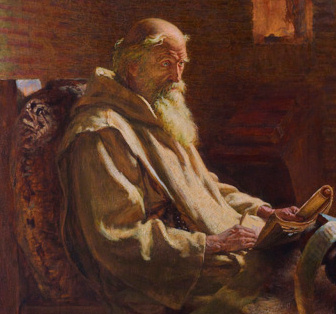
"The Venerable Bede Translates John" by James Doyle Penrose (1862-1932

The library in Jarrow was the largest library in England at the time. Bede became one of the most learned men in Western Europe.

All his works were written out by hand with ink made from ground up oak gall on vellum (animal skins).

Bede wrote 68 books in total, mainly religious biographies, scientific and theological works with a quill dipped in "encaustum", the monk’s word for ink.


Ecclesiastical History of the English People, Bede's classic historical tome written in Latin of the purest style, which tells of early Anglo Saxon kingdoms and their conversion to Christianity. Scrupulously researched, he even had a monk colleague gathering material for him in the Pope's archives in Rome.

Bede cited his references and was very concerned about the sources of all his sources, which created an important historical chain. He is credited with inventing footnoting.

An oddity in Bede's writings is that in one of his works, the Commentary on the Seven Catholic Epistles, he writes in a manner that gives the impression he was married. The section in question is the only one in that work that is written in first-person view, where Bede says: "Prayers are hindered by the conjugal duty because as often as I perform what is due to my wife I am not able to pray."

In those days when people did not believe the Earth was round, Bede wrote that the Earth was indeed round "like a playground ball", contrasting that with being "round like a shield".

Bede tells us of in writings of his interest in carpentry and music and how he enjoyed long walks along the Northumbrian coast that allowed him to study the movement of the tides.

Bede loved cooking and was especially proud of his store of peppercorns and spices that he added to improve the bland monastery food.

Late in life, Bede became almost blind because of the strain on his eyes of working long hours by candlelight. He would dictate his works to other monks, who would write them out for him.

Bede died on May 26, 735 (Ascension Day) on the floor of his cell, chanting "Glory be to the Father and to the Son and to the Holy Spirit" and was buried at Jarrow.


Cuthbert, a disciple of Bede's, wrote a letter to a Cuthwin describing Bede's last days and his death. According to Cuthbert, Bede fell ill, "with frequent attacks of breathlessness but almost without pain", before Easter. Two days before Bede died, his breathing became worse and his feet swelled.

On the evening of May 26th, Bede's scribe, a boy named Wilberht said, "Dear master, there is one sentence still unfinished." "Very well," he replied, "write it down." After a short while, the lad said, "Now it is finished." "You have spoken truly," Bede replied. "It is well finished. Now raise my head in your hands, for it would give me great joy to sit facing the holy place where I used to pray, so that I may sit and call on my Father." Singing "Glory be to the Father, and to the Son," he died.

When Bede died his estate was made up of some peppercorns, incense and handkerchiefs.

Bede's remains were moved to Durham Cathedral’s Galilee Chapel in 1370 and lie within a tomb chest sealed by a black marble slab.

Bede's tomb in Durham Cathedral

Bede is the only Englishman to be named by Dante as being in paradise in his Divine Comedy.

St Paul's Church, Jarrow, where Bede worshipped is still situated on the grounds of the monastery. A nearby metro station, Bede station is named after him.

Tuesday, 11 October 2011

Saint Augustine of Hippo

Saint Augustine (354-430) was born on November 13, 354 in the municipium of Thagaste (now Souk Ahras, Algeria) in Roman Africa.

Augustine admitted in his autobiography Confessions, that as a boy he "told lies to my tutors, my masters and my parents all for the love of games and the craving for stage shows." Young Augustine also stole pears from a neighbor's tree, and the sin troubled him for the rest of his life.

Augustine taught rhetoric at Carthage, and then handed in his notice as he had heard that the students in Rome were better behaved than their loutish counterparts in Paris or Carthage. The students in Carthage were prone to cheating the teachers of their fees.

He was slim, clean shaven, shaven haired with sharp features. If you go by the paintings of Augustine, he was very fair for a North African.

The earliest known portrait of Saint Augustine in a 6th-century fresco, Lateran, Rome

Augustine never married but he had several lovers prior to his conversion to Christianity. He later confessed that as a youth, he had the "most wicked sins of evil lusts."

Augustine was baptized, along with his son Adeodatus, on Easter Vigil on April 25, 387 in Milan. Augustine recorded his entrance into the church thus: "And we were baptized and all anxiety for our past life vanished away."


In his Confessions, Augustine describes the baptism ceremony thus: "I wept at the beauty of the hymns and canticles and was powerfully moved at the sweet sound of your church is singing. My feeling of devotion overflowed and the tears ran for my eyes and I was happy in them."

Tradition has it that whilst Augustine was being baptized by Saint Ambrose, the two of them improvised the "Te Deum Laudamus" (We Praise Thee O Lord) in alternate verses.

Baptism of St Augustine. Louis de Boulogne II. 1702.

In 391 Augustine was ordained a priest in Hippo Regius (now Annaba), in Algeria. Four years he was made coadjutor Bishop of Hippo, and became full Bishop shortly thereafter. He remained in that position until his death in 430.

The Hippo in Hippo Regius came from a Carthaginian word meaning harbor and had nothing to do with hippopotamuses.

He believed in evolution. Well, Augustine thought that some species of plants and animals had developed from earlier creations.


In Book 11 of Confessions Augustine recorded a startling, brilliant discovery. He came to see that God had not only created both time and space but had created them simultaneously and interdependently. This insight, which Augustine derived from meditation on the Bible, anticipated Einstein's theory of relativity by 1,500 years.

Augustine is partly to blame for the fallacy that Christians have a problem with fun. He confidently asserted that there was "no frivolous jollity" in Paradise.

The great theologian developed many Catholic doctrines helping make infant baptism, belief in purgatory and the teaching that there is no salvation outside the Catholic Church normal practice.

Portrait by Philippe de Champaigne, 17th century

Augustine's teachings that no one can really love God or believe in him properly until the grace of God comes to them influenced Luther and Calvin.

Augustine died aged 76 on August 28, 430 in Hippo, while the Vandals were besieging his Episcopal city. As he lay dying, Augustine had the penitential psalms copied on parchment and fixed to the wall of his room so he could read them from bed.

Pope John Paul II was once so taken by Gerald Depardieu’s resemblance to Augustine that he asked the French actor to impersonate the saint on a world tour.

Augustine wrote about 230 books and treatises and in addition around 350 of his sermons survive today. More of Saint Augustine's words survive than those of any other writer of antiquity.

Monday, 18 July 2011

Alcuin of York

Alcuin of York (c. 735 – May 19, 804) was an English scholar, who became a leading teacher at the Carolingian court.

Alcuin, roof figure, Museum of History of Arts, Vienna. By © Hubertl  Wikipedia

Alcuin was born in Yorkshire, England, sometime in the 730s. Virtually nothing is known of his parents, family background, or origins.

He was educated at the cathedral school of York and became the head of the school in 778.

During a mission to Rome in 780, Alcuin became acquainted with Charlemagne. He took up residence at Charlemagne's court in Aachen two years later.

Alcuin conceived new forms of education reconciling the classical studies of antiquity with those of religious texts. The reforms that he initiated led to the opening of schools throughout the Holy Roman Empire.

After a brief visit back home to England in 790, Alcuin returned to Charlemagne's court. In 794 at the Council of Frankfurt Alcuin led the successful fight against adoptionism, a heretical belief then dividing the Catholic church.

Alcuin was appointed abbot of Marmoutier Abbey near Tours in 796. The appointment was made with the understanding that Alcuin should be available if Charlemagne ever needed his counsel. He remained there until his death.

As abbot of Marmoutier Abbey, Alcuin encouraged the work of the monks on the beautiful Carolingian minuscule script, ancestor of modern Roman typefaces.

Alcuin had a reputation for holiness, yet he is not included in the canon of saints and never advanced to holy orders beyond those of deacon.

He wrote many letters, works on rhetoric, and poems. Alcuin's letters are among the most valuable sources of information about the social life and humanistic learning of 8th-century France.  Picture below shows Raban Maur (left), supported by Alcuin (middle), dedicating his work to Archbishop Otgar of Mainz (Right)

A Carolingian manuscript, c. 831

One phrase of Alcuin is frequently quoted, from a letter to Charlemagne in 800: Vox populi, vox Dei (the voice of the people is the voice of God). In isolation it sounds like an early call for democracy, but this was precisely the opposite of Alcuin's meaning. He urges the emperor that "those people should not be listened to who keep saying Vox populi, vox Dei, since the riotousness of the crowd is always very close to madness."

His words “Lord, open our lips. And our mouth shall proclaim your praise,” begin many Anglican services.

Alcuin died on May 19, 804, some ten years before the emperor, and was buried at St. Martin's Church, Tours.

Alcuin produced the epitaph for his own gravestone, which reads “My name was Alchuine, and wisdom was always dear to me.”

The impetus given to humanistic studies by Alcuin and his successors led not only to a revival of learning but also to the development of the Carolingian minuscule, a script that influenced the handwriting of the Renaissance in Italy and, indirectly, the Roman letters of the early Italian typesetters, from which modern type is derived. 


Sources Funk & Wagnells Encyclopedia,  Encyclopedia Of Britain by Bamber Gascoigne