Search This Blog

Showing posts with label Missionary. Show all posts

Friday, 9 August 2019

Francis Xavier

EARLY LIFE 

Francis Xavier was born Francisco de Jaso y Azpilcueta on April 7, 1506. He entered this world in the royal castle of Xavier, near Sangüesa and Pamplona, in the Spanish kingdom of Navarre.

A painting of Saint Francis Xavier, held in the Kobe City Museum

Francisco was born into an aristocratic Basque family. He was the youngest son of a high government official. Francisco's father lost his post when Spain won possession of Navarre.

Francis's mother was Doña María de Azpilcueta y Aznárez, sole heiress of two noble Navarrese families.

In 1512, Castile invaded Navarre. Many fortresses were devastated, including the family castle, and land was confiscated.

The castle of the Xavier family By Jsanchezes,

Francis' father died in 1515.

Francisco was first taught by his father’s chaplain then later entered the University of Paris.

UNIVERSITY AND EARLY CAREER

At the age of 19 Francis went to study in Paris at the Collège Sainte-Barbe, University of Paris where he earned the title of Magister- similar to a modern Doctor of philosophy degree.

Francis furthered his studies at Paris University in theology, and became acquainted with Ignatius Loyola, who was already planning the foundation of the Society of Jesus. Ignatius won the confidence of Xavier. Five others having joined them, the seven professed vows of poverty, chastity, and later obedience to the Pope in the church of Montmartre, Paris, on August 15, 1534.

Church of Saint-Pierre de Montmartre, Paris

The seven vowed to leave at the end of 1534 for the  Holy Land to convert infidels. But the war between the Venetians and the Turks prevented this, and the pope detailed them to other tasks.

In 1537, the Jesuit fraternity traveled to Italy to seek papal approval for their order. Pope Paul III gave them a commendation, and permitted Xavier and his colleagues to be ordained priests. On June 24, 1537, Xavier received Holy orders with St. Ignatius.

MISSIONARY WORK 

Known as "The Apostle of the Indies" Xavier had high qualifications to be a missionary: he was animated with glowing zeal; endowed with great linguistic gifts, and restless pushing forward marked his activity.

In 1541 Francis Xavier was commissioned by King John III of Portugal to preach the Christian faith in the Portuguese colonies in the East, thus marking the beginning of the Jesuit missions. He left Lisbon on April 7, 1541, his thirty-fifth birthday, along with two other Jesuits and the new viceroy Martim Afonso de Sousa, on board the Santiago.

Francisco Xavier asking John III of Portugal for an expedition

After a 13-month voyage, Xavier arrived in Goa, India in 1542 and during the few months he stayed there he sparked off a moral revolution.

Xavier learned that along the coast, which extends from Cape Comorin on the southern tip of India to the island of Mannar, off Ceylon (Sri Lanka), there was a group of people called Paravas. Many of them had already converted to Christianity in return for Portuguese protection but know little about the religion they had adopted. Accompanied by several native clerics from the seminary at Goa, Xavier set sail for Cape Comorin in October 1542.

Once he arrived in South India, Xavier started laboring amongst the pearl fishers there. When he rang a handbell, the villagers gathered in the church, then Xavier recited the Lord's Prayer, the Ten Commandments, the Creed and the Rosary. He then explained to them through interpreters about the meaning of the words and many of these poor people with their faith strengthened turned from nominal Christianity to a real faith.

Conversion of the Paravars by Francis Xavier in South India,19th-cent lithograph

Xavier met a Japanese man from Kagoshima named Anjirō in Malacca in December 1547. Anjirō became the first Japanese Christian and adopted the name of 'Paulo de Santa Fe'. He later helped Xavier as a mediator and interpreter.

Xavier reached Japan on July 27, 1549, with Anjirō and three other Jesuits, only six years after the first ever Portuguese merchant visited there. 

When Xavier arrived in Japan the local Japanese people initially assumed that the he was Buddhist monk from India and that Christianity was a new Buddhist sect.

After learning Japanese at Kagoshima, Xavier was given leave to teach as a representative of the Portuguese King. During his time teaching as a representative of the Portuguese King Xavier made 150 converts.

After the feudal ruler of his area made it a capital offence to become a Christian, Xavier set out as a wandering missionary. During 1551, Xavier preached in some important cities, forming the nucleus of several Christian communities, which in time increased with extraordinary rapidity.

He most remarkable mission was establishing a Christian community, which has survived to this day, despite numerous periods of severe persecution.


In both South India and Japan Xavier was granted the gift of tongues, healed countless people, raised several from the dead and prophesied the future.

PERSONAL LIFE 

A bright and cheerful man of great personal charm, Xavier had both abundant common sense and a mystical sense. He was a man of remarkable energy and organisational ability.

In his early years at the University of Paris, Xavier acquired some reputation as an athlete especially as a high-jumper.

LAST YEARS, DEATH AND LEGACY 

After working about two years and a half in Japan Xavier left this mission in charge of Father Cosme de Torres and Brother Juan Fernández, and returned to Goa, arriving there at the beginning of 1552. During his trip to Goa, he had met Diogo Pereira, a rich merchant and an old friend from Cochin. Pereira showed him a letter from Portuguese prisoners in Guangzhou, asking for a Portuguese ambassador to speak to the Chinese Emperor on their behalf.

On April 17, 1552 Xavier set sail with Diogo Pereira on the Santa Cruz for China. He reached the Chinese island of Shangchuan off the shore, near Canton and whilst waiting for a junk to take him to the mainland, he fell ill with a fever. A poor man, George Alvarez, found him lying on the shore and carried him to his hut. He died on the island on December 2, 1552, at age 46, without having reached mainland China.

By Nicoco007 -

Xavier was first buried on Shangchuan Dao’s beach. His intact body was taken from the island in February 1553. It was temporarily buried in St. Paul's church in Malacca on March 22, 1553. An open grave in the church now marks the place of Xavier's burial. Pereira came back from Goa, removed the corpse shortly after April 15, 1553, and moved it to his house.

On December 11, 1553, Xavier's body was shipped to Goa. The body, having resisted extensive decay, is now in the Basilica of Bom Jésus in Goa, where it was placed into a silver casket on December 2, 1637. This casket, constructed by Goan silversmiths between 1636 and 1637, was an exemplary blend of Italian and Indian aesthetic sensibilities.

Casket of Saint Francis Xavier in the Basilica of Bom Jesus in Goa, India

There is a debate as to how the body could have remained incorrupt for so long. Some say that Francis Xavier was mummified, while others argue that the incorruptible body is evidence of a miracle.

The silver casket is lowered for public viewing only during the public exposition which occurs for a duration of six weeks every ten years, the most recent of which took place between November 22, 2014 and January 4, 2015.

Xavier was canonized with St. Ignatius in 1622, although on account of the death of Gregory XV, the Bull of canonization was not published until the following year.

Pius XI named St. Francis Xavier in 1927 the patron Saint of Catholic Missionaries in foreign countries.

His feast day is December 3.

Sources CatholicEncyclopaedia, Donmartin

Tuesday, 29 May 2018

Charles Studd

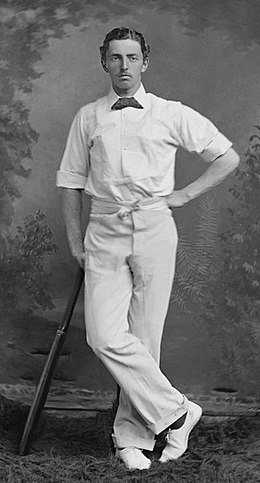
Charles T Studd, often known as C. T. Studd (December 2, 1860 July 16, 1931) was an outstanding cricketer who represented England in international matches against Australia. 

Studd played for England in the 1882 match won by Australia, which was the origins of The Ashes. He was also in the English team that returned from Australia in triumph in 1883 with the Urn. Studd was twice declared to be "the best all-round cricket player" in England. 

Charles T Studd

His wealthy father Edward Studd was converted to Christianity during an 1876 Moody and Sankey campaign in England. A visiting preacher to the Studd home at Tidworth converted Charles and his two brothers to the faith while they were students at Eton. 

At first Charles didn't take his faith seriously but years later, attending another D. L. Moody revival meeting, he was brought to a position of full surrender to Jesus Christ.

Studd was one of the "Cambridge Seven," six students from Cambridge University and one from the Royal Military Academy, who offered themselves to Hudson Taylor for missionary service at the China Inland Mission, leaving for there in February 1885.

The Cambridge Seven

Studd's favourite doggerel was:
"Some want to work within the sound
Of church or Chapel Bell
I want to run a rescue shop
Within a yard of hell."

Studd was sent home from China because of ill health in 1894. Between 1900–1906 Studd served as pastor of a church at Ootacamund in Southern India.

In 1910 Studd sailed for Africa, contrary to medical advice. Studd's only companion in Africa was a 21-year-old medical student and together they founded churches in what is now the Democratic Republic of Congo.

Studd founded in 1913 the Heart of Africa Mission, which later became the Worldwide Evangelisation Crusade, (now called WEC International) a mission that currently has over 1,800 workers evangelizing throughout the world.


CT Studd served in Africa until his death 21 years later.

Source Reformationsa

Saturday, 7 January 2017

Saint Patrick

EARLY LIFE 

St. Patrick was born in Roman Britain c 387. His birthplace was somewhere along the west coast of Britain in the little settlement or village of Bannavem of Taburnia, which has never been identified with certainty.

Statue of St Patrick near Saul, Ireland Wikipedia

In his Confessions Patrick mentions his father Calpornius, a deacon, civil official, and a town councilor, who had a farm by the sea. His grandfather was Potitus, a Romano-British priest.

An old tradition makes Patrick's mother from the upper-class Gaulish family of Martin of Tours, though Patrick himself makes no such claim.

Patrick's real name was probably Maewyn Succat. The only name that he uses for himself in his own writings is Pātricius.

CAPTIVITY 

At the age of 16, Patrick was carried off by pirates from the western coast of Wales to Ireland where he was sold as a slave. His parents were killed by the same barbarians who took Patrick captive.

While in captivity, Saint Patrick worked as a herdsmen of sheep and pigs on Mount Slemish in Co. Antrim. His sole companion was a dog.

Slemish, County Antrim, traditionally associated with Saint Patrick's time as a shepherd slave.

Patrick considered his kidnapping and slavedom as a punishment for his lack of faith and he turned to God and became a man of deep prayer.

After six years of captivity Patrick heard a voice telling him that he would soon go home. Fleeing his master, he traveled to a port, two hundred miles away, where he found a ship with a cargo of hunting hounds travelling to Gaul. Patrick had no money to pay his passage, so was originally received rather unsympathetically, but once the captain noted the calming effect the runaway slave had on the dogs, he was allowed on board and put in charge of the hounds.

EDUCATION 

Having escaped slavedom, Patrick entered a monastery in Auxerre, Gaul to start training for the priesthood. He refers to himself in Confessions as badly educated and indeed his Latin was poor.

Though he studied principally at Auxerre, Patrick is thought to have visited the Marmoutier Abbey, Tours and to have received the tonsure at Lérins Abbey. Saint Germanus of Auxerre ordained the young missionary.

MISSIONARY ACTIVITY IN IRELAND

In 432 Patrick was called in a dream to return to Ireland. During his vision, the babies of the Emerald Isle pleaded with him to return to their land and tell them about Christ. There were already some Christians in Ireland but Patrick hoped to bring about a mass acceptance and an organized church.

When St Patrick landed in Wicklow Town, the villagers greeted him by throwing stones. He was forced to leave to seek a more welcoming landing place further north.

Patrick decided to sail up the coast to county Antrim, where, as a young man, he’d tended flocks on the mountain. However strong currents swept his boat from the harrows at Strangford in County Down and he landed where the river flows into Strangford Lough, near Downpatrick.


Patrick's strategy was to become a Christian druid to the Irish druids. In order to demonstrate the power of God he planned to preach a Gospel of power to the magician druids who performed human sacrifices and worshiped spirits in the hills as well as natural elements. Patrick took them on in Elijah-like contests to demonstrate the power of God.

Patrick confronted the High King Laoghaire and his Druid priests at Tara, the political center of the Kingdom, on the eve of Easter 433. At Tara, Patrick defied the Druid law and kindled his famous Paschal fire on the Hill of Slane, not far from Dublin. The fire could not be doused by anyone but Patrick, which silenced the Druids and enabled him to gain a hearing.

St. Patrick explained the doctrine of the Holy Trinity to the Irish people by showing people the shamrock. He used the three-leafed plant to illustrate the Christian teaching of three persons in one God. The shamrock has since become a central symbol for St Patrick's Day.

St. Patrick depicted with shamrock in stained glass window in St. Benin's Church, Kilbennan. By Andreas F. Borchert, 

In 441 Patrick spent 40 days in retreat on the Crough Patrick Mountain, fasting and praying with tears that Ireland might be delivered from the hands of the pagans. Every night an angel appeared to him with more and more promises from God arising from his prayers. Patrick stubbornly refused to leave the mountain until all his prayers were answered including that at the last judgement Patrick himself should be appointed to pronounce judgement on the Irish people. Finally he was assured by the angel that all his prayers had been heard and he descended the mountain pausing only to preach a sermon in which he cast the snakes (meaning the serpent symbolism of the Irish pagans) out of Ireland.

Image of St. Patrick banishing the snakes

St Patrick's Purgatory is a great subterranean cave situated on Station Island in Lough Derg in Ulster, where the saint used to meditate on the judgement of God.

The importance of St Patrick's Purgatory in medieval times is illustrated by the fact that it is the only Irish site designated on Martin Behaim's world map of 1492. The cave has been closed since October 25, 1632, when the monastery on the island was dissolved.

Since Patrick's death it has been a place of pilgrimage. The importance of The Purgatory of St Patrick in medieval times is illustrated by the fact that it is the only Irish site designated on Martin Behaim's world map of 1492. The cave has been closed since October 25, 1632, when the monastery on the island was dissolved.

Photo below the chapel and bell tower on Station Island. The bell tower stands on a mound that is the site of the original cave.

Chapel and bell tower on Station Island By Egardiner0 

After a dozen years of spreading the gospel in Ireland Patrick built a church in Armagh, an area which Dichu, a down chief, had given him. By establishing his headquarters in Armagh, Patrick marked the community's emergence as the ecclesiastical capital of Ireland with him becoming the first bishop of Armagh.

Armagh is today the primary seat of both the Catholic Church in Ireland and the Church of Ireland, and both cathedrals in the town are named after Patrick.

MUSIC AND LITERATURE 

According to legend, when St Patrick was fresh to Ireland he was visited by two angels who told him he should record the pagan songs and rescue them from oblivion. Other Irish Monks did this along with Patrick and the Irish literary tradition was preserved.

In the Confession of St Patrick, he reviews his life and work and his sense of calling. The work was written in rude Latin and is considered genuine though with some later alteration to conform to the legend of St Patrick.


The only other surviving work of Patrick’s is his letter to Coroticus, a chieftain of an Irish tribe where he denounces an attack by Coroticus’ men on one of his congregation.

PERSONAL LIFE 

Patrick was walking along the shores of Lough Neagh when accosted by a tearful St Bridget. Her nuns had mutinied as they weren't allowed to propose marriage, St Patrick offered to allow them to do so every seven years. Bridget negotiated him down to one year in four-leap year. The happy Bridget then proposed to Patrick who solved the problem by giving her a kiss and a silk gown instead. Thus he initiated the custom for women proposing marriage on February 29 and receiving a silk gown if turned down.

Saint Patrick himself may have studied alongside Egyptian monks in Gaul. There is a legend that he learnt from them the process of distillation and taught the Irish the process of distilling cereals to make a cheering, warming drink.

LAST YEARS AND DEATH 

A variety of dates are given for Sr Patrick's death. It is likely to have been either 461 when the annals say that "Here some record the repose of Patrick or in 492/3 where they record the death of "Patrick, the arch-apostle (or archbishop and apostle) of the Scoti", on March 17, at the age of 120.

Saint Patrick was reputedly buried on Cathedral Hill, Downpatrick together with Saint Brigit and some relics of Saint Columba. Down Cathedral was later constructed on this spot. His grave is still a place of pilgrimage on St Patrick's Day

Reputed grave of St. Patrick in Downpatrick

LEGACY 

Saint Patrick is widely venerated in Ireland and elsewhere today. March 17 is believed to be his death date and is the date celebrated as his Feast Day. He is the patron saint of Ireland.

March 17 became a feast day in the Catholic Church through the efforts of the Irish Franciscan scholar Luke Wadding, as a member of the commission for the reform of the Breviary in the early part of the seventeenth century.

The first St. Patrick's Day celebration was held in America on March 17, 1737 by the Charitable Irish Society of Boston.

The Saint Patrick Visitor Centre in Downpatrick is purpose-built to tell the story of the Irish patron saint. It is the only permanent exhibition in the world dedicated to Saint Patrick.

Sources The Independent, Irish-genealogy-toolkit.com

Monday, 27 June 2016

Lottie Moon

On July 7, 1873 after waiting many years for her church to agree that women could be missionaries, 32- year-old Southern Baptist Charlotte Digges "Lottie" Moon  (1840-1912) of Virginia was appointed as a Baptist missionary to China.

Lottie joined her sister Edmonia at the North China Mission Station in the treaty port of Dengzhou, in Shandong, and began her ministry by teaching in a boys school.

A gifted linguist, she quickly picked up the Chinese language and for 40 years "the cookie lady" taught and cared for Chinese children. She also wrote numerous letters back home to America, mobilizing many women to pray, give or to even become missionaries themselves.

Lottie Moon

In her 70s, Lottie gave away all her money and possessions to help provide for the starving Chinese.

Lottie Moon died on December 24, 1912 on board a ship returning home to the States and at her death she weighed barely 50 lbs.

For many years Southern Baptist foreign missions have been supported through the Lottie Moon Christmas Offering, which has raised hundreds of millions of dollars. It finances half the entire Southern Baptist missions budget every year.

Thursday, 4 February 2016

David Livingstone

EARLY LIFE

David Livingstone was born on March 19, 1813 in a Glasgow worker's tenement in the mill town of Blantyre, Strathclyde, Scotland

He was the second of seven children born to Neil Livingstone (1788–1856) and his wife Agnes (née Hunter; 1782–1865).

Livingstone's father ran his own business as a door-to-door tea salesman, so the room was constantly fragrant with the smell of tea.

David Livingstone's birthplace The National Trust, having taken over the running of the museum from the original Trust, has recreated the look of the room of Livingstone's family using furnishings and artefacts from around 1800. By kim traynor, CC BY-SA 2.0,Wikipedia Commons

His father was a Calvinist Congregationalist who distributed tracts as he sold tea. Neil Livingstone disapproved of non religious novels and science books. The only escapism young David was allowed were travel books like Robinson Crusoe.

David was employed at the age of 10 in the cotton mill of Henry Monteith & Co. in Blantyre Works in order to help support his impoverished family. He and his brother John, worked twelve-hour days as piecers, tying broken cotton threads on the spinning machines.

From a young age, David had a thirst for knowledge. While working in the cotton mill, David laid a Latin crammer on the spinning jenny so he could learn as he worked. Other urchins threw spindles to knock it down.


MISSIONARY CAREER 

At the age of 21, Livingstone was inspired to take up Theology and Medical studies after hearing an appeal by British and American Churches for medical missionaries to go to China.

Livingstone took a medical degree at Glasgow University, walking nine miles to and from his home.There he attended medicine and Greek classes in the winter and took a Theological course in the summer as preparation for the calling he was experiencing to be a missionary overseas.

Livingstone was prevented from going to China by the Opium War and after a conversation with the the founder of the London Missionary Society, Robert Moffat, he decided to take up his work in Africa. He started his missionary training at the Congregational Church, Ongar, Essex.

Livingstone was a poor speaker. On his first sermon for the London Missionary Society, he stood in the pulpit for five minutes in silence. The tongue-tied fledgling preacher then admitted he had forgotten all he had to say.

He was a student at the Charing Cross Hospital Medical School from 1838–40; Livingstone's courses covered medical practice, midwifery, and botany.

Livingstone was posted to the Kuruman Mission North Cape Colony in Africa. The newly ordained medical doctor set out for South Africa in December 1840, little realizing he would be gone 16 years. The voyage, via Brazil, was so rough the little sailing ship was tossed like "a ship in a fit of epilepsy." Three months later, he arrived in Cape Town, the main British colony.

Posthumous portrait of David Livingstone by Frederick Havill

He spent his first six months in Africa cut off from European society in modern day Botswana, with the Bechuna people learning their language and traditions.

When the Bechuna chief, Sechele, became a Christian, Livingstone had to prevent the new convert from forcing other members of his tribe to follow him in the faith by whipping them with rhinoceros hide.

Livingstone made very few conversions, in his first twelve years in Africa, Sechele was his only convert. Even The Times criticized him for not winning more converts.

AFRICAN EXPLORATION

In 1855, while walking across Africa from West to East, David Livingstone became the first white man to see Victoria Falls. Later he described the Falls as "scenes so lovely, they must have been gazed upon by angels in their flight."


Livingstone returned to England in 1856 a national hero. He arrived at Christmas and Queen Victoria was there to greet him. However the London Missionary Society complained that his activities have only the remotest connection with the spread of the Gospel.

Livingstone's Missionary Travels and Researches in South Africa, first published in 1857, described his travels and work in parts of southern and central Africa previously unknown to Europeans. It was an immediate bestseller, selling 70,000 copies.

He made more than 120 times his £100 annual London Missionary Society salary from the royalties for the book which he used for his family and his expeditions. Despite its success, Livingstone reportedly said "I think I would rather cross the African continent again than undertake to write another book."

The British government agreed to fund Livingstone's idea and he returned to Africa as head of the Zambezi Expedition to examine the natural resources of southeastern Africa and open up the River Zambezi.  It was a complete failure as the Zambezi turned out to be completely impassable to boats past the Cahora Bassa rapids. Livingstone eventually returned home in 1864 after the government ordered the recall of the expedition because of its increasing costs and failure to find a navigable route to the interior.

The journeys of Livingstone in Africa between 1851 and 1873. Uploaded by Hans Erren - Gutenberg project, Public Domain, Wikipedia Commons

Livingstone was the first person to discover the Tsetse fly, the bearer of sleeping sickness to millions.

BELIEFS 

Livingstone was a committed Christian. "I will place no value on anything I have or may possess, except in relation to the Kingdom of Christ," he once said

Livingstone believed it was Europe's duty to bring the 3 C's to Africa, Christianity, commerce and civilization. His main motive for his journeys was to drain the Arab slave trade. He hoped to replace the slave economy with a capitalist economy: buying and selling goods, like beeswax and ivory, instead of people.

Livingstone partially financed his travels by trading goods from one native state to another: guns for bronze, bronze for elephant tusks, tusks for slaves (whom he escorted to safety and set free), arriving at the coast with cart-loads of ivory left over.

PERSONAL LIFE 

Livingstone spoke slowly with a Lanarkshire accent.

He was not an easy man, being awkward, dour, shy and bad tempered. Livingstone was prone to quarreling with white men, through whom he suffered in his later years. He preferred the company of Africans to whom he was gentle and kind.

Livingstone married Mary Moffat, the daughter of Robert Moffat, in January 1845. They loved each other deeply and for the next eight years she accompanied him in Africa.

In 1852, after seven years of marriage, Livingstone escorted Mary and the children to Cape Town, his first visit to "civilisation" in 11 years. He put them on the boat to Britain, and did not see them again for four years.

In 1858 Livingstone sailed to Cape Town with his wife and young son, he left them there and he attempted unsuccessfully to sail up the Zambezi. Tragically Mary died of malaria on April 27, 1862 in his arms only days after joining him at the mouth of the Zambezi.

Burial site of Mary Moffat Livingstone in Chupanga, Mozambique.By Soccerman321 - Wikipedia Commons

Though often separated from her husband for years at a time, Mary gave birth to six children in their 17 years of marriage.

MEETING WITH STANLEY 

In January 1866, Livingstone returned to Africa for a third time, this time to Zanzibar, and from there he set out to seek the source of the Nile.

By 1871 he had been lost to the world for over five years and had trekked 30,000 miles in his attempt to find the source of the Nile. His men had deserted him and he has been left with just four native boys. The Bible verse that sustained Livingstone through the years of loneliness in a hostile land, where strange languages are spoken, was "Lo, I am with you always, even unto the end of the Earth." (Matthew 28 v 20)

The journalist H.M. Stanley eventually found Livingstone at Ujiji, on the bank of Lake Tanganyika on November 10, 1871 and greeted him with the famous words "Dr Livingstone I presume".

Henry Morton Stanley meets David Livingstone

Livingstone had spent several months resting at Ujiji. He was suffering from fever, dysentery and foot ulcers, having had his medicine chest stolen. In addition for many years he'd had to endure the pain from an un-united fracture of the upper left arm after a lion bite.

When Stanley found Livingstone, the Scottish explorer was wearing a bluish cap with a faded gold band around it, a red sleeved waistcoat and a pair of grey white trousers.

Stanley described Livingstone as "pale looking, grey bearded."

Livingstone's report on his discovery of Lake Nyasa included a comment on the way Arabs had destroyed the local African tribal society by using them as slaves to haul ivory overland. Livingstone suggested that steamers on the lake would be the solution to this problem. Stanley took this report back to England and they became a catalyst in awakening the nation's conscience. The Government was forced to use it's influence to end the trade and the African Lakes Company was set up to arrest the situation.

LAST YEARS AND DEATH 

Livingstone was determined not to leave Africa until his mission was complete. He died on May 1, 1873, at the age of 60 at Old Chitambo, Zambia, while still searching for the source of the Nile in the headwaters of the Zambezi, ignoring the advice of his guides.

Livingstone Memorial in Ujiji, Tanzania. By Peter Levey, Wikipedia Commons

While his body was being prepared for burial, a blood clot several inches long was found obstructing his small intestine, evidence that his death had been hastened by severe hemorrhoidal bleeding

His body was carried 1500 miles across harsh equatorial terrain for ten months to the coast by his loyal attendants Chuma and Susi, and shipped to England.

His death alone in Africa touched the nation and helped get Livingstone's anti slavery message across.

Livingstone's heart was buried by his followers within the roots of an old African tree. On it's bark a native carved "Dr Livingstone May 4th 1873". The tree was later sent to England in a box.

Three of Livingstone's nieces, who were pupils at Walthamstow Hall School, Kent, got hold of some seeds from the tree and over hundred years later, in 1992, they were planted in a greenhouse. They are now healthy saplings.

Source Christinity.com

Saturday, 2 January 2016

Pope Leo XIV

Pope Leo XIV was born Robert Francis Prevost on September 14, 1955 at Mercy Hospital in Chicago, Illinois. 

EARLY LIFE

Young Robert was raised in a bilingual household with French Canadian roots, where the Sacred Heart of Jesus shared wall space with a Chicago Cubs calendar. He was reportedly a quiet child, fond of libraries and guitars, and once served as the best altar boy in his parish for three consecutive years—an achievement that earned him a glow-in-the-dark rosary and a firm handshake from the bishop.

Robert was the editor-in-chief of his high school's yearbook.

Prevost's childhood home in Dolton, Illinois by Michael Howie,

He joined the Order of St. Augustine in his teens and went on to study theology in Rome, where he developed a taste for both espresso and ecclesial nuance. But it was in the Andes of northern Peru—not in the marble halls of the Vatican—that he found his true spiritual home.

MISSIONARY IN PERU

Sent to Chulucanas in the 1980s, Prevost embraced missionary life with the zeal of a friar and the practicality of a Midwesterner. He learned Spanish (and enough Quechua to impress grandmothers at village festivals), rode mules to remote parishes, and once helped build a chapel roof using palm fronds, prayer, and a borrowed hammer.

In one oft-repeated local story, Father Prevost postponed a regional meeting of clergy to deliver medicine to a highland family struck by dengue fever—proving that for him, the “periphery” wasn’t a theological buzzword but a real place with names, needs, and neighbors.

Eventually he became bishop of Chiclayo, a bustling coastal diocese where he was known for traveling without entourage and for quoting St. Augustine during Sunday homilies—sometimes to puzzled teenagers, always with conviction.

FROM BISHOP  TO POPE 

In 2014, after decades in Peru, Prevost was unexpectedly called back to his native United States to become bishop of the Diocese of Chicagoland’s lesser-known cousin—Chiclayo, Peru. From there, he was swiftly noticed in Rome for his mix of doctrinal orthodoxy, pastoral warmth, and an uncanny ability to manage both spreadsheets and seminarians.

The Vatican first tapped him for advisory roles on Latin American clergy formation, but he didn’t truly step into the spotlight until 2020, when Pope Francis brought him into the Dicastery for Bishops—essentially the department in charge of vetting and recommending bishops worldwide. It was here that Prevost became known as “The Augie Whisperer” for his habit of quietly but firmly advancing humble, community-rooted pastors over polished climbers.

By 2023, he was made Prefect of the Dicastery—a job that is part HR director, part talent scout, part ecclesial gatekeeper. Insiders say he kept a small notebook listing prospective bishops, which he cross-referenced with prayer requests and notes about how they treated their staff.

Cardinal Robert F. Prevost at the Consistory in 2023

In an institution sometimes known for its Byzantine bureaucracy, Prevost stood out for his insistence that holiness was more important than a résumé—and that bishops should smell like their sheep, not their incense. He played a key role in promoting less clerical, more community-rooted shepherds—sometimes to the confusion of careerist monsignors used to silk cassocks and smooth corridors.

He also won points for his unruffled manner in high-stress meetings and his trademark pastoral quip: “A bishop isn’t a CEO—he’s a shepherd, and sometimes a shepherd has to carry the sheep and fix the fence.”

Provost was known in the Curia for wearing sandals well into November and quoting St. Augustine in multiple languages. 

Though he remained relatively low-profile outside church circles, Vatican-watchers quietly began floating his name as papabile—a potential future pope. When the conclave of 2025 began,  following the death and funeral of Pope Francis, few expected the quiet American friar with Peruvian roots to emerge in white.

PAPACY

Robert Francis Prevost was elected pope on May 8, 2025. Upon election, he chose the name Leo in homage to both Leo I (who talked Attila the Hun out of sacking Rome) and Leo XIII (who issued Rerum Novarum, the foundational text of Catholic social teaching). The “XIV” raised eyebrows in trivia circles, as no Leo had reigned in over 120 years—leading some to joke that “he must be a fan of sequels.”

Despite the dramatic expectations often attached to new papacies, Leo XIV began his reign quietly, reportedly spending his first morning in the Domus Sanctae Marthae cafeteria, sipping coffee and asking the staff about their families.

He is the first pope to have been both a missionary bishop in Latin America and a Vatican official in Rome—what one Vatican wag dubbed a “bicameral pope.”

Pope Leo XIV's Spanish is fluent, his demeanor quietly tenacious, and his theology refreshingly pastoral—he once described ecclesial reform as “more like gardening than engineering.”

Pope Leo XIV still plays Wordle and Words With Friends with his brother during their daily phone calls, a routine they kept from before his election.


Wednesday, 17 June 2015

The Haystack Prayer Meeting

In 1806 five students from Williams College in Massachusetts met together to pray together for world missions under a New England haystack during an afternoon thunderstorm. Their prayers became increasingly fervent as rather than their usual invocation for a spiritual revival on campus, instead they began praying for a missionary movement that would carry the gospel from New England to Asia and other distant lands.

Once the storm had abated one of the students Samuel Mills (1783-1818) stood up and cried "We can do this, if we will". This became their adopted motto as they proceeded to answer their own prayers by forming the Society of the Brethren, one of the first Protestant missionary societies and the first nationwide student missionary movement in North America.

In 1816 Mills was influential in forming the American Bible Society to provide Bibles for the pioneers flooding into the American mid west and the various tribes of Indians.

Friday, 10 April 2015

Vincent Van Gogh

EARLY LIFE 

Vincent van Gogh was born on March 30, 1853 in Groot-Zundert, a village close to Breda, in the predominantly Catholic province of North Brabant in the southern Netherlands. He was the oldest surviving child of Theodorus van Gogh and Anna Cornelia Carbentus.

His father, a calvinist minister of the Dutch Reformed Church, died in 1885. Van Gogh found his father's profession appealing and would be drawn to it later in his life.

Theodorus van Gogh

Vincent was given the name of a brother stillborn exactly a year before his birth. He felt unwanted as a child feeling he was a substitute for the other Vincent who his parents had tragically lost

Vincent didn't get on with his three sisters, one of whom  described him as serious and introspective. However, he cherished a lifelong friendship with his brother Theo, who was four years his junior.

In 1864 his parents unable to cope with Vincent's prickly temperament sent him away to a school in Zevenbergen where he spent five unhappy years.

Vincent c. 1866, approx. age 13

CAREER

In July 1869, Van Gogh's uncle Cent helped him obtain a position with the art dealer Goupil & Cie in The Hague.

After his training, in June 1873, Goupil transferred him to London, where Van Gogh lodged at 87 Hackford Road, Brixton and worked at Messrs. Goupil & Cie's offices at 17 Southampton Street, near Convent Garden.

Van Gogh became moody after being rejected by a girl and was transferred to Goupil & Cie's Paris branch, where he became resentful at how art was treated as a commodity and started to lecture prospective customers on moral issues. On April 1, 1876, Goupil dismissed Van Gogh for lack of motivation.

Goupil & Cie Editeurs, Place de l'Opéra, Paris

Van Gogh returned to England for unpaid work as a supply teacher in a small boarding school in Ramsgate, where he taught languages and maths. When the proprietor of the school relocated to Isleworth, Middlesex, Van Gogh moved with him, but the arrangement did not work out and he left to become a Methodist minister's assistant.

Whilst living in England Van Gogh fell in love with the country’s national game of cricket.

At Christmas 1876, Van Gogh  returned home and found work in a bookshop in Dordrecht for six months.

To support his wish to become a pastor, Van Gogh's family sent him to Amsterdam to study theology in May 1877, but he failed the entrance exam.

After dropping out in 1878, Van Gogh became a missionary in a poor Belgian mining region known as the Borinage.

Bulb Fields (see below) was the first garden painting by Vincent van Gogh. Completed in The Hague in 1883, this painting depicts rectangular plots of blue, yellow, pink, and red hyacinths.


After his father's death on March 26, 1885, Van Gogh worked constantly in all the hours under the sun with little sleep to try to make a go of life as an artist. He painted furiously all the time, never stopping, slowly cracking up.

In the months following his father's death, Van Gogh painted The Potato Eaters, considered his first major work. The painting symbolized the rugged, honest peasant, wrestling life and livelihood from the soil.

Van Gogh had received little formal art training until the winter of 1885-86 when he spent three months at the academy in Antwerp. This proved a disappointment, as he was dismissed after a few months by Professor Eugène Siberdt.

In 1886 Van Gogh went to Paris to join his brother Théo, who was the manager of Goupil's gallery. Theo had supported Vincent financially throughout his life and he was able to introduce him to the impressionists in Paris such as Gauginm Cezanne and Monet.

In 1888 Van Gogh rented and decorated a yellow house in Arles, south east France in which he hoped to found a community of “impressionists of the south.”

Van Gogh first painted his masterpiece, Sunflowers in Paris in 1887. His still life of 15 sunflowers in a jar came about after the troubled artist stumbled on the past-their-best flowers discarded in the street. He returned to his subject a year later in Arles, this time showing bouquets of sunflowers in a vase.

Sunflowers

Van Gogh used slanted lines to depict rainfall in his 1889 painting Rain, drawing inspiration from Japanese prints such as those by Hiroshige.

Van Gogh painted a picture a day for the last 70 days of his life.  ll in all, he produced 900 paintings in a 10 year career, making him one of the most prolific painters of all time. However, by the time of his death in 1890, he had only sold one painting. The Red Vineyards Near Arles was bought by the Belgian artist Anna Boch.

Van Gogh had the habit of sucking on or biting his paintbrushes while he worked

RELATIONSHIPS

Van Gogh was red haired, freckled, with extremely deep bright blue green eyes,

Self-Portrait, September 1889

Whilst in England Van Gogh fell in love with his Landlady's daughter, Eugénie Loyer. He was unable to confess to her of his feelings until he was about to return to Holland. When Vincent finally told her of his love, she rejected him, saying that she was secretly engaged to a former lodger

In 1881, Van Gogh declared his love to his widowed cousin Kee Vos, who rejected him with the words "No, nay, never" ("nooit, neen, nimmer").

Van Gogh move in with the prostitute Sien Hoornik and her children in 1882 and considered marrying her; his father was strictly against this relationship and even his brother Theo advised against it. They separated a year later.

Jeanne Calment, the French supercentenarian who has the longest confirmed human lifespan on record  lived in Arles, France and worked in her father's shop, eventually selling Van Gogh a set of colored pencils. She recalled Van Gogh was: "Ugly as sin, bad tempered, a grumbler and smelling of alcohol."

CHRISTIAN MINISTRY

Van Gogh wished for a long time to go into the ministry. He preached his first sermon at the Wesleyan Methodist Chapel in Kew, London and he begun with the words: "I am a stranger on this Earth. Hide not thy commandments from me. It is an odd belief and a good belief that our life is a pilgrim’s progress."

He worked for a time as co-worker at Turnham Green Congregational church in London, but Van Gogh preached long, ambiguous sermons that he read badly.

In 1878. Van Gogh started working as a missionary to the poor miners who worked in harsh conditions in Belgium. He  had desired for a long time to devote his life to suffering humanity. "It always strikes me”, he wrote, “and is very peculiar that whenever we see the image of indescribable and unutterable desolation; of loneliness, poverty and misery, the end and extreme of things, the thought of God comes into one's mind."

By 1880, disillusioned at the church authorities negative reaction to his work with the Belgian miners, Van Gogh decide to serve God in his paintings rather than in the pulpit. He left the Christian ministry a bitter man and tried to find the love he was missing in relationships with women.

LAST YEARS, DEATH AND LEGACY

On December 23, 1888, Paul Gauguin, Van Gogh's painting companion, threatened to leave him alone to spend a hard winter in Arles. In retaliation,, the tortured Dutchman came at the French artist with an open razor. He was stopped by Gauguin, but instead cut off part of his own left earlobe.

Van Gogh put the severed part of his ear in an envelope, wrapped his bleeding head in a scarf and handed it to a girl he knew in a brothel.  When the prostitute opened the envelope she promptly fainted.

The incident led to Van Gogh's painting Self-Portrait with Bandaged Ear, which was sold privately in the late 1990s for an estimated US$80/$90 million.


After cutting off his ear, Vincent van Gogh painted a portrait of  Dr. Félix Rey the 23 year old intern doctor who treated him. By January 17, 1889 van Gogh had given the portrait to Rey as a keepsake. While appreciative, the doctor never really liked the painting and used it for years to repair a chicken coop. It's now worth $50 million.

By 1889 Van Gogh was physically weak, having caught both gonorrhoea and syphilis from consorting with prostitutes and without half his teeth. He was feeling increasingly increasingly lonely and inadequate after the incident with Gauguin.

Van Gogh often ate lead-laden paint chips and sucked on his brushes, perhaps contributing to his bad health.

In May 1889 Van Gogh left Arles and entered an asylum (at his own request) in Saint-Rémy-de-Provence. He spent much of his time there painting the irises which he saw growing in the gardens of the hospital.

His painting A Starry Night, which Don McLean references in his song "Vincent," was painted by the artist in 1889 inside Saint-Rémy-de-Provence asylum. He painted the night sky from memory.

Still Life: Vase with Pink Roses is an oil painting on canvas completed in 1890 by Van Gogh in Saint-Rémy. At the time the work was painted, the troubled artist was readying himself to leave the Saint-Rémy asylum for the quiet town of Auvers-sur-Oise outside of Paris. The painting reflects the optimism Van Gogh felt at that time about his future, both in his choice of flowers as a subject and the colors used.

In May of 1890, Van Gogh appeared to have regained his health and went to live in Auvers-sur-Oise. However two months later he shot himself in the chest. The injured artist was able to walk back to the Auberge Ravoux, where he was attended by two physicians. However, without a surgeon present the bullet could not be removed. After tending to him as best they could, the two physicians left him alone in his room, smoking his pipe. Theo rushed to be with his brother as soon as he was notified,  but within hours Van Gogh began to fail due to an untreated infection caused by the wound. He died in the evening of July 29, 1890 aged 37.

Van Gogh's last words were: as "La tristese durera toujours", which meant, "The sadness will last forever" in French.

Vincent and Theo's graves at Auvers-sur-Oise. By Héric SAMSON - Wikipedia 

His last painting was Wheat Field with Crows. The work shouted out the torment Van Gogh was going through in his last months of his life.

Vincent Van Gogh didn't start to paint until the age of 28. In the nine years, until his death at 37, he painted over 800 paintings.

Van Gogh's work did not go completely unrecognized during his lifetime. In the last few years of his life, he did receive some recognition for his artistic talents. His work was featured in two major exhibitions in Paris in 1889 and 1890, which received positive reviews from critics and helped to raise his profile as an artist.

Additionally, some successful artists, such as Émile Bernard and Paul Gauguin, recognized van Gogh's talent and became his friends and supporters. However, despite this recognition, van Gogh continued to struggle with mental illness and personal difficulties, which contributed to his decision to take his own life.

During his brief career Van Gogh had only sold one painting, but his finest works were all sold in less than three years after his death.

Vincent van Gogh's Portrait of Dr. Gachet was sold at auction in Christie's New York office on May 15, 1990 for a total of US$82.5 million. At the time it was the world's most expensive painting.

Portrait of Dr. Gachet 

Johanna Bonger, the sister-in-law of Vincent van Gogh, played a pivotal role in promoting his art and ensuring his posthumous recognition as one of the most influential artists in history. After Van Gogh's untimely death in 1890, Bonger tirelessly devoted her life to preserving and disseminating his work.

Bonger's unwavering dedication began with the careful conservation of Van Gogh's letters, which she meticulously organized and transcribed. These letters, filled with Van Gogh's insightful thoughts, personal struggles, and artistic aspirations, provided a unique and intimate glimpse into the mind of the artist. Bonger recognized the value of these letters and understood their potential to deepen the understanding and appreciation of Van Gogh's art.

In addition to preserving Van Gogh's letters, Bonger also played a crucial role in organizing and exhibiting his paintings. She tirelessly worked to arrange exhibitions of his work, both in the Netherlands and abroad, showcasing his unique style and artistic vision to a wider audience. These exhibitions helped to introduce Van Gogh's art to a broader public, expanding his influence and reputation.

A farmer found the gun that killed Van Gogh in 1965 in the French village of Auvers-sur-Oise. The discovery was made in the same field in which Van Gogh is thought to have shot himself in the stomach. The 7mm Lefaucheux revolver went under the hammer at an auction in Paris selling for €162,500 ($183,000).

Friday, 2 January 2015

Jim Elliot

In 1945, Jim Elliot (1927- 1956) entered Wheaton College, a private Christian college in Illinois. Elliot first gained an interest in missions during his years at Wheaton.

At the end of his third year, Elliot attended the International Student Missionary Convention, sponsored by InterVarsity. There he met a missionary to Brazil, and this encounter led him to more firmly believe that his missionary calling was to tribal work in South America.

Elliot arrived in Ecuador on February 21, 1952, with the purpose of evangelizing Ecuador's Quechua Indians. He first stayed in Quito, and then moved to the jungle taking up residence at the Shandia mission station.

Taken from the DVD ''Beyond the Gates of Splendor'' Wikipedia Commons

On October 8, 1953, Jim Eliot married fellow Wheaton alumna and missionary Elisabeth Howard. The wedding was a simple civil ceremony held in Quito.

In early January 1956  Jim Elliot, pilot Nate Saint, and three other missionaries landed a plane on a river sandbar n the rain forests of Ecuador in order to make contact with the isolated ‘Auca’ Indians. Days later on January 8th, the five young men become martyrs when they were all speared to death.

The tragic death of the five young missionaries in Ecuador greatly impacted the lives of Christians around the world. Many were greatly affected by the fact that they paid the ultimate sacrifice for Christ.

In an incredible act of love, forgiveness and bravery, Nate Saint's sister Rachel and Jim Elliot’s widow Elisabeth went to Ecuador to make peaceful contact with the Auca people, including the men who had speared their loved ones.

Elisabeth later published two books, Shadow of the Almighty: The Life and Testament of Jim Elliot and Through Gates of Splendor, which describe the life and death of her husband.