Search This Blog

Wednesday, 13 February 2013

Boots (company)

Boots the Chemist, is a well-known retail pharmacy and health and beauty retailer in the United Kingdom and several other countries. 

Boots Belfast By Ardfern - Own work,

Devout Methodist John Boot opened his first store at 6 Goose Gate, Nottingham in 1849. Originally working as a farm worker, Boot was forced by ill health to change careers and set up a small shop called The British and American Botanic Establishment to sell medicinal herbal remedies, Although he had no formal qualification, Boot had learned the skills from his mother and from the Methodist book, Primitive Physic by John Wesley.

The shop is listed in the 1853 Directory of Nottinghamshire as a medical botanist. 

Upon the passing of John Boot on May 30, 1860, his wife Mary assumed control of the family business, renaming it as M & J Boot, Herbalists.

Their young son Jesse, (June 2, 1850 –June 13,1931) played a vital role in its operations. Collaborating with his mother and drawing upon the knowledge imparted by his father, Jesse took charge of herb collection and shop management. Jesse gathered herbs from nearby fields-their intended customers were the urban poor who, with no National Health Service, could not afford to pay a doctor.

Jesse Boot's true aspiration was to expand the enterprise. Recognizing the significance of procuring stock in bulk to reduce costs for his clientele, Jesse embraced the motto "Health for a Shilling," remaining loyal to his father's original mission of delivering affordable healthcare to the community. In 1877, he opened his first chemist's shop in Nottingham. 

As sales surged, Jesse successfully expanded his enterprise both on Goose Gate and in Nottingham. In a pivotal moment in 1884, he achieved a significant breakthrough by inaugurating his initial stores in nearby towns, including Lincoln and Sheffield. Concurrently, he hired his first qualified pharmacist to dispense medicines, marking a crucial step in the evolution of the business.

In 1892, Jesse Boot began large-scale drug manufacture, and soon after the beginning of the 20th century was controlling the largest pharmaceutical retail trade in the world, with over a thousand branches by 1931.

Jesse Boot in 1909 by Noel Denholm Davis

Jesse Boot sold Boots the Chemist to the United Drug Company of America in 1920. However, due to deteriorating economic conditions in North America, the company was sold back into British hands in 1933. The grandson of the founder, John Boot, who inherited the title Baron Trent from his father, headed the company.

Boots launched its No7 own-brand beauty range in 1935, with 11 products focusing on skincare. The name was chosen because seven was often used to denote perfection.

Boots was the first pharmacy chain to introduce self-service stores in the UK. Their first self-service store was opened in Burnt Oak, Edgware in London in 1951.

Boots launched its first nationwide repeat prescription service, known as the "Boots Repeat Prescription Service," in the United Kingdom in 1987. This service was a significant development in the pharmacy industry and aimed to make it more convenient for customers to manage their repeat prescriptions.

In 2006, Boots merged with Alliance UniChem to form Alliance Boots. This merger created one of the largest pharmaceutical wholesalers and retail pharmacy chains in Europe.

In 2012, Walgreens, a major American pharmacy retail chain, acquired a 45% stake in Alliance Boots. This eventually led to the formation of Walgreens Boots Alliance, Inc., a global pharmacy-led health and well-being enterprise. In 2019, Walgreens Boots Alliance became a wholly-owned subsidiary of Walgreens Boots Alliance, Inc.

Today Boots is the largest pharmacy chain in the UK, with over 2,200 stores. Boots also has a large online presence, and offers a wide range of products and services.

Boots operates not only in the UK but also has a presence in several other countries, including Ireland, Norway, the Netherlands, and Thailand.

Tuesday, 12 February 2013

William Booth

EARLY LIFE

William Booth was born on April 10, 1829. He was the only son of four surviving children born to Samuel Booth and Mary Moss in Sneinton, Nottingham, England.

Booth's speculative builder father was wealthy by the standards of the time, but during his childhood, as a result of bad investments, the family descended into poverty and Samuel Booth became an alcoholic. William said of him "He set his heart unduly upon worldly gains and was miserable when his fortune melted away."

In 1842, Samuel Booth, who by then was bankrupt, could no longer afford his son's school fees, and 13-year-old William was apprenticed to a pawnbroker.

A "careless" lad up to the age of 15, after a bad illness William's spirit became awakened and he joined a Wesleyan chapel. Inspired by a hellfire preacher from USA, he was converted to Methodism. William then read extensively and trained himself in writing and in speech, becoming a Methodist lay preacher.

EARLY MINISTRY

On his 23rd birthday Booth left pawnbroking and became a full-time preacher. He travelled through England as an itinerant preacher of the Methodist Reform Church and took on several minister's jobs.

In 1861, Booth resigned from the Methodist ministry as he was unhappy that the annual conference of the denomination kept assigning him to a pastorate, the duties of which he had to neglect to respond to the frequent requests that he do evangelistic campaigns. Instead he became an independent evangelist.

William Booth in about 1862

In 1865 Booth began work as unattached evangelist heading up 'The Christian Mission' aimed at the unprivileged classes that lived in unspeakable poverty in the East End of London.

FOUNDING OF SALVATION ARMY

The 1878 circular for William Booth’s Mission's Christmas appeal was in dialogue form. One of the questions was “What is the Christian mission?” to which the answer was “a volunteer army”. Suddenly Booth seized a pen, crossed out “volunteer” and wrote instead “salvation”, thus coining the title "Salvation Army" for his movement. Booth's mission adopted the name Salvation Army as churches were reluctant to accept his converts.

In 1880 Booth set up the first Salvation Army branch in USA. The branch was located in New York City, and it was led by George Scott Railton.

The Salvation Army quickly grew in popularity in the United States, and by the end of the 19th century, there were hundreds of Salvation Army branches in the country. The Salvation Army became known for its work with the poor and homeless, and it also played a major role in disaster relief efforts.

Booth explained the authoritarian framework of his Salvation Army by remarking that if Moses had operated through committees the Israelites never would have got across the Red Sea."

MARRIAGE  

William first met Catherine Mumford when he came to preach at her church. She had to go home sick from the meeting, and he escorted her. They soon fell in love and became engaged on May 15, 1852. During their three year engagement, Catherine constantly wrote letters of encouragement to William as he performed the tiring work of a preacher.

Catherine and William Booth

William and Catherine married on June 16, 1855 at Stockwell Green Congregational Church in London. Their wedding was very simple, as they wanted to use their time and money for his ministry. Even on their honeymoon Booth was asked to speak at meetings.

Catherine bore William eight children and they were reared with an iron disciple. His granddaughter Catherine Bramwell-Booth (1884-1987) was a regular on British chat shows including Parkinson in the 1970s and 80s. His son William Bramwell (1856-1929) succeeded his father as general of Salvation Army.

Booth once ordered his children's pet dog to be shot when it snapped at a servant. He was surprised when they were heartbroken and retrieved the carcass in order to have the pelt made into a rug. The Salvation Army leader was bewildered when they received this with hysteria rather than gratitude.

Catherine was a temperance advocate and banned her husband’s medicinal port.

Willam and Catherine lived on a small income partly settled on him by a friend and partly derived from the sale of his publications.

LATER MINISTRY  

Booth's Salvation Army pinched the pop songs of their day and added Christian words. Booth argued, "Why should the devil have all the best tunes." Their loud processions with their drums and bass and dancing Christians disrupting the Sunday peace and quiet annoyed a lot of people.

As a preacher, Booth was a populist crowd puller. For example he was known to demonstrate the easy road to Hell by sliding down the stair-rail of his pulpit. A champion of the poor he railed against those who “reduce sweating to a fine art, who systematically and deliberately defraud the workman of his pay, who grind the faces of the poor and rob the widow and the orphan.”


In 1904 Booth took part in a 'motorcade' when he was driven around Great Britain, stopping off in cities, towns and villages to preach to the assembled crowds from inside his open-top car.

Booth's Salvation Army learnt that Under 16-year-old girls were being exploited as prostitutes. They were trapped and lured into brothels in London by adverts in county newspapers requesting "domestic help needed." Lured inside, drugged, raped and shipped off in caskets to Brussels and Antwerp, they were delivered to businessmen who had put in orders. The Salvation Army exposed this trade in a series of articles in the Pall Mall Gazette in the mid 1880s. As a result a 400,000 petition persuaded Parliament to change the age of consent from 12 to 16.

Booth's 1890 In Darkest England and the Way Out contained proposals for the physical and spiritual assistance of the great mass of down and outs. As a result a scheme was launched the following year for the spiritual and social betterment of the submerged tenth. Booth asked for £100,000 - more than that came in.

In Darkest England And The Way Out not only caused a sensation after its 1890 release, but it set the foundation for modern social welfare schemes.

In their early days Booth's "hallelujah band" of converted criminals and others met violent opposition. A skeleton army, supported by brewers which opposed Booth's teetotalism as a threat to their trade, was organised to break up meetings and for years the rank and file and the general himself incurred fines and imprisonment for breaches of peace. In 1882, 642 Salvation Army officers including women were assaulted and 60 Salvation Army buildings damaged. Even leading evangelical, Lord Shaftesbury referred to him as "anti Christ."

When King Edward VII invited Booth to be officially present at his 1902 coronation ceremony, the public changed their views. By 1905 he was the cat's whiskers. The Salvation Army General went on a tour of the country and was received in state by many mayors and corporations.

Reverend William Booth, General of the Salvation Army

DEATH

William Booth was 83 years old when he died on August 20, 1912 at his home in Hadley Wood, London. He had been in poor health for several years. At the three day lying in state at Clapton Congress Hall, 150,000 people filed past his casket.

On August 27, 1912 Booth's funeral service was held at London’s Olympia where 40,000 people attended, including Queen Mary, who sat almost unrecognized far to the rear of the great hall.

The following day Booth's funeral procession set out from International Headquarters. As it moved off 10,000 uniformed Salvationists fell in behind. Forty Salvation Army bands played the "Dead March" from Handel’s "Saul" as the vast procession set off.


Booth was buried with his wife Catherine Booth in the main London burial ground for 19th century non-conformist ministers and tutors, the non-denominational Abney Park Cemetery in Stoke Newington.

Memorial to William and Catherine Booth in Abney Park Cemetery

Monday, 11 February 2013

John Wilkes Booth

John Wilkes Booth was an American actor who shot U.S. president Abraham Lincoln on April 14, 1865, in Washington, D.C. Lincoln died the next morning.

EARLY LIFE AND THEATRICAL CAREER

John Wilkes Booth was born in Bel Air, Harford County, Maryland on May 10, 1838. His parents, the noted British Shakespearean actor Junius Brutus Booth and his mistress Mary Ann Holmes, moved to the United States from England in June 1821.

Booth made his stage debut on August 14, 1855, in the supporting role of the Earl of Richmond in Richard III at Baltimore's Charles Street Theater. The audience hissed at the inexperienced actor when he missed some of his lines.

Booth’s brother, Edwin Booth, was the greatest American actor of the nineteenth century. Booth himself became a successful actor, earning over £20,000 a year.

He stood 5 feet 8 inches (1.73 m) tall, had jet-black hair, and was lean and athletic. His strikingly handsome appearance enthralled women.


ASSASSINATION OF ABRAHAM LINCOLN 

Booth became politically active in the 1850s, joining the Know-Nothing Party, a group that wanted fewer immigrants to come to the United States.

In 1859, Booth joined a Virginia company that helped with the capture of John Brown after his raid at Harpers Ferry. Booth watched Brown's execution.

During the Civil War, Booth worked as a Confederate secret agent. He met frequently with the heads of the Secret Service, Jacob Thompson and Clement Clay, in Montreal.

A few days before delivering the Gettysburg Address, Abraham Lincoln saw John Wilkes Booth perform as a villain in a play at Ford's Theatre. Someone told Lincoln, "He almost seems to be reciting these lines to you." To which Lincoln replied, "He does talk very sharp at me, doesn't he?"

On March 4, 1865, Booth attended Abraham Lincoln's second inauguration as President, as can be seen in photographs taken that day.

On April 14, 1865, while picking up his mail at Ford's Theatre in Washington, D.C., Booth discovered that Lincoln would be attending the play Our American Cousin that evening. Booth knew the play well.

Booth met with his co-conspirators and established a plan to kill President Lincoln, Vice-President Johnson, Secretary of State Seward, and possibly General Grant—all around 10:15 that evening.

During the play, Booth quietly entered the unguarded balcony room and fired a pistol at point-blank range into the back of Lincoln's head. Booth timed his shot to coincide with laughter after "you sockdologising old man-trap" was said to the recently departed Mrs Mountchessington.


Booth  had spent the afternoon drinking before assassinating Lincoln, so was quite drunk when he pulled the trigger during the third act.

Booth escaped by jumping from the balcony onto the stage, where he shouted a triumphant line to the audience. He broke his leg during the jump, but escaped out the back door and onto his horse.

The mortally wounded Lincoln was carried across the street to Petersen House, where he died the next morning. One co-conspirator attacked Secretary of State Seward with a knife but Seward survived the attack. The conspirator who planned to attack Vice-President Johnson did not follow through with the plot.

After escaping from the theater, Booth got a Dr Mudd to set his leg, thus allowing the assassin to escape to Virginia with an accomplice on horseback, the doctor being unaware of his identity.

There was little public support for Booth's assassination of Abraham Lincoln. Formerly anti-Lincoln newspapers condemned the act and while some Southerns were happy Lincoln was dead others feared it would spur retribution upon the already defeated Confederate states.

An army troop caught up with Booth on April 26, 1865 in a Virginia barn. His accomplice surrendered but Booth refused. He died from shots fired by Union army soldier Boston Corbett during his capture.

Booth's escape route

The unfortunate Dr Mudd was treated as an accessory. He was sentenced to life in a federal prison, but was pardoned later after helping to prevent an outbreak of fever in the jail..

Boston Corbett later went insane and was incarcerated in a mental asylum (Topeka Asylum for the Insane) in 1887. He escaped from the facility a year later and was never seen again.

Saturday, 9 February 2013

Daniel Boone

Daniel Boone was an American frontiersman and explorer who is best known for his role in the westward expansion of the United States during the late 18th century

Daniel Boone was born in Pennsylvania on November 2, 1734 into a family of Quakers - his father had come to the colonies from England in 1713 and settled in Pennsylvania. 

Later the Boone family left the Quakers and relocated to the Yadkin River Valley of North Carolina. It seems that Mr. Boone’s children kept marrying outside their faith and sometimes a child would be on the way before the actual marriage ceremony.

Boone received his first rifle at the age of 12. He was trained by locals, both Europeans and Native Americans. One tale that became part of his image was of calmly shooting down a panther as it attempted to pounce on him.


Unfinished portrait by Chester Harding 1820 Wikipedia Commons Public Domain

Daniel Boone married Rebecca Bryan (January 9, 1739 – March 18, 1813) in Yadkin River, North Carolina on August 14, 1756.  Rebecca was nearly as tall as her husband and was very attractive with black hair and dark eyes.

He did have a daughter named Jemima, but what many historians now agree on is Jemima was actually fathered by Daniel’s brother Ned. Boone knew this but brought Jemima up as his own along with the many other children he and Rebecca had together. It seems that the relationship started between Rebecca and the brother as Boone had been away a couple of years on one of his hunting trips.


Two of his sons were killed by Native Americans. One was tortured to death as a warning for settlers to leave Kentucky, which under Daniel’s protest, was heeded. And two of his daughters were kidnapped by an Indian war party. Boone was able to get the girls back and scare the war party off.

Boone was captured by Native American groups several times. In 1775 he was taken and adopted by a Shawnee Chief, who gave him the name, Shel-tow-ee, meaning “Big Turtle” because he carried a large pack and moved very slow. Boone stayed with the Shawnees for five months before escaping and riding a stolen horse 160 miles back to Fort Boonesborough. By this time his family had returned to North Carolina thinking he was dead.

Boone cleared a forest path called the Wilderness Road in 1775. The Wilderness Road was a trail that led from what is now eastern Virginia to the region that would later become Kentucky. Boone and a group of axmen carved out this path through the dense wilderness, making it possible for settlers to travel westward into Kentucky and beyond. This trail played a crucial role in the westward expansion of the United States, allowing for the migration of pioneers and settlers into the frontier regions of Kentucky and Tennessee. It became one of the main routes for early American pioneers heading into the western frontier during the late 18th century.

Boone is often associated with Kentucky, where he helped establish Boonesborough, one of the first American settlements west of the Appalachian Mountains. He played a significant role in the early history of the state.

George Caleb Bingham's Daniel Boone Escorting Settlers through the Cumberland Gap (1851–52) 
 
Boone wasn't just a hunter, trapper, guide, and adventurer. He saw military action in the American Revolution, French and Indian War, and many other Indian conflicts such as Dunmore's War. In his lifetime he was a tavern owner, surveyor, land speculator, legislator, horse trader, and slave owner.

Daniel Boone is often depicted wearing a coonskin cap. However, there is no evidence that Boone actually liked coonskin caps. In fact, he is reported to have said that he found them to be unstylish and instead donned hats made from beaver.

Boone spent his final years living in Missouri. He moved there in 1799 when it was still part of Spanish Louisiana. There he was appointed as “judge and jury” as well as military leader of the Femme Osage district.

This engraving by Alonzo Chappel (circa 1861) depicts an elderly Boone hunting in Missouri.

Before the end of the 18th century, more than 200,000 European people migrated to Kentucky by following the route marked by Boone.

Daniel Boone died September 26, 1820. He and his wife Rebecca Boone were buried on Tuque Creek in Missouri. In 1845 they were reburied in the Frankfort Cemetery in Kentucky.

Sources
http://www.ushistoryjournal.com, Historyiselementary

Friday, 8 February 2013

Boomerang

A boomerang is a curved throwing tool that is typically designed to return to the thrower when thrown correctly. It is a traditional hunting and sporting tool used by Indigenous Australian people for thousands of years, and it is also used for recreational purposes around the world today.

It's important to note that not all boomerangs are designed to return. Some boomerangs, called "non-returning" boomerangs, are designed for straight flight and do not come back to the thrower. The returning variety are thought to have evolved as a special form, for recreational use and for scaring birds into hunters nets.


There are seven types of boomerangs. They are the 'returning', 'hunting', 'hook', 'club', 'U shape', 'Y shape' and the 'cross'

Boomerangs used for hunting are not designed for a curved return flight, but to fly straight and hit their target. The returning boomerang has only been around for about 200 years and is only used to frighten birds into movement.

It is believed that boomerangs are amongst the first flying objects invented by humans, which were heavier-than-air.

The oldest boomerang found is a 23,000-year-old mammoth tusk carving discovered in the ObÅ‚azowa Cave in the Carpathian Mountains of Poland in 1986. It is believed to have been used for hunting and ceremonial purposes. The boomerang is made of a single piece of mammoth tusk and is about 40 centimeters (1 foot 4 inches) long. It has a curved shape and is decorated with intricate carvings. 

Boomerangs were found in King Tutankhamen's tomb (1371 - 1325 BC) in excellent condition. Some of them were capped with gold.

Although difficult to say with any precision, it seems that the name is loosely based on the Aborigine shout; “boom my row”, which roughly means, ‘return, stick’. It seems that those who threw the boomerangs cried this to will it to return to them. Boomerang was first described in detail and recorded as a "boumarang" in 1822.

Aboriginal boomerang

An astronaut threw a boomerang while visiting the International Space Station and it came back to him, even in the absence of gravity.

The current world record for boomerang juggling (keeping at least two boomerangs in the air), is 555 consecutive catches set by Yannick Charles of France in Strasbourg, France on September 4, 1995.

The longest recorded time for throwing and catching a boomerang that stayed airborne is 3 minutes and 49 seconds. This record was set by Seattle attorney Betsylew Miale-Gix at a tournament in Tucson, Arizona. on February 23, 2008. 

The world's largest working boomerang is 2.74 meters (9 feet) from tip to tip and was thrown by the British Boomerang Society and The One Show at the Kia Oval Cricket Ground, London, on April 28, 2014. The boomerang is made of carbon fiber and is very lightweight, weighing only 1.3 kilograms (3 pounds). The boomerang was thrown by Logan Broadbent, a world champion boomerang thrower. Broadbent threw the boomerang over 100 meters (330 feet) and it returned to him safely.


The world's smallest boomerang to travel more than 20 meters is 48 millimeters (1.89 inches) wide and was thrown by Australian boomerang maker and thrower David Atkinson on October 8, 2019, at the Boomerang World Cup in Denmark. The boomerang is made of lightweight carbon fiber and has a very flat profile. This makes it very aerodynamic and allows it to travel a long distance. Atkinson threw the boomerang over 24 meters (79 feet) and it returned to him safely.

Thursday, 7 February 2013

Book

BOOK HISTORY

It is not until about 425 BC that a book trade developed in Athens, with educated people acquiring papyrus scrolls to read in the privacy of their homes.

Plato, writing in the Phaedrus in about 365 BC, expressed strong disapproval of this new-fangled fashion for reading by oneself.

The earliest books in China can be traced back to  the 3rd century BC, in the form of wood or bamboo leaves bound with cord. The records indicate that they were in use at least 1000 years earlier, in the Shang dynasty.

An indigenous plant in China, the bamboo, proved as convenient a writing material as papyrus in Egypt. Chinese characters at this early period were written in vertical columns, so a thin strip of bamboo was ideal for a single column. To create a longer document, two lines of thread linked each bamboo strip to its neighbour. The modern Chinese character for a book evolved from a pictogram of bamboo strips threaded together.

In 213 BC the Chinese Emperor ordered that all books (except those on medicine, agriculture and divination) were to be burnt.

In 523 Boethius, who was the head of the civil service and chief of the palace officials for Theodoric The Great in Rome, was arrested on suspicion of secret dealings with Theodoric’s enemies in Constantinople. During his time in prison awaiting execution, he wrote The Consolation of Philosophy, which encouraged man to find consolation through meditation and prayer. Over the next millennium, The Consolation was probably the most widely read book after the Bible.

The St Cuthbert Gospel is a 7th-century pocket gospel book, written in Latin, which was placed in the tomb of Saint Cuthbert at Lindisfarne, probably a few years after he died in 687. Its finely decorated leather binding is the earliest known Western book-binding to survive, and the whole book is in outstanding condition for its age. When the British Library purchased the volume for £9m ($14.3m) from the British Jesuits, they described it as "the earliest surviving intact European book and one of the world's most significant books". 

A block print copy of the Chinese version of Diamond SÅ«tra has been dated back to May 11, 868 making it the oldest known dated printed book. The Diamond SÅ«tra is a Buddhist collection of aphorisms from the "Perfection of Wisdom" genre, and emphasizes the practice of non-abiding and non-attachment. 

Frontispiece of the Chinese Diamond Sūtra

On May 13, 1373 Lady Julian of Norwich experienced 16 mystical visions over two days whilst suffering from a life-threatening illness. God showed these 16 different revelations of his immense love to her in order that she could meditate upon them for the rest of her life and to share them with others. Twenty years later, the fifty-year-old mystic recorded them in a book, The Revelations of Divine Love. This was the first book written by a female in the English language. 

Before the Renaissance, three-quarters of all the books in the world were in Chinese. This was due to a number of factors, including the fact that China had a large and literate population, a well-developed system of writing, and a long tradition of scholarship and education.

The Gutenberg Bible was the first western book printed with movable type. The traditional date for its publication was February 23, 1455.
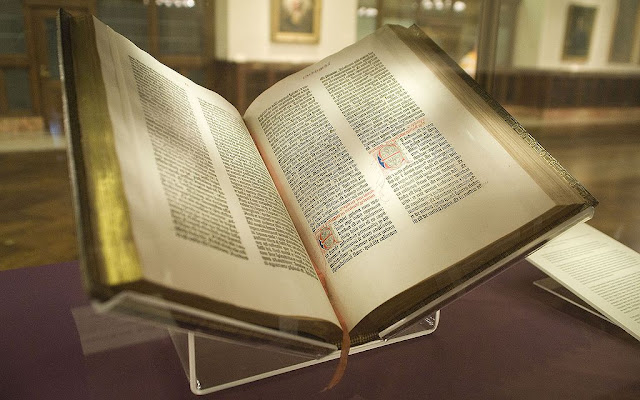
Gutenberg Bible of the New York Public Library. By NYC Wanderer (Kevin Eng)

The first printed book in Europe to bear the name of its printer is a magnificent Psalter completed in Mainz on August 14, 1457, which lists Johann Fust and and his son-in-law Peter Schöffer. The Psalter is decorated with hundreds of two-colour initial letters and delicate scroll borders that were printed in a most ingenious technique based on multiple inking on a single metal block.

The Mainz Psalter (1457) of George III, rebound in 1800

De Officiis (On Moral Obligations) by Cicero was printed by Johann Fust and and his son-in-law Peter Schöffer in 1465. This quarto of 88 leaves was the first printed edition of a Latin classic and contained the first printed Greek characters.

The first to be printed in the English language was The Recuyell of the Histories of Troye, a version of a French book written around 1463. It was translated over a three-year period by William Caxton, who would go on to pioneer the printing press in England. He published his version around 1474, at a time when when most books were printed in Latin, in either Ghent or Bruges, Belgium.

The biggest selling novel in history is Don Quixote by Miguel de Cervantes. It is estimated to have sold over 500 million copies worldwide. The novel was first published in two parts, in 1605 and 1615.  The novel tells the story of Don Quixote, a middle-aged man who loses his mind after reading too many of these romances. He sets out on a journey to become a knight-errant, but his adventures are often humorous and misadventures. 

The first book published in what is now the United States was The Whole Booke of Psalmes (often referred to as the Bay Psalm Book). It was published in 1640 in Cambridge, Massachusetts, by Stephen Daye, an English printer who had brought his printing press with him to the Massachusetts Bay Colony.

The Whole Booke of Psalmes was a metrical psalter, which means it contained metrical versions of the Book of Psalms from the Bible. It was created to be used as a hymnbook for the Puritan settlers of the Massachusetts Bay Colony and to facilitate their worship. The book was a huge success, and it helped to establish the printing press as an important tool for communication and education in the colonies.

Mary Rowlandson's 1682 book about her capture by Native Americans, The Sovereignty and Goodness of God: Being a Narrative of the Captivity and Restoration of Mrs. Mary Rowlandson, is considered America's first "bestseller."

From the Middle Ages to the 18th century books were often chained to a bookshelf or a desk. This was because books were very valuable, and there was a high risk of them being stolen. The chains were usually made of iron or brass, and they were attached to the book's spine. The other end of the chain was then attached to a fixed object, such as a bookshelf or a desk. This prevented the book from being removed from the library without breaking the chain.

Chained libraries were common in monasteries, universities, and other institutions where books were kept. They were also found in some private homes. The practice of chaining books began to decline in the 18th century, as books became more affordable and less valuable.

Photographs of British Algae: Cyanotype Impressions, published in 1843, was the first book ever to contain photographs. It was written by Anna Atkins (née Children; March 16, 1799 – June 9, 1871), an English botanist and photographer.

Atkins used a photographic process called cyanotype to create her images, which involved placing plant specimens directly onto light-sensitive paper and exposing them to sunlight. This produced a blueprint-like image that showed the intricate details and structures of the plants.

Atkins' book contained 307 cyanotype images of different species of algae found along the British coast. 

A cyanotype photogram made by Atkins which was part of her 1843 book, Photographs of British Algae: Cyanotype Impressions

The slowest-selling book is reputedly a 1716 translation of the New Testament from Coptic into Latin. The last of its 500 copies was sold in 1907.

The world's oldest bookstore that is still in operation is Livraria Bertrand in Lisbon, Portugal. It was founded in 1732 by Pedro Faure, a Portuguese visionary. The bookstore has been located in its current location in the Chiado neighborhood of Lisbon since 1755.

The oldest bookstore in America is the Moravian Book Shop in Bethlehem, Pennsylvania. It was founded in 1745 by Samuel Powell, a keeper of the Church's Crown Inn on the south side of the Lehigh River. The Moravian bishop had suggested the settlement would need many new books. The business took off and it is said to be the first bookstore in America. 

The first book described as a "best-seller" was Fools Of Nature by US writer Alice Brown in 1889. Fools of Nature is a collection of short stories about rural life in New England. It was published by Houghton Mifflin and received positive reviews from critics. The book was a commercial success, selling over 10,000 copies in its first year.

Book tokens were launched by the Booksellers Association in 1934 with the slogan “The Gift is Mine. The Choice is Thine”. The idea for them came from Harold Raymond of Chatto and Windus in 1926 but the scheme took six years to come to fruition.

The Catholic Church abolished its list of Forbidden Books, which had existed since the sixteenth century. By 1948 over 4,000 titles had been censored including works by Erasmus, Defoe, Descartes and Immanuel Kant.

The Unfortunates is an experimental book, which was published in 1969 by English author B. S. Johnson. It shipped as a 'book in a box' consisting of 27 unbound sections with the first and last chapter specified. The remaining sections range from a single paragraph to 12 pages in length and are designed to be read in any order.

The International Standard Book Number (ISBN) was invented by British retailer W H Smith, because they were moving to a computerized warehouse in 1967. It was approved as a ISO standard in 1970.

Zen and the Art of Motorcycle Maintenance was originally rejected by 121 publishers, more than any other bestselling book, according to the Guinness Book of Records. It was eventually published in 1974 and went on to sell five million copies worldwide.

First edition

The largest single first printing in publishing history is The Da Vinci Code by Dan Brown. It was printed in an initial run of 80 million copies in 44 languages. The book was released on March 18, 2003, and became an instant bestseller, selling over 80 million copies in its first year.

The fastest-selling hardcover book of all time is Harry Potter and the Deathly Hallows by J.K. Rowling, the final book in the popular Harry Potter series. It sold 8.3 million copies in the United States and United Kingdom on the day of its release, July 21, 2007 setting a new record for the fastest-selling book in history. The book also broke the record for the highest first-day sales of any book in history, with sales of over 11 million copies worldwide.

FUN BOOK FACTS

World Book Day is a charity event held annually on the first Thursday in March. celebrating everything to do with literature and reading. The annual event, celebrated in over 100 countries around the world is led by the charity Unesco, It is largely targeted towards children and aimed at encouraging their love of reading.


EL James' erotic novel Fifty Shades of Grey broke the UK weekly paperback sales record, when it sold 205,130 copies in the second week of June 2012, some 64,000 copies more than the previous record set by Dan Brown's The Lost Symbol in July 2010. The novel tells the story of the steamy relationship between billionaire businessman Christian Grey and "unworldly, innocent" literature student, Anastasia Steele.

The worlds largest book was lost by the city of Cleveland. It was called The Golden Book of Cleveland and it was as large as a mattress. It was misplaced in 1936.

When printers started to print books in the 15th century, they used scraps of ancient and medieval parchments to help bind the book. Examining the bindings, historians have reconstructed old texts. Some texts only survive in the modern day in this way.

Old books have a particular smell due to lignin being present in the paper. Lignin is related to vanillin, leading them to have a faint vanilla scent.

'Bibliosmia' is the enjoyment of the smell of old books.

In Japanese, "tsundoku" means collecting books and letting them pile up, not for neglect, but for the joy of knowing they're there, full of untold stories.

One of eleven surviving copies of the first edition of the Bay Psalm Book sold at auction in November 2013 for $14.2 million, a record for a printed book.

42% of college students will never read another book after they graduate.

The average Briton devotes 5 hours 18 minutes a week to reading. 


According to a 2005 survey by the NOP World Culture Score Index, the world's biggest readers are Indians. The people of India read an average of 10.7 hours a week, which is twice as long as Americans. The survey also found that Indians are more likely to read for pleasure than for work or education.

Ten books on a shelf can be arranged in 3,628,800 different ways.

The Japanese word "tsundoku" refers to the practice of buying books and letting them pile up, unread.

38% of people finish books they don’t like.


The Bible is the best-selling book of all time. It has been estimated that over 5 billion copies of the Bible have been sold worldwide. The second best-selling book is the Quran, which has been estimated to have sold over 2 billion copies.

The most expensive book ever sold at an auction is the Codex Leicester, a collection of 18 scientific notebooks written by Leonardo da Vinci. It was sold for $30.8 million in 1994 at Christie's auction house in New York City. The Codex Leicester is a priceless treasure trove of Leonardo's thoughts and ideas on a wide range of subjects, including anatomy, astronomy, engineering, and geology. It is one of the most important scientific documents ever written, and its sale was a major event in the world of book collecting.

The Codex Leicester was originally owned by the Italian nobleman Francesco Melzi, who was a student and close friend of Leonardo da Vinci. After Melzi's death, the Codex passed through a number of hands before it was acquired by American businessman Armand Hammer in 1917. Hammer sold the Codex to Bill Gates in 1994.

In May 2023, Sotheby’s sold the world’s oldest complete Hebrew Bible for $38 million, but reporting usually distinguishes religious manuscripts from other categories of “books.” 

The thickest book published is the Shree Haricharitramrut Sagar by Gyanjivandasji Swami. It is a biography of Bhagwan Shree Swaminarayan and was published in Gujarat, India in 2020. The book is 496 mm (19.5 in) thick and weighs 35 kg (77 lb). The book is written in Gujarati and contains 18,000 pages. It took 12 years to write and compile the book. The book is divided into 12 volumes and each volume is 42 cm (16.5 in) thick.

The largest book in the world is called This the Prophet Mohammed and is the largest, heaviest, widest, longest and most expensive book ever produced. It was unveiled in Dubai in February 2012 by the Mshahed International Group and weighs a staggering 1,500kg, roughly the same as a fully-grown giraffe! The book is an anthology of stories about the Prophet Mohammed and was written by around 15 scholars. The book measures 16.40-by-26.44 feet (5 m by 8 m) and has 429 pages. It is made of high-quality materials, including gold leaf and leather. The book is also equipped with a sound system that plays verses from the Quran.

Sources HistoryWorld, Daily Express, My knowledge

Wednesday, 6 February 2013

Boogie-Woogie

Boogie-woogie is an African American style of piano-based blues that became popular in the late 1930s and early 1940s.


Boogie Woogie piano playing originated in the lumber and turpentine camps of Texas and in the sporting houses of that state in the early 1870s. Additional citations place the origins of boogie-woogie in the Piney Woods of northeast Texas.

It wasn't called the 'Boogie Woogie' then. George W Thomas was the fellow who used this style and first wrote it down. 

The word 'Boogie' already existed as a slang word for a party. 'Woogie' was then added as a rhyming element.

"New Orleans Hop Scop Blues", published in 1916, is claimed to be the first twelve-bar blues to be written with a boogie-woogie bass line.


The first time the modern-day spelling of "boogie-woogie" was used in a title of a published audio recording of music appears to be Pine Top Smith's December 1928 recording titled, "Pine Top's Boogie Woogie", a song whose lyrics contain dance instructions to "boogie-woogie."

The boogie-woogie fad lasted from the late 1930s into the early 1950s, and made a major contribution to the development of jump blues and ultimately to rock and roll, epitomized by Little Richard and Jerry Lee Lewis.

Boogie woogie progressions are exactly the same as rock n roll progressions. It is the I-IV-V chord progression that is played at a fast pace.