Search This Blog

Saturday, 21 February 2015

Stephen Foster

Stephen Foster was born in Lawrenceville, Pennsylvania., on July 4, 1826 of well-to-do parents. He was of Scotch-Irish ancestry.

By the time Foster was 15-years-old, he had already composed a waltz for four flutes. He entered Jefferson College in Canonsburg, Pennsylvania, but his only interest was music and he left college after only a month.

His family objected to a musical career, and in 1846 Foster went to Cincinnati to be a bookkeeper for his brother's steamship company.

Foster's first great musical success was "Oh! Susanna" which was first performed in the Eagle Ice Cream Saloon in Pittsburgh, Pennsylvania on September 11, 1847. It became an anthem of the California Gold Rush.

Original sheet music

In the late 1840s Foster returned home to concentrate on being a songwriter. He signed a contract with the Christy Minstrels and it was during this period that Foster would write most of his best-known songs such as "Camptown Races" (1850), "Swanee River" ((1851) and "My Old Kentucky Home" (1853).

Foster was the first man to be paid a royalty on sheet music sales and the first American to make a career of writing songs.
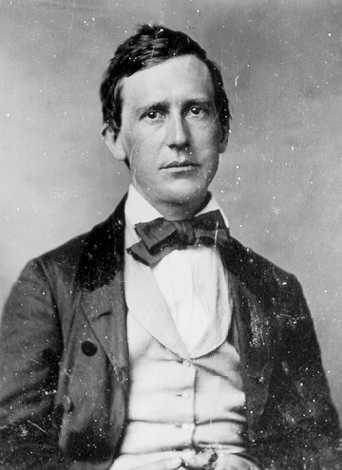

Foster married Jane Denny MacDowell on July 22, 1850 in Trinity Episcopal Church, Pittsburgh. He wrote “Jeanie With the Light Brown Hair" for her four years later. They had one daughter, Marion, but their marriage was troubled and the couple separated.

Never very astute financially, in 1857 Foster sold all rights to future songs to his publishers for $1,900. Profits went largely to the publishers and performers.

In 1860 Foster moved to New York City, but separated from his wife, his fortunes decreased . Impoverished, he died in Bellevue Hospital, New York City on January 13, 1864 of alcoholism and a fall from his bed. Soon afterwards, Foster's renamed publishing company, William A. Pond Co., published the last song he wrote a few days before his death, "Beautiful Dreamer."


During his lifetime Foster earned only $15,091.08 in royalties from his sheet music. He died with 38 cents in his pocket.

Foster is known as the "father of American music." 

Stephen Foster Memorial Day is a United States Federal Observance Day observed on January 13.  It was made law in November of 1966 and was first celebrated in January 1967. The date commemorates date that Foster died.  It commemorates the music of the man who composed many of America’s first popular songs.

He was inducted into the Songwriters Hall of Fame in 1970.

Foster commemorative stamp in the Famous American Composers series, 1940

“My Old Kentucky Home" is the official state song of Kentucky and "Swanee River" is the official state song of Florida.

Source Compton's Interactive Encyclopedia © 1998 The Learning Company, Inc

Jodie Foster

Jodie Foster was born in Los Angeles on November 19, 1962 as the youngest of four children of Evelyn Ella "Brandy" (née Almond) and Lucius Fisher Foster III.

Jodie Foster at the César awards ceremony. By Georges Biard, Wikipedia

Her father, a decorated U.S. Air Force lieutenant colonel turned real estate broker, came from a wealthy background and left his wife before Foster was born.

Jodie was a gifted child, and was reading by the time she was three-years-old and began her career as a child model at the same age.

Jodie Foster learned to speak fluent French when she attended a French-language prep school in Los Angeles. She spoke her own lines in the 1977 film Moi, fleur bleue and has been known to dub herself in the French versions of her movies.

Her big sister, Connie, acted as her body double in sexually suggestive scenes in the movie Taxi Driver, in which a 12-year-old Jodie Foster played a child prostitute.

Jodie Foster starred in five feature films in total in 1976 (including Taxi Driver, Bugsy Malone and Freaky Friday), winning two Baftas, an Oscar nomination, and countless other awards.

Jodie Foster graduated in 1980 as the class valedictorian from the private academy Lycée Français in Los Angeles.

Trying to impress Jodie Foster, obsessed fan John Hinckley, Jr. shot and wounded President Ronald Reagan and three others outside the Hilton Hotel in Washington, D.C in 1981.


Jodie Foster enjoys kickboxing, yoga, karate, aerobics, and weightlifting and collects fancy kitchenware and black and white photos.

Foster is openly lesbian and is married to actress Alexandra Hedison.

Fossil

The word "fossil" is derived from the Latin word "fossilis" literally meaning "obtained by digging."

Xenophanes, who died ca. 490 BC, found fish fossils and concluded that the land where they were found must have been underwater at some time. He was the first person known to have used fossils as evidence for a theory of the history of the Earth.

Scientists announced in 2016 that the Isua Greenstone Belt, Greenland, contains the world's oldest fossils that formed approximately 3.7 billion years ago.

In 2017, scientists announced the discovery of microfossils within rocks dated between 3.77 and 4.28 billion years old from Northern Quebec, Canada, making them the oldest fossils of life on Earth.

The extinct reptile Nyasasaurus is described as the possible oldest known dinosaur from 243-million-year old fossils discovered in Tanzania.

On April 4, 1796 the French zoologist Georges Cuvier delivered his first paleontological lecture at École Centrale du Pantheon of the National Museum of Natural History on living and fossil remains of elephants and related species, founding the science of Paleontology.

Cuvier with a fish fossil. By http://wellcomeimages.org Wikipedia Commons

Thomas Jefferson studied and classified fossils at a time when the investigations of these objects was in it's infancy.

The tongue twister "she sells seashells by the seashore" is likely about a real girl named Mary Anning (1799-1847). She was one of the very first people to discover a massive dinosaur fossil, which she did at the age of 12 while looking for seashells to sell by the seashore.

In 1912 amateur archaeologist Charles Dawson claimed that he had discovered the "missing link" between ape and man at Piltdown, East Sussex, England. A collection of fossilized skull remains, for years they were believed to belong to a human ancestor from 500,000 years ago. On November 21, 1953, the Piltdown Man skull was revealed to be a hoax. (The jaw was that of an orangutan, which had been deliberately combined with the cranium of a fully developed, though small-brained, modern human).


The most expensive fossil ever sold at auction is "Apex," a Stegosaurus skeleton, which fetched $44.6 million at Sotheby's on July 17, 2024. The remarkable specimen was the largest and most complete Stegosaurus fossil ever discovered, measuring 11 feet tall and 27 feet long. It was unearthed in 2022 in Colorado's Morrison Formation and is about 70% intact, making it an exceptional find. The buyer, billionaire Kenneth Griffin, expressed plans to loan the fossil to museums or research institutions, ensuring its availability for public viewing and study.

Out of all the species that ever lived throughout all of Earth’s history, less than one percent have fossilized. Even fewer are discovered by humans. Most of life’s history will be forever unknown

The first fossil in space was a Maiasaura dinosaur fossil taken on a space shuttle mission in 1985.

The ginkgo tree is considered a living fossil because the only species relative we know of is from fossil records.

Formula One

The first World Championship for motor racing drivers under the jurisdiction of the Fédération Internationale de l'Automobile (FIA) was contested in 1950.

The first race was the British Grand Prix at Silverstone on May 13. 1950. It was won by Italian driver Giuseppe Farina, driving an Alfa Romeo. 

Farina went on to win the inaugural Formula One World Championship, winning 3 of the 7 races that year, including the final race of the season, the Italian Grand Prix at Monza. He finished the season with 38 points, 3 points ahead of his teammate Juan Manuel Fangio.

The 1950 Italian Grand Prix was held on September 3, 1950 at the Autodromo Nazionale di Monza in Monza, Italy. Farina started the race from pole position and led for most of the race. He was challenged by Fangio, but Farina was able to hold on to win the race and the championship.

Giuseppe Farina

It was at the wheel of the Brabham BT3 that Jack Brabham became the first driver ever in 1966 to score Formula One World Championship points in a race car of his own manufacture. It remains the only such achievement using a car bearing the driver's own name.

The use of seat belts in F1 wasn't mandatory until 1976.

Hans Heyer was a German racing driver who failed to qualify for his only attempt at Formula 1 -  the 1977 German Grand Prix on July 21, 1977. Though only a reserve driver, he joined  the race illegally anyway by slipping out of the pits. Heyer was only be discovered by racing officials after 10 laps when his gearbox failed,  whereupon he was disqualified.

Fifty drivers have suffered fatal accidents while driving Formula One cars since the creation of the Formula One World Championship in 1950. Thirty-two of the drivers died during World Championship Grand Prix race weekends, seven during test sessions and eleven during non-championship Formula One events.

Only two Formula One Champions have died while racing or practicing in Formula One, Jochen Rindt in 1970, and Ayrton Senna in 1994. Rindt is the only driver to win the championship posthumously.

Sebastian Vettel became the youngest Formula One champion ever when he won the Drivers' Championship at the 2010 Abu Dhabi Grand Prix on November 14, 2010, at the age of 23 years and 135 days. He entered the final race of the season trailing Fernando Alonso by 15 points, but he was able to win the race and secure the championship. Vettel's victory was a historic moment for Formula One, as he broke the record for the youngest world champion, which had been held by Lewis Hamilton since 2008. 


Italian racing driver Kimi Antonelli broke Sebastian Vettel's record when he became the youngest ever winner of the World Drivers' Championship on November 1, 2026. Aged just 20 years and 68 days, the Mercedes driver secured the title with a third-place finish at the Mexico City Grand Prix, with four races of the season still remaining. 

Antonelli's achievement ended a 73-year wait for an Italian world champion. The previous Italian to take the title was Alberto Ascari, who won it in 1952 and 1953. Antonelli's triumph made him only the third Italian to become Formula One world champion, following Ascari and Giuseppe Farina. 

At 120 miles per hour, a Formula One car generates so much downforce that it could drive upside down on the roof of a tunnel.

When Max Verstappen made his Formula One debut, aged 17 years, 166 days, at the 2015 Australian Grand Prix, he became the the youngest World Championship Grand Prix driver. With the rules now preventing any driver under 18 to be given a super licence, Verstappen's record will probably never be surpassed.

Max Verstappen By Foto: Stefan Brending, Lizenz:  Wikipedia Commons

Max Verstappen became the youngest driver to win a Formula One race by winning the Spanish Grand Prix on May 15, 2016 aged 18 years and 228 days.

Formula 1 cars don't have airbags because, with a five-point harness and a HANS device, the driver's head will never hit the front of a car.

Forgery

Forging money was punishable by death in the UK from 1697 till 1832, when the sentence was reduced to transportation.

Henry Fauntleroy was the last man hanged in Britain for forgery in 1824. He stole £20,000 in fake cheques from a bank his father founded.

The astronaut Neil Armstrong refused all requests for autographs since 1994, after he found that his signed items were selling for large amounts of money and that many forgeries were in circulation.

Xiao Yuan, 57, a curator at Guangzhou Academy of Fine Arts in southern China, admitted in 2015 to stealing more than 140 paintings by Chinese masters from a university and replacing them with his own forgeries. He sold 125 of the exhibits for more than 34m yuan (£4m, $6m). Yuan later found out his own fakes were being stolen and replaced with yet more copies.

Forest

FOREST IN HISTORY

The word forest comes from the Latin foris meaning “out of doors”.

By Donar Reiskoffer, Wikipedia Commons

William the Conqueror cleared 225 Saxon villages during his reign to create the New Forest in southern England, which became a royal hunting area.

William the Conqueror's son, William Rufus, succeeded his father to the throne in 1087. Thirteen years later he was killed in a hunting accident in the New Forest. There is a legend that claims the king died because locals had placed a curse on him for stealing their land.

The Charter of the Forest, issued on November 6, 1217 by King Henry III of England, was a foundational legal document that restored and protected the rights of common people to access royal forests, which were vast tracts of land designated by the monarchy for hunting and royal use. This charter was closely related to the Magna Carta, which had been signed two years earlier in 1215, as both sought to curb the crown’s power over common resources and address the grievances of free men against royal restrictions.

The destruction under Genghis Khan may have scrubbed as much as 700 million tonnes of carbon from the atmosphere by allowing forests to regrow on previously populated and cultivated land.

Louis XIV's minister of finance had the huge Forest of Troncais created in 1670 to provide the future French Navy with a supply of oak masts. When the forest reached maturity 250 years later, the navy was busy switching to steam ships.

Shoshone National Forest is the first federally protected National Forest in the United States and covers nearly 2,500,000 acres (1,000,000 ha) in the state of Wyoming. Originally Yellowstone Park Timberland Reserve, it was established by President Benjamin Harrison on March 30, 1891. It was renamed Shoshone National Forest on September 13, 1902.

During his presidency, Theodore Roosevelt established 150 National Forests.

On September 24, 1950 forest fires blacked out the sun over portions of Canada and New England. A blue moon was seen as far away as Europe.

The average distance between patches of forest in the U.S. increased by nearly 1,690 feet—or 14%—between 1992 and 2001.

The International Day of Forests, March 21, was established by resolution of the United Nations General Assembly on November 28, 2012. Each year, various events celebrate and raise awareness of the importance of all types of forests, and trees outside forests, for the benefit of current and future generations.

FUN FOREST FACTS

Over two million square miles of the Amazon basin is virgin rain forest, containing 30% of all known plant and animal species.

The Amazon rain forest is considered by many to be the world’s largest, containing one-fifth of the world’s freshwater reserves and producing one-third of the earth’s oxygen.


The Taiga region in the far north, covering much of Canada, Alaska, Scandinavia and Russia, is considered by some to be the world’s largest forest.

Around one third of all the trees on earth are conifers in the Taiga.

A forest the size of Wales is needed to supply the paper used in the UK every year.

Since ancient times, it is estimated that the world has lost 80 per cent of its forests.

Due to the deforestation of the forests in North China, over one million tons of sands blows into Beijing from the Gobi desert. It sometimes causes the sky to turn yellow.

China has planted over 500 thousand square kilometers (193,000 square miles) of forest since 1978 to combat the expansion of the Gobi Desert making it the largest forest plantation in the world.

New Hampshire is the most tree-covered of the lower 48 American states. 89 percent of it is covered in forest.

Malaysia has the world's oldest rainforests. The forests of Sabah are the home of trees towering over one hundred metres high.

20% of the world's forests are found in Russia.

Sweden is actually increasing forest biomass despite being the second largest exporter of paper in the world because they plant three trees for each one they cut down.

The Białowieża Forest in Poland is one of the last remaining remnants of a forest that once stretched across all of Europe. The forest is only intact because a king in the 14th century used it as a refuge from the plague and afterward made it a protected land.

Officials in Siak, Indonesia are using trained elephants outfitted with water pumps and hoses to help control forest fires.

Lightning is the cause of most forest fires.


Forest fires move faster uphill than downhill.

You can remove all the birds and still have a forest, but if you remove all the fungi, the forest will die.

Foreign Legion

The French Foreign Legion was created by King Louis Phillipe in 1831 to keep potential dissidents busy fighting for France rather than against it. Because enlistment historically required no official identification, many criminals joined under assumed names to hide their unsavory backgrounds.

A drawing showing French Foreign Legion troops in action against tribesmen in Morocco in 1908. By Le Petit Journal

Anyone joining the French Foreign Legion must do so anonymously with a fake name. This practice is known as the anonymat. This is because the Legion wants to attract recruits from all walks of life, regardless of their background or circumstances. The anonymat allows recruits to start with a clean slate and build a new life for themselves.

Soldiers of the French Foreign Legion can immediately apply for French citizenship if wounded during battle or at the completion of three years of service.

Those selected for the French Foreign Legion sign a five-year enlistment contract and are dispatched for basic training (including French-language instruction, if needed) with the 4th Foreign Regiment, based at Castelnaudary, France.

Basic training in the Foreign Legion is notoriously rigorous, both physically and mentally. Recruits are pushed to their limits, both in terms of their physical fitness and their ability to work under pressure. They are also taught the basic skills of soldiering, such as weapons handling, tactics, and survival skills.

At the end of basic training, recruits are awarded the traditional white cap, the képi blanc, in an impressive torchlight ceremony. The képi blanc is a symbol of the legionnaire's commitment to the Legion and its values. The green beret remains the Legion's battle-dress headgear, but the képi blanc is worn on special occasions, such as parades and ceremonies.


A new recruit to the French Foreign Legion is paid £1,018 a month net. Food and lodging is included.

While the normal marching cadence is 116 paces per minute, the French Foreign Legion soldiers come on at a measured 88.